

China’s leadership is scheduled to meet in the coming days to set economic policy for the second half of the year. Given below-target Q2 growth and the recent equity selloff, investors’ attention is focused on the prospects for additional stimulus and equity-market support. We do not expect the leadership to make strong commitments on either issue. We also see a meaningful risk that policy support will prove insufficient to offset headwinds to growth and equities in the coming months.
A key reason for our low expectations for stimulus and equity support is that the Chinese government has already begun addressing both issues, while conditions are stabilizing—or at least are no longer worsening:
- A slowdown in fiscal expenditure was the key factor behind disappointing growth in Q2 (see our analysis HERE). However, fiscal expenditure returned to positive yoy growth in June, and central government borrowing accelerated in July. This suggests that China’s leadership already has begun to take corrective action.
- Similarly, Chinese equities have stabilized following stock purchases by the state-backed “national team” securities firms. Given the reduced urgency, the likelihood that the leadership will further escalate its policy response is low.
With exports still booming and social pressures contained, policy upside is limited.
Growth: Incremental Stimulus Meets Resurgent Oil Prices
Local governments are under heavy political pressure this year to reduce their off-balance sheet debts; progress on this front will be a key benchmark for officials seeking promotion at the 21st Party Congress in fall 2027. Unless Beijing provides political guidance otherwise, the default stance of local governments will be to prioritize deleveraging over growth. This is precisely what happened in Q2, when government spending slowed sharply – a risk we highlighted back in February (link HERE). The upcoming Politburo meeting will direct a modest course correction.
However, the boost from fiscal stimulus will be limited because (1) the room for additional fiscal expenditure in the budget is smaller than it appears, and (2) the overall directive to continue deleveraging constrains the fiscal impulse.
At first glance, China’s better-than-projected budget revenue growth—4.7% yoy versus the projected 2.2%—and slow ytd fiscal expenditure appear to create substantial room for stimulus in the second half. However, two factors offset this apparent room. First, land sale revenue (which is counted outside the main budget but is still critical for local governments) is down 31.5% ytd yoy. Second, we expect Beijing to rebuild fiscal savings, which could reduce fiscal expenditure by another approximately RMB 500 billion. As a result, our baseline is for low-single-digit yoy fiscal expenditure growth through year-end. This implies that, after a modest acceleration in Q3, fiscal policy will not be supportive of growth during the remainder of the year.
Recent news strongly suggests that local government officials are reluctant to stray from the deleveraging campaign. Local government borrowing remains depressed ytd and has shown no signs of accelerating in recent weeks (see Figure). Meanwhile, Beijing recently tightened restrictions on LGFV borrowing. We expect local fiscal deleveraging to remain intense through at least the end of this year.
The recent resurgence in global oil prices creates further downside risk. If oil prices remain close to $100/bbl, higher energy costs could offset the expected incremental stimulus.
Equities: A Targeted Effort to Stabilize IPOs
We interpret the recent national-team buying as being motivated by two considerations: preventing a crisis and preserving the recovery in China’s IPO market ahead of upcoming tech listings. Margin financing fell by RMB 80 billion ($11.8 billion) the last trading day before the national-team buying was announced – the largest one-day unwinding outside of the 2015 equity market collapse. Without intervention, a vicious cycle could have forced further liquidations and fire sales.
Since its inception, the primary function of China’s stock market has been to finance Beijing’s strategic initiatives. The current priority is to provide financing for Chinese high-tech companies, including the high-profile listing of memory chipmaker CXMT on July 27. High tech IPOs have accounted for almost all domestic IPOs in recent years. It is more than a coincidence that Chinese leaders began speaking more regularly about supporting the equity market at around the same time that IPO volume fell to a multiyear low (Figure) in 2024. As the current IPO volume is still less than half of its 2021 peak, the authorities have a strong incentive to intervene to preserve the recovery.
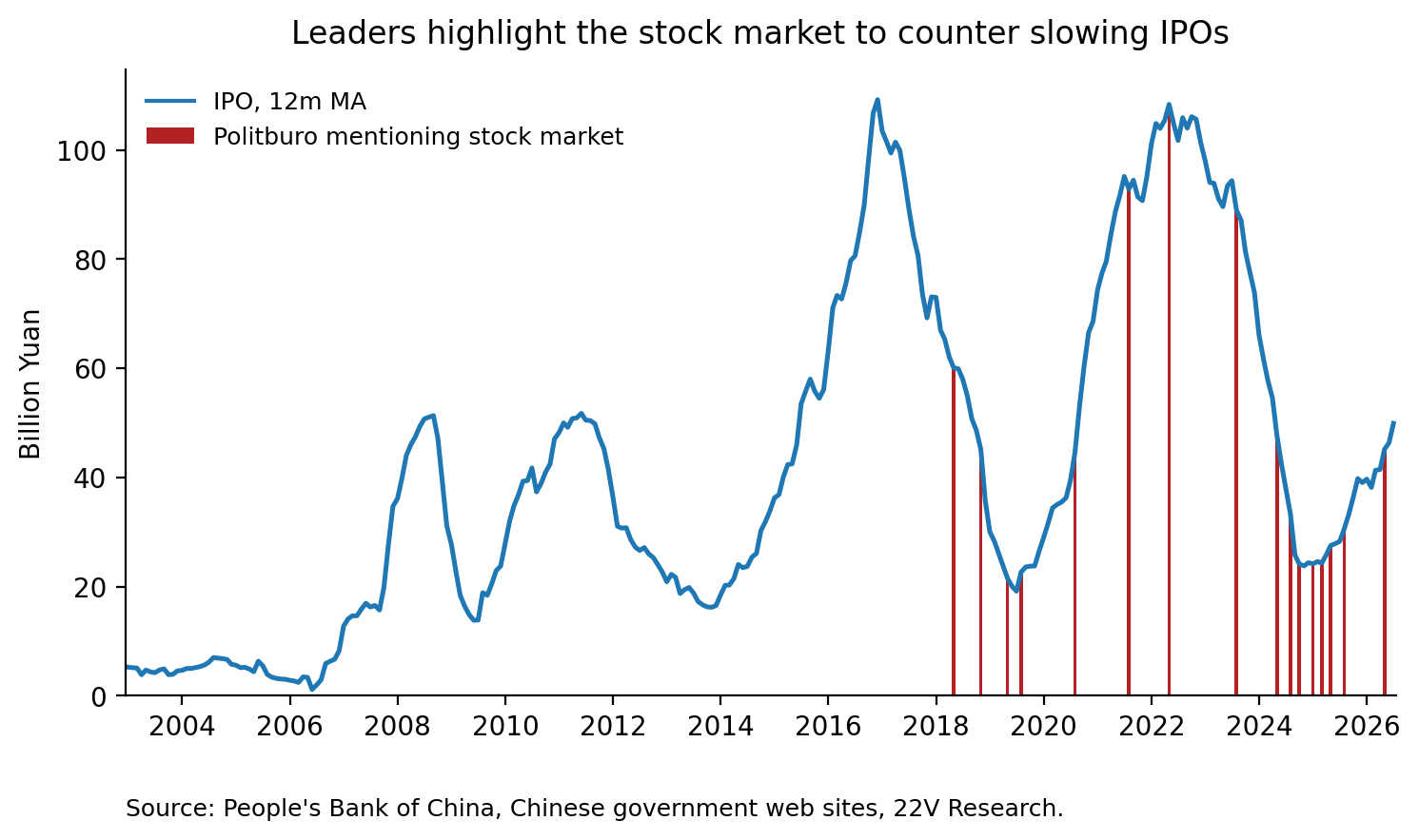
However, we expect national team buying to slow in the near term unless there is another bout of major volatility. Beijing wants to use the national team to stabilize the stock market to facilitate IPOs, which it likely has through its recent intervention. In other words, national team buying is more likely to happen if IPO demand weakens, which is usually coincident with weak investor sentiment. But if IPOs prove to be resilient, there is less reason for national team to continue buying. Moreover, current high valuations are likely to make the national team reluctant to hold large positions for an extended period. The national team tends to unwind its positions once its short-term stabilization mission has been accomplished, which explains its aggressive selling of equities in 2026 H1.
As a result, we expect China’s leadership to reiterate its support for the stock market at the upcoming Politburo meeting, as it has at all but two such meetings since September 2024. However, these remarks should be interpreted as a continuation of existing policy rather than as a signal of new support for boosting equity prices overall.

