

Bottom Line: Global Manufacturing Cycle & AI Buildout
The global manufacturing cycle is recovering, and there appears to be an AI buildout effect helping Transports. 23 of the 37 S&P 1500 Transport stocks mentioned AI as a tailwind in their Q1 earnings. That AI buildout tailwind is unlikely to abate anytime soon. Dauvin Peterson, head of 22V Data Infrastructure/Commodities Research, had the opportunity to connect with a handful of operators and developers across the AI factory build-out recently. The overarching theme is that the market remains compute constrained for the foreseeable future and that hyperscalers and AI builders are likely to continue front loading the AI build-out. The AI buildout tailwind for transports will continue.
Relevant News: JOLTS
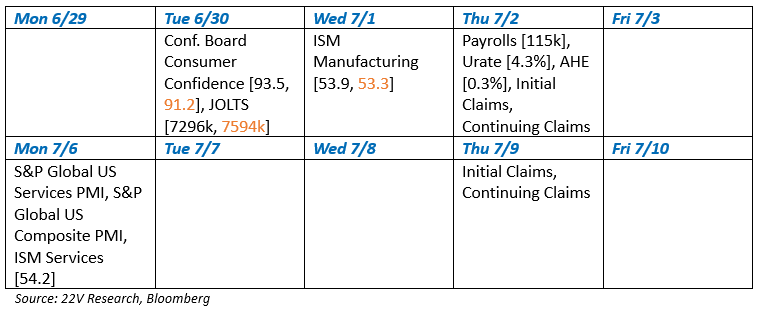
Job churn remains very low relative to other measures of labor market slack. Whether due to post-covid accelerated quitting still be settled into, workforce aging, or a broader malaise remains somewhat unclear. But churn measures tend to be closer to 2014-15 than the near 20y highs of the prime-age employment to population rate or the 2018-like comps of the unemployment rate. The JOLTS-based analytic measures match the gradual improvements seen in the NFP, JOLTS net-hiring, urate, and PAEPOP signals of modest rightening since fall of 2025. Both the NFP and JOLTS data have been showing a clear increase in net hiring since fall 2025. Surprisingly, job openings stayed high after their bounce in April. They are somewhat above the level that postings on Indeed suggest.
Things to Watch [Consensus, Results]:
Strategy:
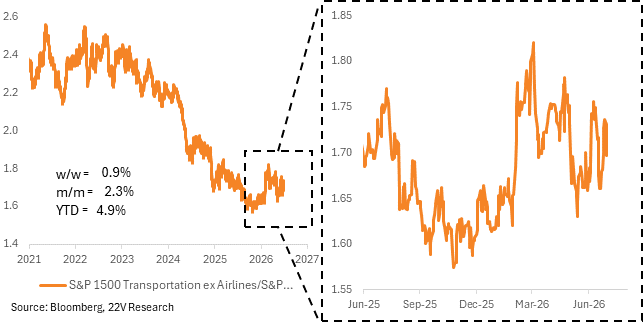
Transports ex Airlines Benefiting from the Global Manufacturing Recovery – (HERE)
Transports ex Airlines, which saw a record drawdown relative to the S&P 1500, are rallying alongside other non-AI cyclicals (Banks, Retailers). Transports are benefiting from an inflection in activity and a reduction in supply (HERE). Transports management teams have highlighted benefits from the AI buildout. That buildout is unlikely to slow anytime soon. Freight rates (ex-fuel surcharges) are rising, reaching their highest point since 2021. NTM earnings, sales, and margin estimates are all increasing. Margin compression had been a significant industry headwind that is now fading.
Quant:
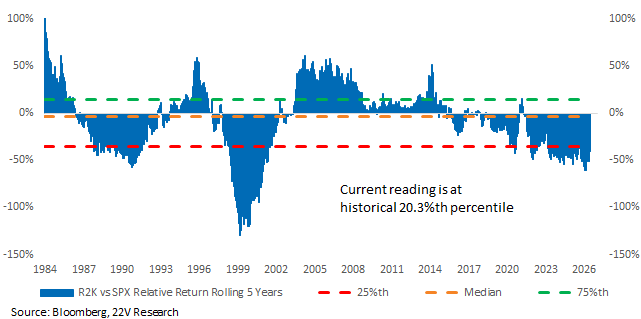
Broadening Out Trade Support Small Caps – (HERE)
Markets turned more defensive following the Fed meeting on renewed concerns about a potential tightening cycle. Financials have tightened, volatility has increased, and pressured risk appetites. Risk-off leadership broadened across market capitalizations, while previously dominant Momentum factors weakened alongside underperformance from several Mega Cap names. Small caps tend to be more sensitive than larger caps to a tightening of financial conditions, in part due to the large Risk-on and Value exposure of smaller cap names. Longer term we remain constructive on small caps. The Russell 2000 consistently underperformed the S&P post-COVID, leaving its rolling five-year relative return and relative valuation near historical lows. The median forward return for Russell 2000 exceeded S&P 500 on 6 months, 1 year and 3 years basis historically.
Financials:
Large Cap Regionals Preview – Continue to Favor US Bancorp and Fifth Third; Downgrading Regions Financial to Sector Perform – (HERE)
The regional banks have outperformed this quarter as investors gained confidence from strong loan growth, stable deposits, improving capital markets activity, and a steeper yield curve. Looking ahead, the note remains constructive on the group, emphasizing that positive earnings revisions and a supportive rate backdrop are the key drivers. Among individual names, FITB and USB are favored on improving earnings outlooks, PNC and CFG are viewed as steady performers, while RF was downgraded on weaker NII and capital markets trends, and TFC, WFC, and MTB remain less attractive due to margin and earnings headwinds.

