Markets turned more defensive following the Fed meeting on renewed concerns about a potential tightening cycle. Financials have tightened, volatility has increased, and pressured risk appetites. Risk-off leadership broadened across market capitalizations, while previously dominant Momentum factors weakened alongside underperformance from several Mega Cap names.
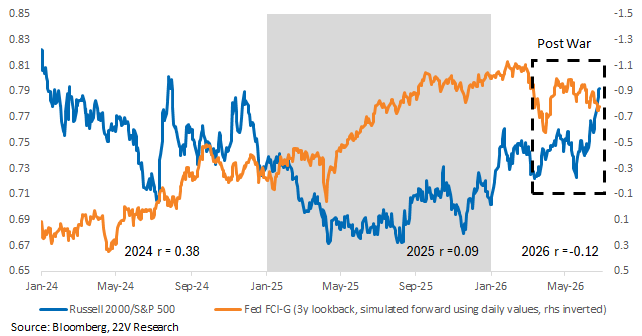
While small caps continued their outperformance even as financial conditions tightened, which is unusual. Small caps tend to be more sensitive than larger caps to a tightening of financial conditions, in part due to the large Risk-on and Value exposure of smaller cap names.
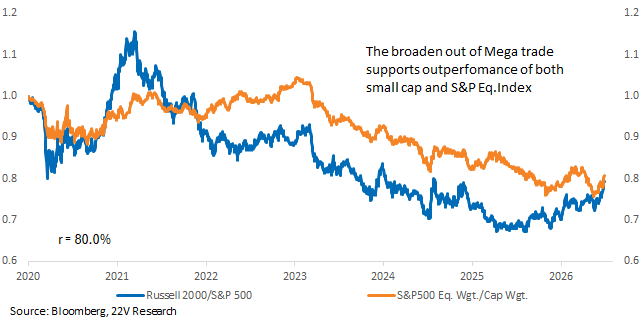
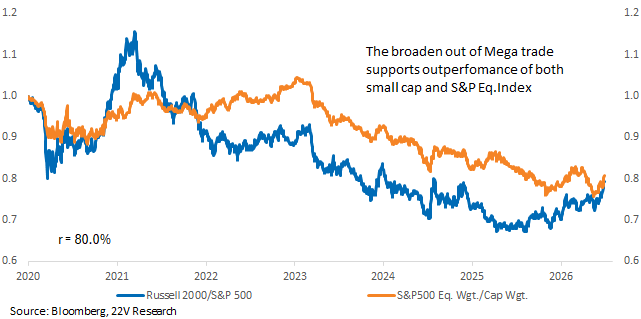
The recent divergence has been driven largely by broadening market leadership. Small-cap relative performance has closely tracked the outperformance of the S&P 500 equal weight index relative to the cap weight index, highlighting a rotation away from Mega 7 and hyperscalers. The recent return breakdown showed higher idiosyncratic risk for small cap as well.
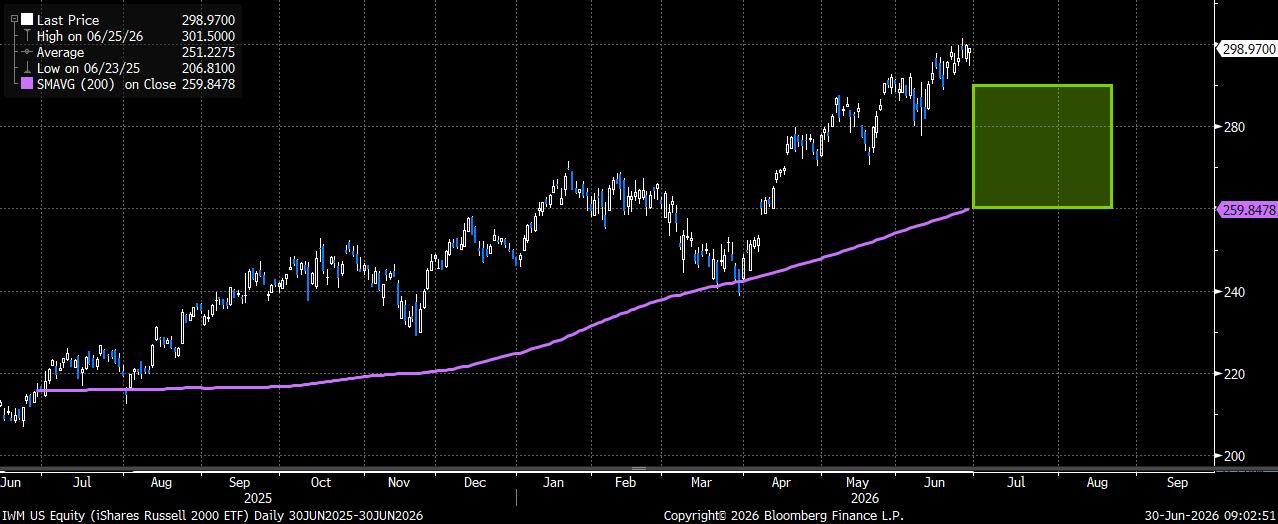
Though small cap earnings continue to see improvement, the upcoming earnings season could be a catalyst for Mega names to rebound, leaving near-term headwinds for small-cap relative performance. 22V Derivative Analyst, Jeff Jacobson recommends buy IWM Aug 21st 290/260 put spread to hedge Mega cap earnings risk on small caps.
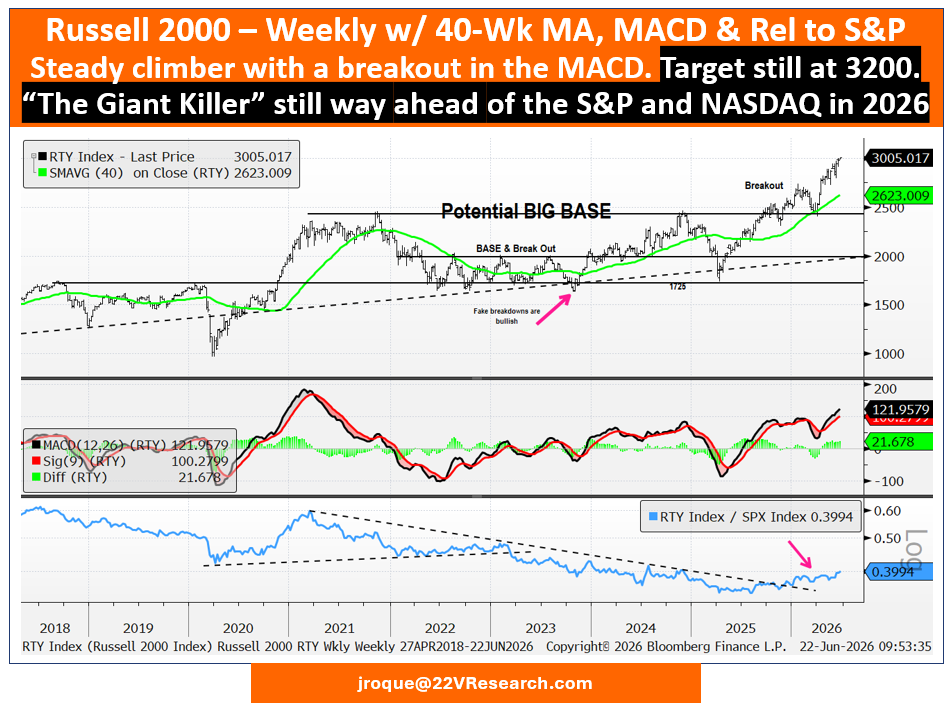
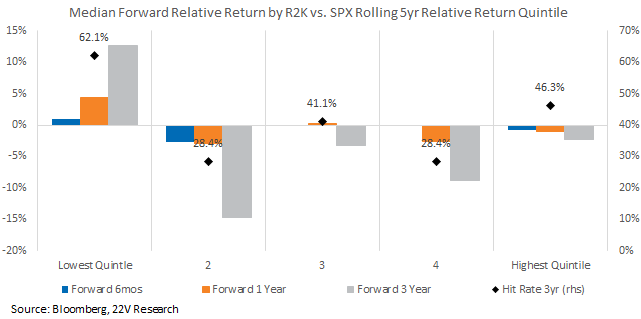
Longer term we remain constructive on small caps. The Russell 2000 consistently underperformed the S&P post-COVID, leaving its rolling five-year relative return and relative valuation near historical lows. The median forward return for Russell 2000 exceeded S&P 500 on 6 months, 1 year and 3 years basis historically. Our Technical Analyst John Roque also sees Russell 2000 target at 3200 this year, a 6% upside from current level.
Broadening Out Trade Support Small Caps: Markets have experienced rising volatility following the Fed meeting as concerns about a hiking cycle weighed on risk sentiment. Market internals rotated decisively toward a more defensive posture last week, with Risk-off leadership broadening across all market-cap segments. Previously leading Momentum factors also weakened as several Mega Caps stumbled.
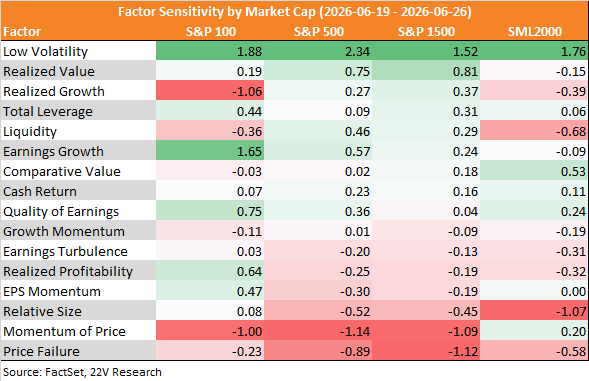
Despite the deterioration in risk appetite, small caps continued to outperform large caps, extending the trend that has been in place since mid-May. This resilience is unusual given the recent tightening of financial conditions. As we discussed previously (HERE), small caps typically exhibit greater exposure to Risk-on and Value factors, making them more vulnerable than large caps during periods of tighter financial conditions.
Part of the driver for the small/large cap divergence is attributed to Mega cap underperformance. There has been a positive correlation between Russell 2000 relative returns and S&P 500 equal vs. cap weighted performance. Both readings rebounded since late May as returns broadened out beyond Mag 7 and Hyperscalers. The relative return breakdown shows that a large part small cap relative outperformance came from idiosyncratic risk. The broaden out trade is also a factor driving short term small cap outperformance.
Ahead of 2Q earnings season in the coming two weeks, relatively strong earnings for small caps should be a support for smaller cap gain (HERE), while stronger-than-expected results from Mega cap companies could trigger a rebound in market leadership, potentially creating near-term headwinds for small-cap relative performance. 22V Derivative Analyst, Jeff Jacobson recommends IMW hedge below to hedge the IWM downward risk from Mega caps earnings surprise.
Buy IWM Aug 21st 290/260 put spread for ~ $4.60 (IWM 299 ref)
Trade offers a 5.5x to 1 max payoff at expiration
Hedge starts ~ 3% lower, and that is following the 25% rally in the small caps since the March lows
Put spread is capped 13% lower and right on the 200-day moving average support @ 260
Structure captures favorable put skew – buying 22.6 vol and selling 28.2 vol
Aug expiration will capture most of the Mag7 earnings
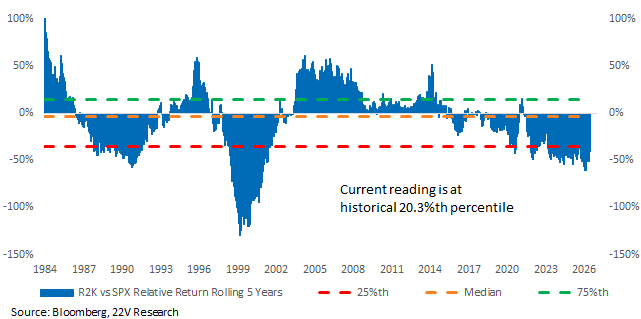
Longer term, however, we remain constructive on small caps. Russell 2000 has significantly underperformed the S&P 500 since the COVID period, leading to the rolling 5-year relative return at the lowest quintile of all time. The valuation spread has also dropped to the lower end as well.
Historically, when the rolling 5yr relative return of the R2K has fallen to its lowest quintile, the median forward return for Russell 2000 exceeded S&P 500 on 6 months, 1 year, and 3 years basis. As the 5-year relative return has rebounded this year and small cap earnings expectations have improved as well, we continue to expect small caps to outperform large caps over the long term.
John Roque, 22V’s technical analyst, has a 3200 target on the Rusell, which is 6% growth from the current reading.