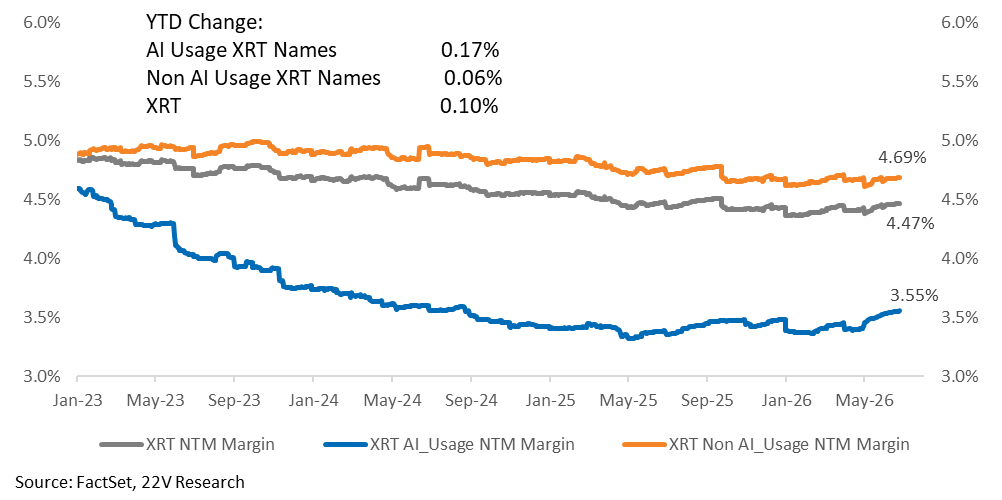
DAILY STRATEGY: Main Point – Two Rate Hiking Scenarios to Keep in Mind: If inflation trends a bit too hot (slightly above 0.21% MoM) but has no singular moment where the forecasts must be reset higher, we are likely to end up with hikes starting in either December or ‘27Q1. This is our most likely path of how a too high core inflation outcome would happen. Not saying it will happen. In this backdrop, financial conditions don’t really tighten much before year-end 2026. The macro implications are Cyclicals, fundamental factors, etc,. still work in 2H26. The overall risk reward in the market is still not very compelling.
If core inflation is tracking above 3.5% YoY for 2026 (Fed Forecast is 3.3%) after the June and July inflation readings, a September hike will be on the table. 2yr yields would likely break above the 4.2% range (head toward 4.3-4.5%) and risk assets would suffer. The unusually high volatility Price Momentum factor would suffer. The market would have more obvious downside risk.
Background – The economic “speed limit” (real growth at or below 2% to keep core inflation in check) needs to be respected. That is a high conviction view from 22V. As it stands today though, nominal spending is growing at a +5% pace, with limited labor supply growth and productivity growth of roughly 2%. Core inflation remaining too high, offset by hikes, would be the outcome if nominal growth remains +5% (HERE).
Retail Stock Update – As we highlighted in the Quant report yesterday, Retail sales surprises have once again become a reliable predictor of earnings surprises as operating leverage has normalized following the pandemic, suggesting investors should place greater emphasis on revenue beats when assessing retailers after earnings. The high frequency consumer data suggests upside risk to sales in 2Q (HERE).
Charts…
Financial conditions should remain relatively easy if inflation trends a bit too hot relative to the Fed’s forecast for 2026 (slightly above 0.21% MoM). A hike would likely be assumed in this scenario, but not until December or Q127. A September hike being priced, because inflation readings come in well above target this summer, would be an issue for risk assets.
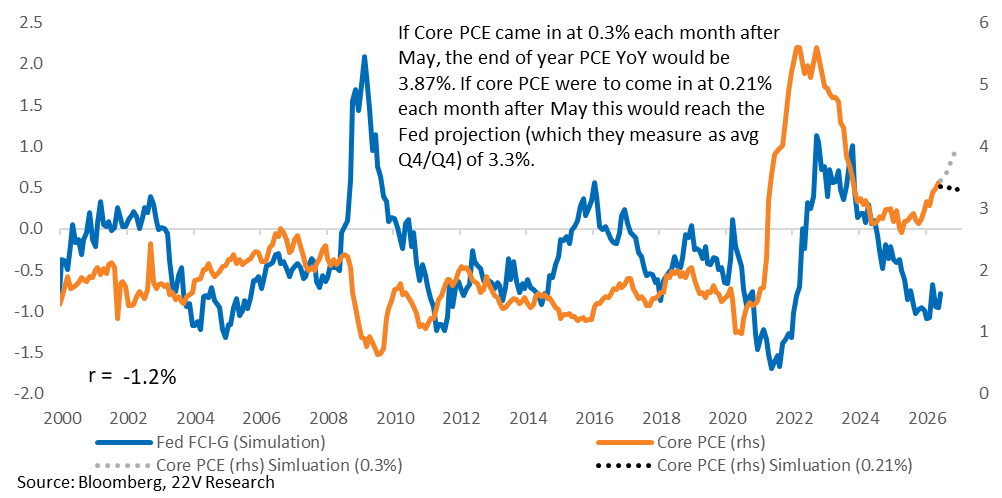
XRT earnings now track sales. Since early 2023, revenue surprises have become a much more reliable predictor of earnings surprises for retailers, reflecting a normalization in operating leverage after the pandemic. During the Covid recovery, volatile input costs and inventory adjustments weakened the pass-through from sales to earnings. Today, the relationship has largely normalized, implying that investors should place greater weight on sales beats when assessing post-earnings revisions. The latest earnings beat ratio has moved to a post-COVID high, along with above median sales beats, suggesting improved retailer fundamentals.
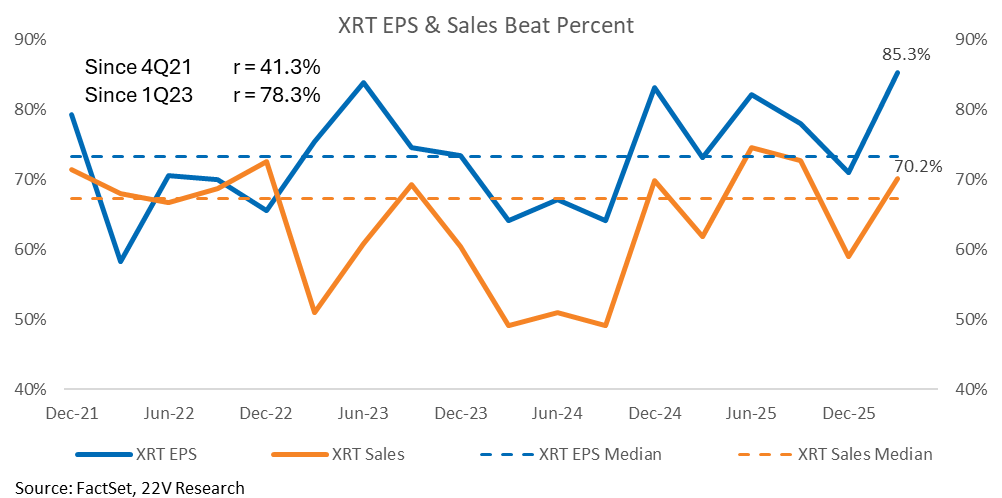
Retail Margins: AI is driving the recovery, from a lower base. AI Users operate at a structurally lower NTM margin than both the broad XRT and the non-AI cohort — this is reasonable given AI adopters are concentrated in high volume, thin margin e-commerce and mass-market models (i.e. Amazon, Walmart, eBay, Etsy). The signal, however, is in the trajectory rather than the level. So far in 2026, all three baskets have expanded margins, but the AI Users have expanded fastest roughly +0.17pp YTD, versus +0.10pp for the broad XRT and only +0.06pp for the non-AI names. AI Users are thus the leading edge of the margin recovery underway across XRT: improving from a lower base, but at nearly three times the pace of their non-AI peers, consistent with AI lifting e-commerce productivity and margins from the bottom up.