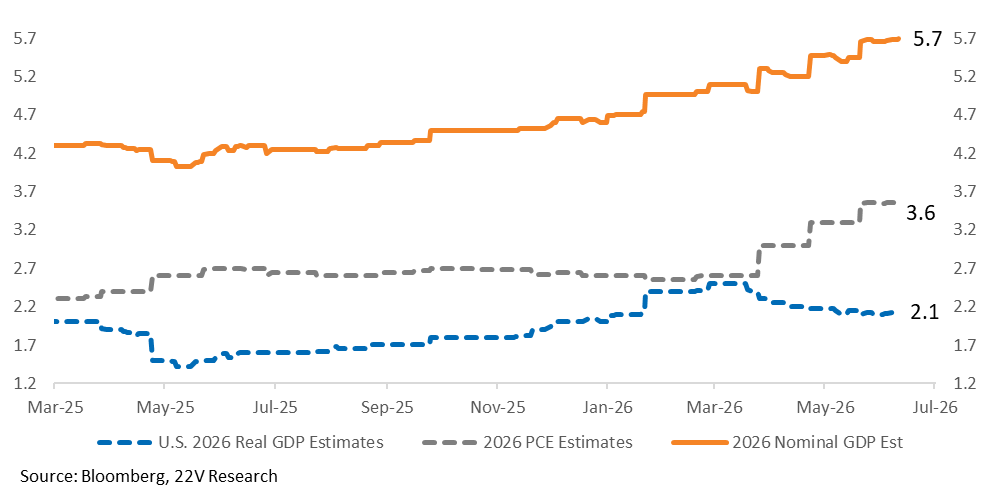
Bottom Line: GDP Growth
Our call remains that to keep inflation in check GDP growth needs to be at or below 2%, assuming trend productivity holds at roughly 2%. Estimates for US GDP growth have started to decline toward 2% and inflation expectations are moving lower. 2026 GDP growth forecasts have moved from 2.7% to 2.1% for 2026 and are ~2% for 2027. GDP estimates holding, and actual inflation following inflation expectations lower, would be POSITIVE for Non-AI related Cyclicals. Retail stocks, Regional Banks, Airlines and Homebuilders.
Relevant News: Fed Preview (HERE)
Fundamentally, the economy already appears close to or below (short-run?) neutral. Officials assessments of labor market and growth risks will move towards balance, while the inflation baseline deteriorates and its risks remain skewed to the upside. A sequence of 2-4x hikes starting in late 2026 or early 2027 seems increasingly plausible. Many officials will want to look through the next few months of inflation given war + tariffs but if that data goes poorly, or the cleaner reads in the fall keeps forcing forecasts higher, not responding becomes increasingly implausible. Easing within the next 12 months would likely take a large swing in baseline inflation forecast and deterioration in labor market risks beyond just a further small linear softening.
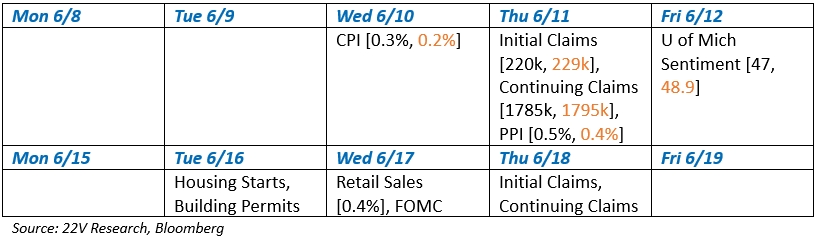
Things to Watch [Consensus, Results]:
Strategy:
Orderly Declines in Growth and Inflation Expectations are Good for Non-AI Cyclicals– (HERE)
Over the back half of 2026, we expect economic growth to slow toward 2% or slightly below and for the Fed to remain on hold AS GROWTH SLOWS. The Fed will let economic growth slow to ensure core inflation eventually declines. The implication is higher real yields, which is bad for gold. The risk reward is less compelling in theory for overall markets, but it’s not a problem. Economic growth is still expected to be +2% real and +4% nominal. The Fed will not have a tightening bias under this scenario, which is good. A tightening bias would be bad for risk assets as it would likely be associated with GDP growth estimates well below 2%.
Economics
Informed consensus around Core PCE– (HERE)
22V Chief Economist, Gerard MacDonell, calculates an informed consensus that the Core PCE Price Index will be up 35 bps in May. Eight bps of this is due to portfolio management and advisory fees. He is inclined to strip out those 8 bps and would chop off another 2 bps for the fact that the lagging government measures of average rents are running above his proxy of marginal rent inflation, which is 1.5%. That gets him to 25 bps or 3% (ar) sequentially during May. This would be the sixth month in a row of baddish to bad inflation figures. And yet another example of how the Core CPI and even back of the envelope attempts to find its underlying signal can be extremely misleading.
Banks:
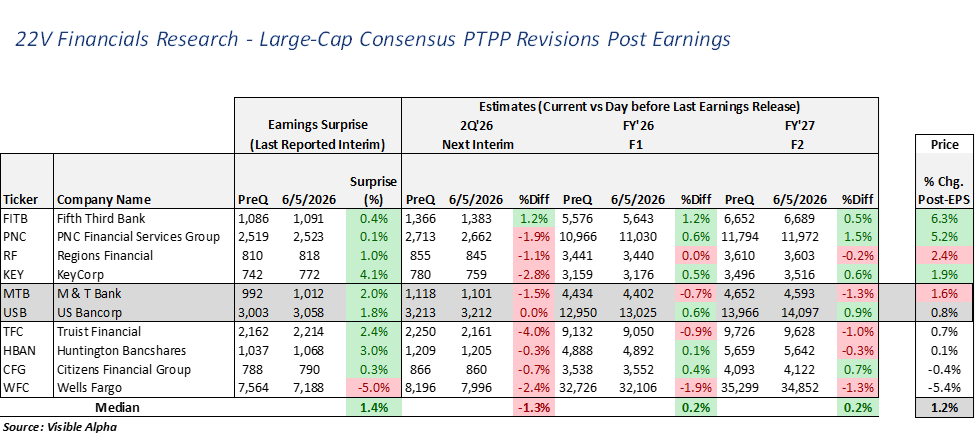
Conference Feedback: Bank deposit commentary balanced – Reiterating our Sector Outperform on USB/Sector Underperform on MTB – (HERE)
Following two recent bank conferences, management teams largely eased concerns around the quarter’s key overhangs—deposit competition and the threat from agentic AI/stablecoins—while reaffirming a generally healthy backdrop for consumers and commercial borrowing. Banks indicated deposit pricing remains competitive but stable, stablecoin risks appear limited given small retail balances and forthcoming tokenized deposit initiatives, and AI is increasingly viewed as a productivity tool whose benefits must be weighed against rising implementation and token costs. Against that backdrop, 22V’s Financials analyst favors USB, where improving NII, fee growth, self-help initiatives, and attractive valuation support upside, while remains cautious on MTB as softer consumer lending trends, ongoing liquidity drawdowns, and a stock already near our price target leave less room for further outperformance.