

SUMMARY
- 22V’s China Economic Sentiment Series (CHESS) tool shows a recovery in analyst sentiment towards the outlook for growth and the equity market in recent weeks; that improvement has been driven by an improved export outlook since the May 12 Geneva agreement between Beijing and Washington.
- By contrast, analyst expectations for stimulus have declined significantly since the Geneva agreement, reflecting a sense that Beijing’s urgency to support the economy has declined; we share that view, and expect only modest fiscal stimulus in Q3.
- The importance of the US-China trade outlook means that a potential call between President Trump and Chinese leader Xi Jinping is a key near-term watchpoint; prospects for the fiscal bill in Congress are also worth monitoring, as securing passage of the bill is one source of restraint on Trump’s trade policies.
Every two weeks, we update our proprietary China Economic Sentiment Series (CHESS) tool. CHESS uses ChatGPT to assess the sentiment among Chinese economists commenting in the domestic financial media, providing a quantitative and visual gauge of how expert views towards the economic and financial outlook are evolving. For more background, you can find the CHESS white paper HERE.
TARIFF DE-ESCALATION BOOSTS BROADER MACRO SENTIMENT
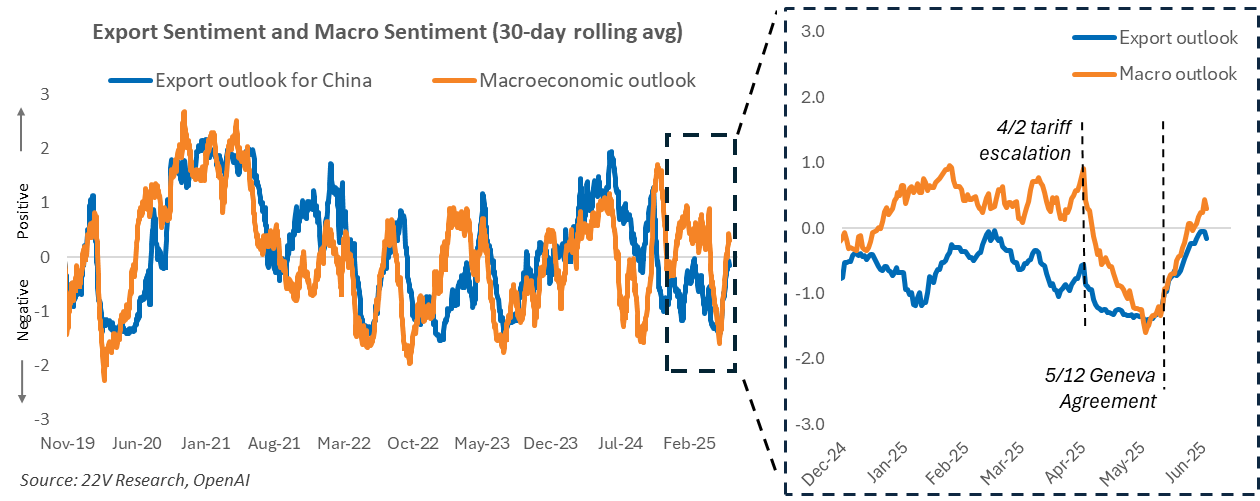
The May 12 Geneva deal led to a boost in export sentiment (blue line below), which is now higher than it was at the time of Trump’s April 2 reciprocal tariff announcement. That is a bit surprising, given that the US effective tariff rate on China is still high at around 40%. But analysts may perceive that the tail risks of tariff escalation are lower in the wake of Trump’s decisions to postpone reciprocal tariffs on imports from China and other trade partners.
The improvement in export sentiment has also lifted sentiment towards the broader macro outlook (orange line), which is now just above neutral.
Our take: A return to neutral sentiment is not unreasonable, but only works if trade risks stay relatively contained. It will thus be important to monitor the dangers of the US-China trade truce breaking down by the August 12 deadline, which are still significant (see watchpoints section further below).
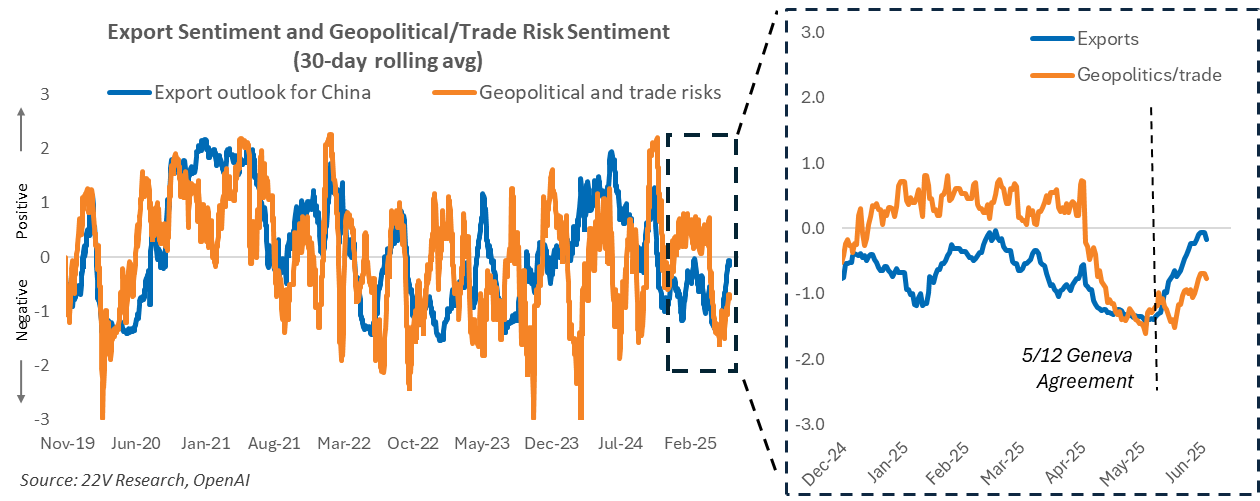
It is worth noting that analysts’ views towards geopolitical and trade risks (orange line below) are more negative than their outlook for exports. This likely reflects the ongoing tit-for-tat between the US and China using non-tariff measures, namely export controls. These are less of a macro risk than a danger for Chinese tech companies (through US semiconductor controls) and for US defense/aerospace firms and automakers (through China’s rare earth export restrictions). We discussed the dispute over non-tariff measures, and the implications for the tariff truce, on a video today updating the policy outlook for the US, China, and Europe (replay HERE).
EQUITY MARKET SENTIMENT REBOUNDS STRONGLY
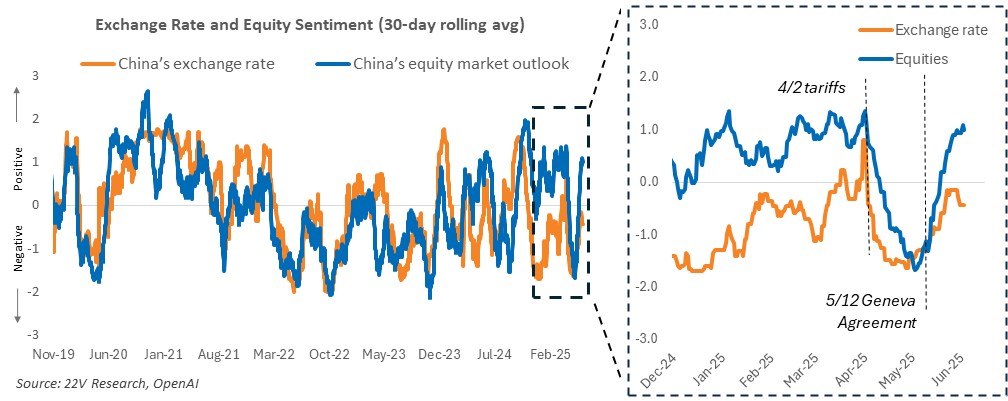
Analyst views towards the equity market (blue line below) are now back to where they were on April 2, which matches the actual performance of domestic equity prices. That recovery reflects trade de-escalation but also the PBOC’s May 7 press conference, which outlined several steps to support capital markets.
Sentiment towards China’s currency (orange line) has not rebounded as strongly in the wake of Geneva but is now back to neutral. While tariffs are still high, analysts are likely also incorporating expectations that weakness in the dollar will provide some cushion to the USDCNY exchange rate.
Our take: As with the macro outlook, the rebound in equity market sentiment is not necessarily wrong as a base case. However, we see risks for the equity markets as tilted to the downside, given the dangers of US-China re-escalation and our subdued outlook for stimulus. The room for upside is limited, as a property market double dip and deflationary pressures will weigh on the economic outlook in coming months. 22V’s head of derivate strategy Jeff Jacobson has proposed a trade idea of buying puts on the main China ETF (FXI) as a way to hedge exposure given the downside risks (for more details on the trade idea and how it fits into our China outlook, see HERE).
STIMULUS EXPECTATIONS DECLINE
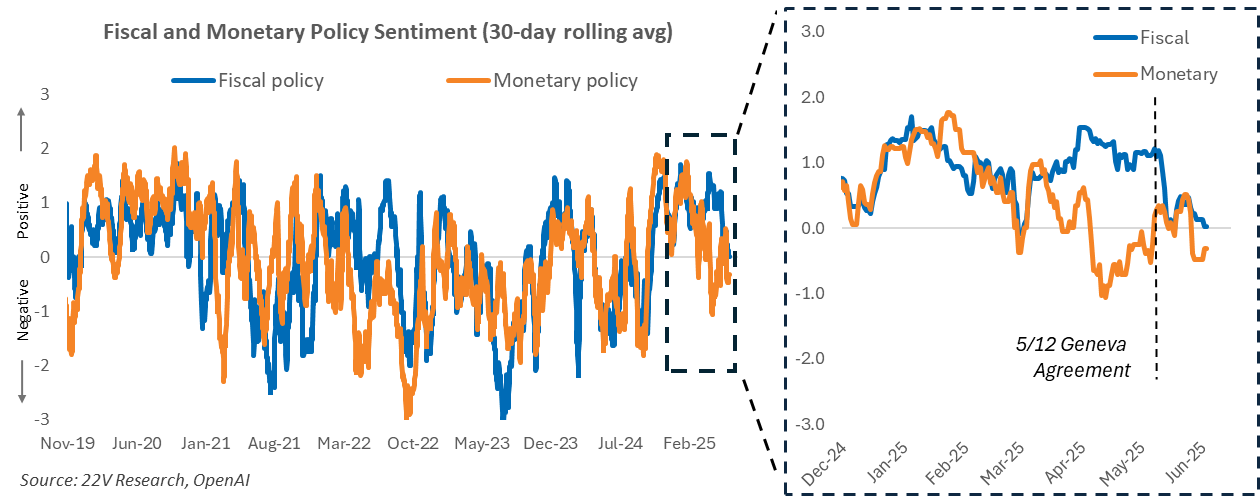
The blue line below shows analyst sentiment towards the prospects for fiscal stimulus, which have declined in the wake of the Geneva agreement. Analysts echo our assessment that trade de-escalation lowers Beijing’s sense of urgency to ramp up fiscal support for growth. Monetary policy sentiment (orange line) has also declined since Geneva.
Our take: We concur that the near-term scope for stimulus is limited. Fiscal policy is Beijing’s most effective tool to support domestic demand, but we expect this to come in Q3 (probably late Q3) and to be modest in scale (see our thoughts HERE).
NEAR-TERM WATCHPOINTS
As noted above, the US-China trade truce will be important for supporting China sentiment in the weeks ahead, especially given muted expectations for stimulus. Our May 23 report (link HERE) noted a 45% probability of re-escalation of the tariff dispute by the August 12 deadline, but the situation is fluid. These are the two most important near-term watchpoints:
- Potential Trump-Xi phone call: As we wrote on Friday (link again HERE), a call between the leaders is critical to de-escalating tensions over non-tariff measures. If a call happens, we see a good chance for the two sides to climb down: a deal could include China speeding approvals of rare earth exports and the US relaxing recent restrictions against EDA tools and aircraft parts. But each side’s bottom line on non-tariff measures is still unclear – for example, will Beijing insist on assurances from the US about future export controls targeting Chinese firms? If a call does not happen, it will increase the risk of further escalation and of the tariff truce breaking down.
- Prospects for Trump’s fiscal bill: We have noted that Trump’s desire to pass a large fiscal package is a key source of restraint on his trade policies. A major re-escalation of tariffs could lead Congressional Republicans more risk averse, jeopardizing the package. Hence, if Congress passes the bill before the August recess, it could embolden Trump to re-escalate the tariff dispute when the Geneva truce comes up for renewal on August 12.Signs of increased unease in Congress over elements of the bill – as well as public criticism by Elon Musk – are thus worth monitoring.
CHESS is a collaborative project, leveraging the expertise of Sophia Wang, 22V’s Director of Quantitative Research, and China-based economic consultant Dr. Fei Han. The author expresses thanks for contributions and insights.

