SUMMARY
- While our base case is that the US and China will extend their trade truce in August, investors may be underweighting the risks of re-escalation; the probability of the truce breaking down will rise significantly if Congress passes a fiscal bill in July, though this is not 22V’s expectation.
- Our outlook for China’s growth remains subdued given ongoing trade headwinds and uncertainty, a double dip in the property sector, and reduced urgency behind fiscal stimulus; new fiscal support measures are unlikely to come until July at earliest.
- Our proprietary CHESS tool shows that the Geneva agreement has led to a modest improvement in domestic economic sentiment; echoing our view, analysts have lowered their expectations for fiscal stimulus in light of tariff de-escalation.
This report has three parts. First, we update the outlook for US-China trade tensions. Next, we discuss how trade developments figure into our expectations for China’s growth and stimulus. Finally, we use our CHESS tool to assess how recent developments are impacting the sentiment of economists in China.
TRADE: TARIFF RISKS ARE TIED UP WITH TRUMP’S FISCAL BILL
Our initial report on the US-China de-escalation agreed in Geneva on May 12 described it as a “climbdown” by President Trump rather than a “breakthrough” on substance. That framing helps gauge the risks around what happens next, as the two sides face a deadline of August 12 to extend or modify their 90-day truce. While our base case is an extension of the truce, investors may underweight the risk of tariff re-escalation, particularly if Trump secures the passage of his fiscal bill in July. 22V’s head of Washington Policy Research Kim Wallace sees a 10-20% probability that the bill passes before August.
The key factor behind the Geneva climbdown was President Trump’s desire to reduce the economic and political blowback from sky-high tariffs. The timing for de-escalation was critical. Imports from China subject to the tariffs are now arriving at US ports, and even the de-escalated tariff rate of “only” 30% is creating discomfort over who bears the costs of tariffs (see Trump’s anger at Walmart). Any further delays in signaling a truce would also have threatened to disrupt orders and logistics for the holiday shopping season. Despite Trump’s description of Geneva as a “total reset,” we see it as a tactical retreat.
Will Trump feel any more emboldened come August, when the truce hits its deadline? It may come down to whether or not he has secured passage of the “big beautiful” fiscal package by the time Congress goes on August recess. If he has not, which is 22V’s base case, he is unlikely to re-escalate the tariff dispute as this would spark a blowback in Congress that threatens the package. If the fiscal bill does pass in July, Trump may have more leeway to talk tough on trade again, at least during August, and possibly even to re-escalate against China. To be clear, re-escalating would still be a major political risk for Republicans, hurting markets and denting approval ratings as price increases ripple through supply chains. But it is not clear how much Trump would care.
Meanwhile, there are two reasons why Trump might lower tariffs a bit further, from 30% to 20-25%:
- China agreed to explore further cooperation in countering fentanyl as an outcome of the Geneva talks. Securing that cooperation was the ostensible reason for 20 percentage points of Trump’s tariff hikes. Not recognizing China’s efforts here would threaten that cooperation.
- Reducing a portion of the fentanyl-related tariffs may be necessary for Beijing to remove the 10-15% tariffs that it imposed on imports from the US in retaliation for Trump’s 20% hike. Without that step, China’s tariffs on US agriculture and energy imports are 20-25%, which makes it uneconomical for Chinese firms to purchase those products as part of a US-China deal.
- Trump’s pending sectoral tariffs on semiconductors and pharmaceuticals could offset a portion of those tariff reductions. If Trump were to impose a 25% tariff on semiconductors and related items, it could raise the US effective tariff rate by several percentage points.
What could go wrong, such that the US and China re-escalate in August? The most likely reason would be that Trump – emboldened by passage of the fiscal bill – insists on a package of commitments that Beijing does not accept. Two potential US demands are: (1) approving a sale of TikTok to a US buyer; and (2) making ambitious commitments to purchase US goods. China’s leadership would consider both, but only if it regards Trump as sincere about limiting further tariff hikes and not seeking to decouple the US from China. The potential for US to impose additional tech restrictions on China – such as placing DeepSeek on the Commerce Department’s entity list – could also limit Beijing’s willingness to deal, although we expect Beijing would retaliate mainly in the form of restrictions on critical mineral exports.
The dynamics above lend themselves to the following scenarios. The probabilities given here are meant to provide our sense of the relative risks and do not imply high conviction or precision:
- Base case: Tariffs stay near their current level (55% probability). In this scenario, tariffs stay in a range of 25-35%, from the current level of 30%. The range reflects the possibility of a 10% reduction in fentanyl tariffs, but also the impact of pending sectoral tariffs on semiconductors and pharmaceuticals. Signposts: A Trump-Xi phone call in coming weeks, which would be a positive sign that the two sides are aligning expectations.
- Truce lapses without agreement, tariffs climb to 35% or above. This is a 30% probability overall but will become the base case if the fiscal package passes in July. Signposts: Early passage of a fiscal bill; de-escalation with other US trading partners, which would provide more scope to target China.
- Deal-making and further tariff relief (tariffs fall from 30% to 10-20%), 15% probability. Signposts: Solid progress on fentanyl cooperation; talks towards a deal on TikTok; a warning sign would be strict new US export controls on China’s tech sector.
ECONOMIC OUTLOOK: A MODEST GROWTH DIVIDEND FROM GENEVA AGREEMENT
The Geneva agreement leads us to upgrade our 2025 growth outlook for China, which is nonetheless subdued. Our probability-weighted forecast calls for real GDP growth of 4.4% in 2025, and nominal GDP growth of below 4% given deflationary pressures. That is, we expect 4.6% growth in the no-escalation scenarios noted above (70% probability), and 4% growth in the re-escalation scenario (30% probability). Prior to Geneva, we had expected real GDP of 4% with a significant risk of falling below that mark. In other words, we have upgraded our growth forecast by 0.4%. There are three main reasons why the boost to growth is relatively limited.
First, trade headwinds are still significant. Even at a roughly 30% tariff rate, and with significant transshipment through third countries, China’s exports to the US will be under pressure. And given substantial uncertainty over the outlook, Chinese exporters will likely meet demand through inventory de-stocking rather than an aggressive ramp up in production.
Second, a double dip in property will amplify the hit to growth from trade tensions. China’s April property data show that the double dip, which we have been warning about for several months, has now arrived. Only 5 of the 70 cities covered by the National Bureau of Statistics reported m-o-m increases in prices of existing properties. Property sales were down -7% y/y (vs -1% in March) and new starts were down -22% y/y. Contracting property investment (-10.3% y/y ytd) exacerbates the weakness of government revenues and the labor market.
Third, we expect several months of muddling through before Beijing modestly increases fiscal stimulus. While the PBOC took steps to shore up flagging confidence two weeks ago by announcing a front-loading of monetary easing measures, fiscal stimulus is the key tool necessary to support domestic demand. However, the Geneva agreement reduces Beijing’s immediate urgency to launch new fiscal measures, especially with year-over-year growth numbers – the main barometer used by China’s leadership – not yet flashing red.
We expect stimulus announcements to be underwhelming for markets:
- In terms of magnitude, our base case (80% probability) is a fiscal stimulus (financed through central government bond issuance) of CNY 1 trillion or smaller, and a 20% probability of a larger stimulus. The base case would be enough to put a floor under growth but not to power a strong recovery, particularly if trade tensions should re-escalate.
- We have less conviction on the timing of fiscal stimulus. We had previously expected stimulus to arrive in July. While that is still possible, we now lean slightly towards a policy response that lags behind the curve, arriving in late Q3/early Q4 (as was the case in 2024).
- The composition of fiscal stimulus will tilt roughly 70/30 towards investment/consumption, a slightly more consumption-friendly mix (80/20) than last year. Among the watchpoints is whether Beijing rolls out birth incentives, which will not be major in scale but will be a helpful turn towards direct income support for households. Another positive would be if the central and local governments provide subsidies for housing renovation, which would help alleviate the weakness in construction sector jobs.
ECONOMIC SENTIMENT: BOTTOMING OUT BUT NOT YET POSITIVE
We conclude with a brief update from our China Economic Sentiment Series (CHESS) tool. CHESS uses ChatGPT to assess the sentiment of analysts commenting in China’s domestic financial media. This update reflects analyst commentary as of May 16.
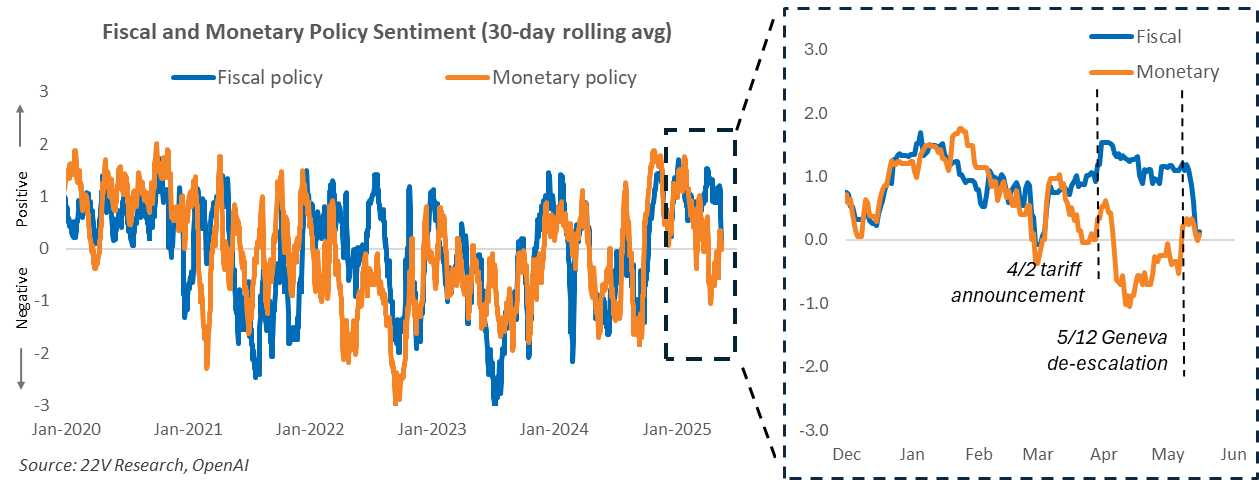
How are analysts updating their outlook in light of the Geneva agreement? The chart below tells the main story. Sentiment towards the macroeconomic outlook (orange line) declined sharply with US-China tariff escalation in April and has started to pick up a bit since the Geneva agreement. However, the degree of improvement is thus far modest. One reason is that expectations for stimulus (blue line) have fallen since Geneva, with analysts echoing our view that Beijing will feel less urgency to boost growth.

It is also notable that expectations for fiscal stimulus (blue line in the chart below) have dropped since Geneva while those for monetary policy (orange line) have held steady. The PBOC signaled a more proactive footing for monetary policy during a news conference on May 6. There have been far fewer signals regarding fiscal policy, and analysts appear to agree with our view that little will happen in the near term.
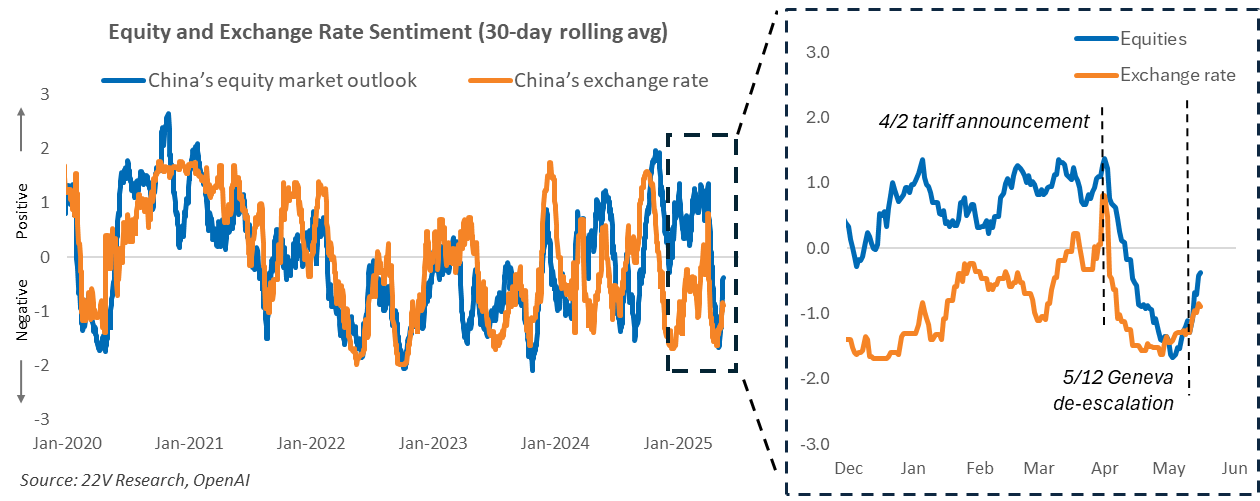
Finally, a quick look at sentiment toward financial assets. Sentiment towards China’s equity markets (blue line below) has bottomed out since Geneva but remains well below its pre-April peak. Expectations for the CNY (orange line) have also come off their recent bottom. A durable lift for equities and the exchange rate will likely require more visibility on trade and the broader growth outlook.