

This report is the latest monthly update of 22V’s China Economic Sentiment Series (CHESS), which uses ChatGPT to analyze shifts in sentiment among economists commenting in China’s domestic media. The previous CHESS report for July can be found HERE. For more background on CHESS, please see the white paper HERE.
SUMMARY:
- 22V’s CHESS tool shows that the sentiment of expert economic commentary in China worsened in August, including sentiment towards current economic conditions as well as expectations for stimulus
- While this subdued outlook is broadly consistent with 22V’s view, we are a bit less pessimistic about the prospects for near-term fiscal stimulus; we expect an increase in government bond issuance, already underway, to provide a modest boost to activity in September and October
- Worsening CHESS sentiment towards the property sector and consumption underscores the weakness of private sector demand and underwhelming policy support; a decline in export sentiment in August is a cautionary note about the extent to which trade can continue to offset anemic domestic demand
- CHESS data provide few reasons to expect a positive inflection point for Chinese equities or China’s commodity demand; the outlook for the CNY is somewhat better as the Fed nears its easing cycle
What the latest sentiment signals show
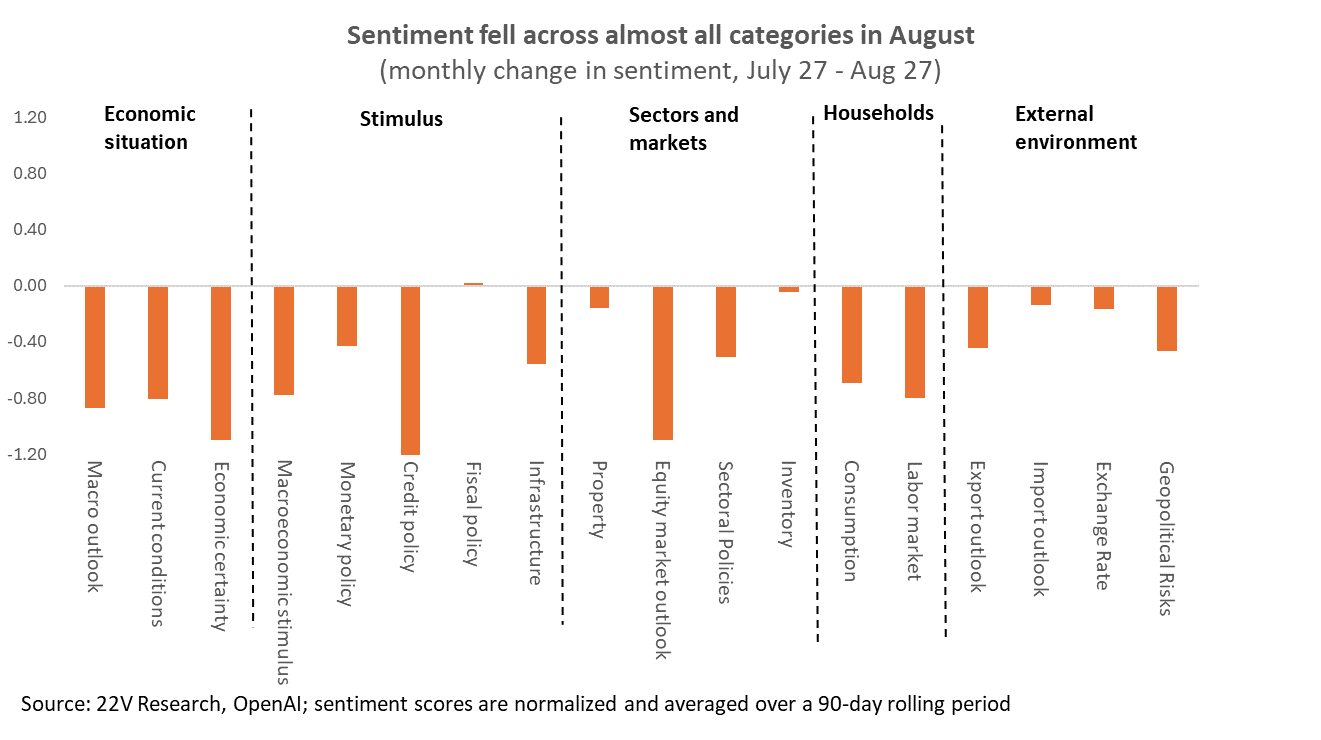
China’s summer doldrums deepened into a funk in August, with expert sentiment falling across almost all areas of the outlook (see chart above):
- After rising in July, stimulus expectations fell sharply in August. This represents analysts’ disappointment with the lack of announcements and follow-through on stimulus at important economic meetings in July: the mid-year Politburo meeting and Third Plenum. The one exception is fiscal stimulus, which ticked up slightly in August. As discussed below, 22V expects a modest further increase in fiscal stimulus in the next several months, which sentiment probably has yet to reflect.
- Analyst views towards the economic situation, particularly domestic demand, continued to worsen. Sentiment towards the macroeconomic outlook, one of the key CHESS series, peaked in June and has now declined to its lowest level since late last year. Domestic demand remains the key source of weakness in the economy, with sentiment towards consumption continuing to slide and property sentiment yet to show signs of life. While sentiment towards exports remains high overall, it has weakened a bit as well, a potential warning sign for broader activity given that exports have been a key support for demand this year.
- Sentiment towards the equity market plunged. Worsening expectations reflect a decline in Chinese equity prices (the Shanghai Composite was down -1.3% in this period) but also analysts’ dim outlook for growth and stimulus. Sentiment towards China’s exchange rate did not worsen as much, with the approach of initial Fed rate cuts relieving some pressure on the CNY caused by the gap in US and Chinese interest rates.
Signals from CHESS are broadly consistent with 22V’s subdued view on the growth outlook, as laid out in our recent Webinar (summary/replay HERE) and take on China’s July economic data (HERE). While we do expect an increase in fiscal stimulus in coming months, including an announcement by October of additional central government deficit borrowing, the effects will be transitory and modest relative to the continued downside pressures on growth from property and weak consumption.
Market implications:
- August economic data is likely to show continued weakness. China’s August data will start rolling out on Friday evening (ET) with the release of the official PMI indexes. CHESS signals provide no reason to think that these and other activity data (including industrial production, retail sales, and property sales and investment) will show a significant improvement from a weak performance in July. 22V does see some potential for August credit data to show an improvement fueled by government bond issuance to fund stimulus, but this is unlikely to lead to an improvement in economic activity indicators until September and October (and the effect will be modest).
- A near-term rebound in equity prices is unlikely. The plunge in equity market sentiment and other CHESS indices that have historically correlated with equity prices (including macro outlook sentiment) point away from Chinese equities reversing recent declines anytime soon. Fed easing should continue to provide short-term support to the CNY against USD but the weakness of the broader domestic macro outlook limits the likelihood of longer-term appreciation.
- China’s demand for key commodities will remain subdued. Our expectation of an increase in fiscal support will provide a moderate boost to infrastructure investment in September and October. But the dim outlook for property and broader growth will remain a drag on construction activity and related materials. Manufacturing activity, much of it absorbed by exports, has been a key source of support for metals demand amid weakness in the property sector; while that is unlikely to reverse, the decline in CHESS sentiment towards exports is a warning signal as to limits of how much further manufacturing exports can offset property weakness.
DETAILS
Stimulus hopes wane, but may overlook a mini-surge of fiscal spending
Below is an update of the single most useful chart from the CHESS series, which compares sentiment towards macroeconomic stimulus (blue line) and sentiment towards the macro outlook (orange line). Viewing the two together is important because inflection points in stimulus expectations tend to lead inflection points in the outlook. Stimulus expectations have been falling since the spring, a trend that we flagged earlier this year as a warning sign for the broader growth outlook – and one that has materialized recently in the form of very weak economic data in June and July.
So how much stimulus relief is on the way? The CHESS data show that analyst expectations are muted. There was a pickup in stimulus hopes in July, but these fell back again in August. This is likely a reaction to the lack of strong support signals, and subsequent follow up, from two economic meetings in July: the Third Plenum and mid-year Politburo meeting.

While our own view on the outlook is broadly consistent with the subdued take from the CHESS data, we are not quite as pessimistic about the near-term stimulus outlook. As we will detail in a note next week, incremental fiscal stimulus is already on the way, as both the central and local governments speed up bond issuance; net central government borrowing was aggressive at roughly CNY 1 trillion in August. We also expect the central government to announce a further increase in the 2024 deficit of CNY 1 trillion. That announcement should come by mid-October, though less than half of the proceeds would be spent this year. The net effect of fiscal activity should be a modest and transitory boost to economic activity in September and October. This is not the bazooka but risk management by Beijing – an effort to keep real GDP growth from falling below 4.5% this year and nominal growth falling below 4%. It is not nearly assertive enough to break out of deflation, given the broader weakness of domestic demand.
Consumption and property woes highlight weak domestic demand
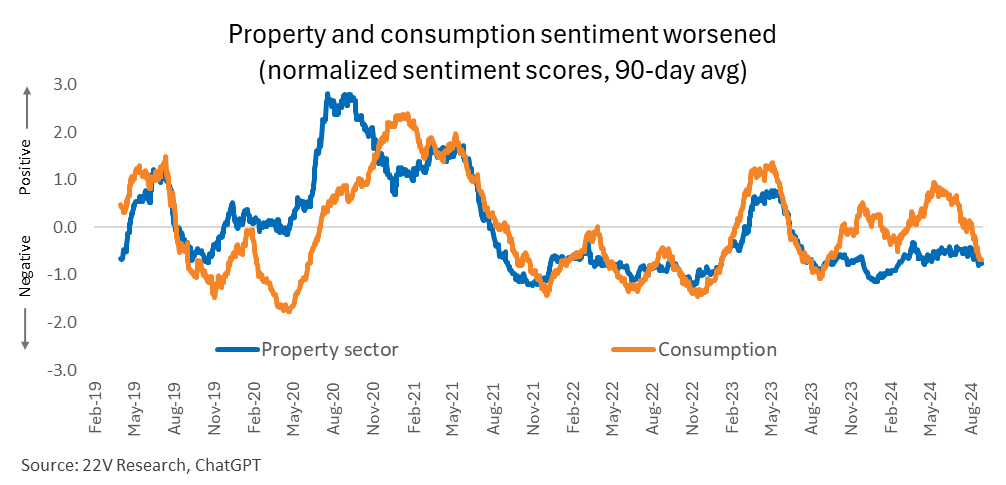
The chart below shows analyst sentiment towards the property outlook (blue line) and towards consumption (orange line). Neither is encouraging.
A series of support measures has failed to lift property sentiment, which remains negative. We are not surprised at this lack of response, as the measures have been underwhelming relative to the scale of headwinds (a large overhang of housing inventory, the indebtedness of developers, and weak household confidence in future income and property price appreciation).
Sentiment towards consumption peaked in May and has since declined, falling sharply in August. As with property, modest policy efforts (a consumer upgrade program) are small relative to the macro problems for consumption – namely, weak income growth (due to slow hiring) and lack of confidence regarding the outlook for housing and the broader economy. We would be surprised to see consumption sentiment fall much further than this, but do not expect a strong recovery in consumption activity anytime soon.
Export sentiment comes off the boil
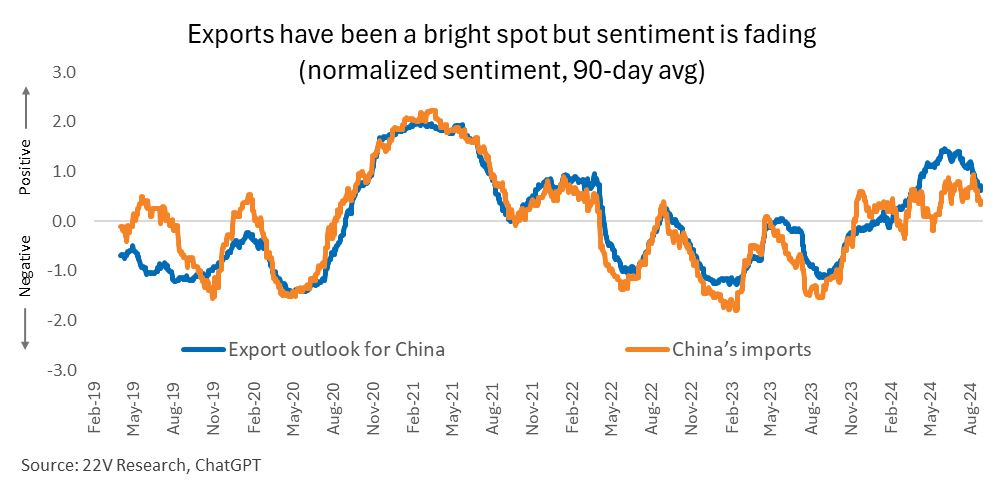
Exports have been a critical source of support for China’s economy this year, helping cushion growth amid weak domestic demand and restrained stimulus. Export sentiment (blue line) has generally been the highest among CHESS categories but turned down in August after China’s July export growth (7% y/y) missed estimates and slowed for the third straight month. We do not yet see cause to think that exports are headed for a sharp slowdown, but the drop in export sentiment is a cautionary note about the extent to which the trade sector can offset the weakness of domestic demand.
Equity sentiment drops, but Fed easing helps the CNY outlook
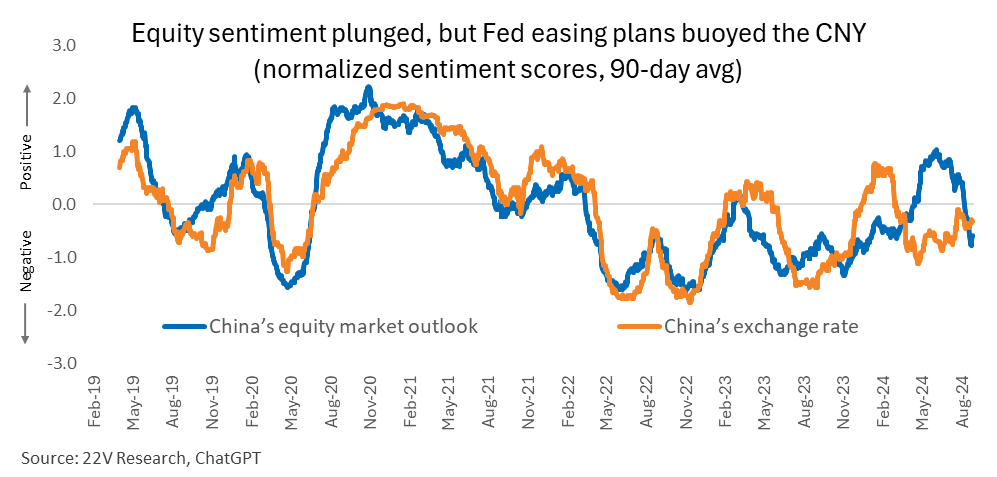
Analyst sentiment towards the equity market (blue line below) plunged in August. This is no doubt due in part to the fall of equity prices, which can itself depress sentiment. But the decline in CHESS equity market sentiment also reflects broader pessimism about the near-term economic situation. Other CHESS indexes that tend to correlate with China’s equity markets (including macro outlook sentiment and export sentiment) also fell in August. In short, the CHESS series provide little reason to think that China’s equity markets are headed for a major near-term inflection point.
While sentiment towards China’s exchange rate (orange line) dipped slightly in August it has recently held up well relative to other CHESS indexes. The main reason is the approach of the Fed’s easing cycle, which reduces pressure on the CNY from the disparity between low interest rates in China and higher interest rates in the US. But the overall weakness of China’s domestic growth outlook, and the likelihood that the PBOC will need to keep rates low, suggests that the CNY is unlikely to see major long-term appreciation.
CHESS is a collaborative project, leveraging the expertise of Sophia Wang, 22V’s Director of Quantitative Research, and China-based economic consultant Dr. Fei Han. The authors express thanks for contributions and insights.

