

SUMMARY
- China’s economic activity in July underscores the weakness of domestic demand; particularly notable was a slowdown in food services, a rise in unemployment, and more signs that the property sector is not yet close to reaching a bottom.
- However, the July data are likely not so bad as to trigger China’s leadership to abandon stimulus restraint; we continue to expect a modest increase in central government deficit spending, to be announced in late Q3/early Q4 and to focus on investment spending rather than consumption.
- A more aggressive stimulus response is possible if Beijing feels necessary to avoid risks to stability; key near-term watchpoints are dynamics around property prices and sales, and signals from China’s leadership as it returns from the annual Beidaihe retreat.
China’s July economic activity data came in on the low side of already weak expectations. Nominal Y-o-Y growth rates for retail sales, fixed investment and industrial value-added are now all below 4%. While most of the weakness is as expected, we want to highlight a few particularly concerning data points before turning to implications for the stimulus outlook.
Slowing catering sales suggests new weakness in services spending. Up until June, food services expenditure (“retail sales for catering,” a proxy for dining) had held up better than goods consumption. Yet, the Y-o-Y growth in food services slowed from 5.4% in June to 3% in July. Given the recent sharp decline in household income growth, there is reason to believe that food services – and perhaps related service expenditures such as travel – will remain weak. In Q2 2024, household Y-o-Y income growth was 4.5% nationwide, and less than 4% for large cities like Beijing and Shanghai. Moreover, given that recent services PMIs have also been soft, a broader slowdown in services activity looks increasingly likely.
Vicious cycle between weak employment and weak consumption. The second notable data point is unemployment. While July unemployment of 5.2% is still below Beijing’s target of 5.5%, the outlook is concerning. The slowdown in food services and construction, which together accounts for more than 50 million jobs, means that both employment and wage growth are at risk. And this may lead to further slowdown in consumption. We discussed the risk of this vicious cycle in our recent Webinar on China’s outlook (see summary and replay link HERE).
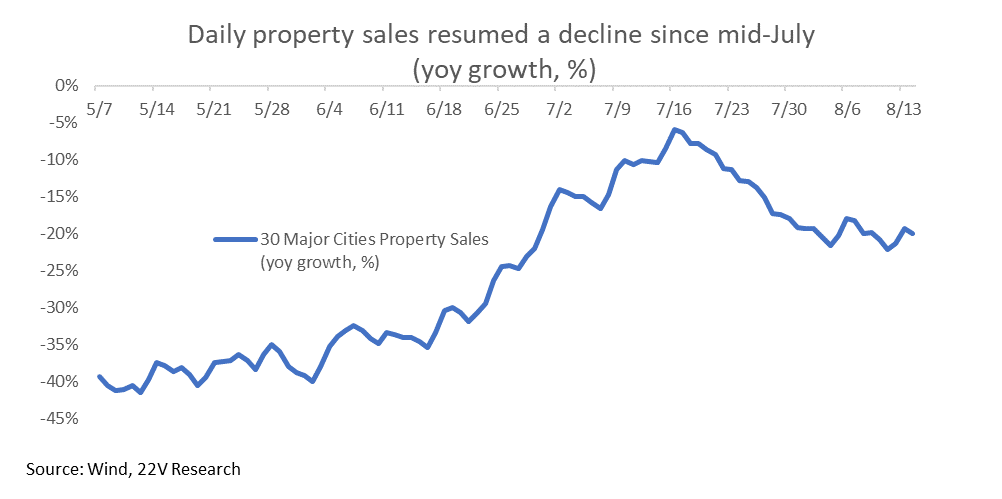
Finally, property has also proven to be even worse than expected. After the aggressive cuts in mortgage rates and downpayment requirements in late May, the rebound in property sales lasted less than 2 months. Y-o-Y growth in residential property sales declined from -12% in June to -16% in July. And daily property sales data indicates continued weakness into August (see chart below). Yet, even during the transitory rebound, property prices continued to decline. The existing home price index for 70 major cities fell by -0.8% M-o-M in July, with 67 out of the 70 cities experiencing price drops. The weak property sales and price data reinforce our call that the property sector is far from reaching bottom.
Infrastructure investment increasingly differentiated. Year-to-date, cumulative infrastructure investment growth slowed from 5.4% in June to 4.9% in July. Within infrastructure, there are large variances between different types of infrastructures. Central government-favored infrastructure, such as flood management and railway, has increased at double digits, while local government-financed infrastructure has performed significantly weaker (see chart below). Given that stimulus will be primarily financed and directed by the central government, we expect this pattern of divergence between central government- and local government-favored projects to continue. While we do not expect broad-based infrastructure stimulus, some opportunities are likely to be present in the sectors that benefit from the shift in financing to the central government. We will conducting be more analysis on that differentiated outlook in the weeks ahead.

Collectively, the July data underscore the weakness of domestic demand. Exports remain a key source of support for China activity. While export growth slowed a bit in July, we expect it to remain resilient in coming months barring a sharp increase in US recessions risks. But China is already seeing the limit of how much strong exports can offset weak domestic demand. A strong rebound in growth requires aggressive stimulus from Beijing. As noted below, however, we expect policy support to pick up only incrementally, sufficient to prevent full-year real GDP growth slipping below 4.5% and nominal growth falling below 4%.
POLICY OUTLOOK
We do not think July’s data are bad enough to alter our basecase of incremental stimulus for the remainder of the year:
- PBOC will likely cut policy rates by the end of Q3, possibly even later this month in order to buoy confidence after the weak data print. The approach of Fed rate cuts provides more room for PBOC to cut, with the CNY recently strengthening as US-China interest rate differentials have declined. However, rate cuts will still be smallish in size, as PBOC sees limited room to lower bank lending rates without hurting banks’ already low net interest margins and worsening financial stability risks. In short, monetary and credit stimulus will continue to play only a supporting role in H2, with fiscal stimulus the more important story.
- In August and September, Beijing will focus on faster implementation of existing fiscal measures: speeding issuance of local government bonds and translating that issuance into spending on infrastructure projects. That will provide a small boost to construction activity, but the overall outlook for metals demand remains dim due to ongoing contraction in property investment. Because the central government has already front-loaded its deficit spending for the year, it will run out of room to boost spending without announcing new deficit spending.
- In late Q3/early Q4, we therefore expect Beijing to announce an increase in the 2024 fiscal deficit, in the form of a new round of “ultra long-term special treasury bonds” by the central government. The spending would largely to go to infrastructure investment and support for high-tech manufacturing. The headline size of the issuance is likely to be CNY 1 trillion (0.8% of GDP, $140 billion), but most of the spending would take place in 2025 due to approach of winter weather and time needed for project preparation. Only a third of the proceeds will be spent in 2024, or around $50 billion.
- The practical impact of the deficit increase is to turn fiscal policy from a drag to neutral stance in Q4 and early 2025. Relative to the downside pressures facing the economy, it is a modest boost and not powerful enough to offset deflationary dynamics. We expect real GDP growth this year to come in slightly below the government’s target of “around 5%.” More importantly, nominal growth – a better barometer of the actual state of the economy, particularly for Chinese corporates – will likely come in around 4% for 2024, down from 4.6% in 2023.
How our basecase could be wrong:
- There is a possibility that a further worsening of the data in August could prompt Beijing to announce stimulus on a faster timeline and larger scale than we anticipate. One watchpoint here would a further deceleration of property prices in August. This could potentially trigger an earlier and/or larger increase in central government fiscal/quasi-fiscal stimulus, such as an expansion of the PBOC’s lending to local governments for housing and infrastructure investment.
- There is also a rising probability – though still not base case – that Beijing could shift the composition of fiscal stimulus from investment to consumption. The chorus of policy advisors pushing for Beijing to consider large-scale consumer vouchers or direct income support has become even louder in recent months. The leadership has also taken some baby steps in this regard, announcing last month that a small portion of central government bonds will be used to help local governments fund consumer upgrades this year. The weakness of consumer spending and decreasing effectiveness of infrastructure investment makes a shift towards consumption-focused stimulus inevitable, but the question is scale and speed of this turn. We think it will be gradual, and that rollout of more ambitious consumption-focused stimulus will wait until next year. But we could be surprised by an earlier shift if those voices promoting consumption are able to convince Xi that the time is now.
The next main policy watchpoint is signaling from China’s leadership as it returns to work from the Beidaihe summer retreat. The annual leadership retreat to the summer resort of Beidaihe may have already wrapped up or will in the next few days. The initial speeches and meetings after Beidaihe can be a useful signal as to the leadership’s evolving priorities. Signals that convey a high level of urgency to boost growth or shift to consumption would be notable. There are thus far no signs of major turning points: the domestic experts invited to meet with senior officials at the start of the Beidaihe retreat were scientists in fields such as AI and quantum computing, a further nod that Beijing’s most urgent concern remains promoting innovation breakthroughs and tech self-reliance rather than boosting domestic demand.

