SUMMARY: Vol fell across assets last week following the dovish FOMC forecast and press conference. Economic growth estimates were revised higher than the policy rate, implying a less restrictive policy stance. There are two important implications from the above. The first is that catchup trades in lagging industries/factors that benefit from stronger real growth should continue. That happened again last week as Value and Price failure were two of the best performing factors while Low Vol stocks fell.
If only it was as easy as just extrapolating last week. But we can’t for now. That brings us to the second implication. Bottom Line: If the Fed’s best guess for interest rates is premised on dovish assumptions playing out going forward (HERE), those assumptions NEED to play out. Factor vol is likely to stay high until we get a clearer signal on inflation trends.
Related to the above, most investors we talked to seem to agree with our take that financial conditions are NOT exerting a drag on the economy. Powell said financial conditions are still a drag. Our sense is investors doubt that the current level of financial conditions can be maintained and the risk they need to tighten. If the labor market data is on the hotter side on April 5th, people will further question Powell’s assessment of financial conditions. If April 10th CPI data is hot, an aggressive reassessment is a real risk. Sectors and factors that have benefited from easier FCI will suffer (Earnings Risk Tech, Biotech, Financials, Value).

Source: Bloomberg, Federal Reserve (for the formulation), FH conversion to daily frequencyData are to the Friday close.
All the above is why the market is unlikely to be full risk-on into April 5th/April 10th data. Risk-on factors and sectors will continue to work but expect volatility. See last week Wed/Thurs risk-on moves followed by a pretty severe risk-off Friday. Risk-on led but it was a volatile week.
FYI – Although it is clear financial conditions are not exerting a drag, that does not make us hawkish. Especially as it relates to market internals. The current levels of GDP growth (2%ish) and Core PCE that moving down toward the Fed’s 2.6% target is enough for the Fed to still cut. That is a positive for risk-on factors, GARP, Cyclicals, etc., Where we would be wrong is if financial conditions needed to tighten much more. That is unlikely if the Fed just CUTS LESS than expected.
We have some cool interest rate and technical commentary from Peter Williams and John Roque below. Expect UST yields to have a downside skew, across the curve, for now. We also highlight how factor moves are becoming more idio driven. Which we think will continue.
Full report below…
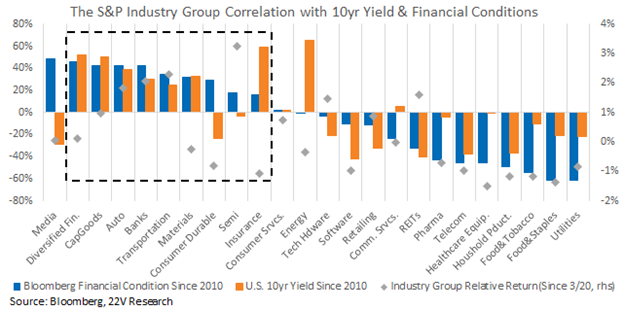
MARKET VIEWS: After the Fed meeting, industry group relative returns were more aligned to their long-term correlation to financial conditions. There is no reason for financial conditions to change much between now and the next set of important data (April 5th with payroll, April 10th CPI). All things equal, that should continue to support the industry groups that benefit from easier financial conditions. The debate around how easy or not financial conditions are has become more intense since the Fed meeting. Most investors we talked to agree with out take, which is why there is still some distrust that the current level of financial conditions is sustainable.
We noted in real time and the next day that we disagreed with Powell’s dovish assessment that financial conditions are exerting a drag on economic growth (HERE). Particularly the labor market. The Fed Financial conditions index (FCI-G) with current market pricing is below. It indicates very little drag on economic growth one year forward. If labor market data is on the hotter side on April 5th, people will further question Powell’s assessment of financial conditions exerting a drag on the economy. If April 10th CPI data is hot, we will see an aggressive reassessment. 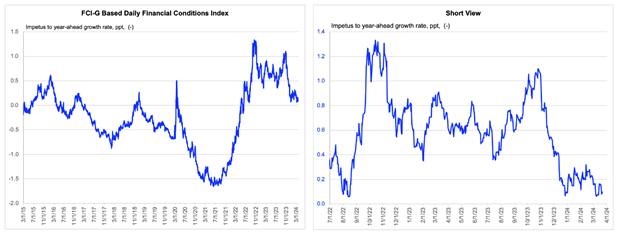
Source: Bloomberg, Federal Reserve (for the formulation), FH conversion to daily frequencyData are to the Friday close.
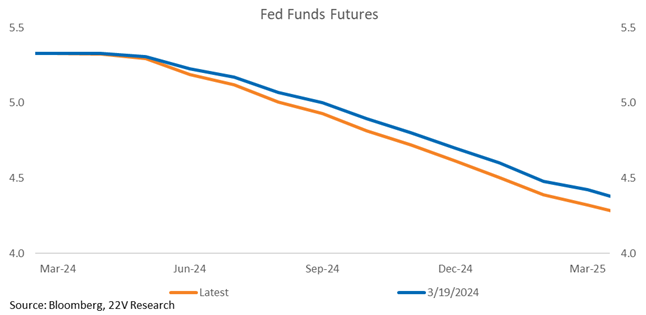
TO BE CLEAR, we would not assume the data is hot enough to change the financial conditions backdrop. But if the Fed’s best guess for interest rates is premised on dovish assumptions playing out going forward (HERE), those assumptions NEED to play out. Otherwise, there is upside risk to the Fed funds futures curve. All the above is why the market is unlikely to be totally risk-on into April 5th/April 10th data. Risk-on factors and sectors will continue to work but will remain volatile. See last week’s Wed/Thurs risk-on followed by a severe risk-off day Friday. On net, internals were risk-on, but it was a volatile week.
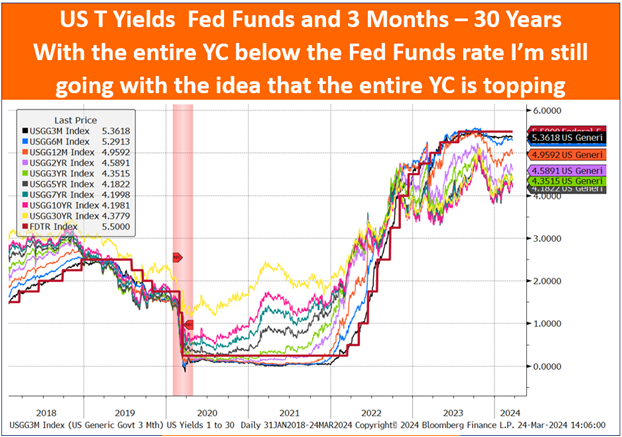
How To Think About UST Yields Across the Curve: Peter Williams made an interesting point in his high frequency distribution list (let us know if you want to be added. It pretty rates outlook/hedging specific). He highlights that “We’ve gone from the recessionary tail dominating rates trading dynamics around the turn of the year, towards a much more symmetric modal-driven distribution. It seems possible that eventually we will go back towards pricing the upside (in rates) but unless we get another hot CPI print or two this spring, that can only come after we get at least a few cuts. The combination of looming cuts, nice technical setups, and a clear direction of travel for shorter-term rates adds a distinct hunting for a ‘buying opportunity’ dynamic to rates at the moment any time there is a move up.” John Roque highlights that the entire Yield Curve is topping, which fits with Peter’s technical point. Bottom line, even if the Fed needs to be more hawkish, the upside on rates is not super attractive.
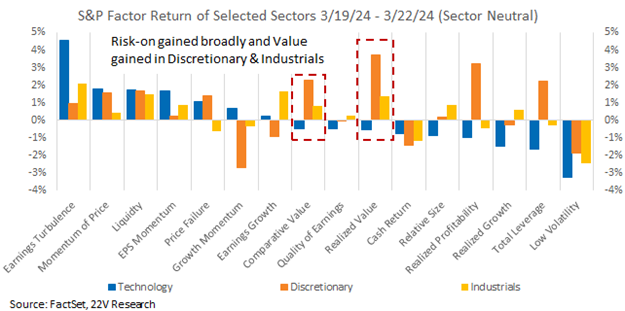
Something that might be related to the point above, the factor returns within the leading sectors after the FOMC meeting last week were a bit odd. Especially for Value factors. The outperformance of Tech was driven more by risk-on (earnings risk in particular), Momentum worked, and Value Tech struggled. Discretionary and Industrials Value names outperformed. If rates are range bound with some bias lower, expect more idio related factor moves vs. broad risk-on/risk-off moves.
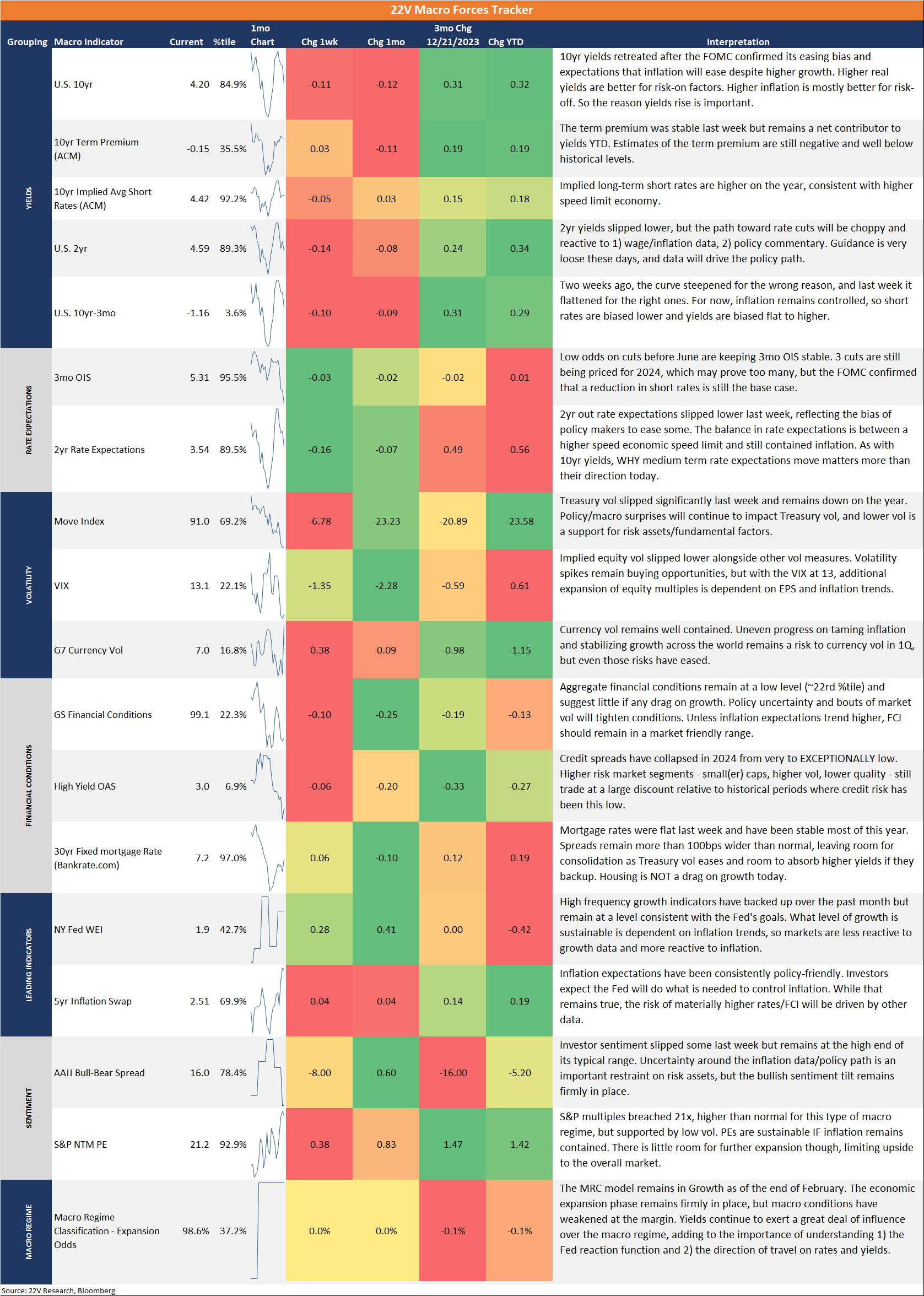
Macro Tracker: Vol fell across assets last week following the dovish FOMC forecast and press conference. Powell reinforced the committee’s expectation that inflation will continue to slow, allowing for some reduction in short rates. That policy bias remained in place even as the FOMC increased its expectations for growth. On net, growth estimates were revised higher than the policy rate, implying a less restrictive policy stance. There are two important implications from the above. The first is that catchup trades in lagging industries/factors that benefit from stronger real growth should continue. That happened again last week as Value and Price failure were two of the best performing factors while Low Vol stocks fell. Expect those trends to continue as long as the easier policy outlook remains in place, which bring us to the second implication of last week’s FOMC meeting. Inflation NEEDS to move lower in March, or the market gains/internal rotation of the past few weeks are at risk. As Gerard noted, implicit in the FOMC’s view is that inflation was seasonal and data going forward will confirm that conclusion. In other words, today’s policy stance is dependent on seasonals fading, and if that does not happen, policy is likely to take on a more hawkish tilt. We continue to favor a GARP framework and risk exposure minimization in part because the policy/inflation backdrop remains unpredictable. The days of medium/long term policy guidance are well in the past. Financial conditions can still tighten IF inflation remains hot or labor demand/wages accelerate further. Some signs of that uncertainty were visible in internals last week, with mega caps leading within the S&P and Momentum and Quality generating some of the highest market-adjusted returns. The odds favor a Value rotation today, but those odds would shift if inflation pressures prove hot over the next few weeks.