

The perception that last week’s FOMC was a significant dovish surprise may prove fleeting for reasons I discuss in this note. However, the perception I am inclined to fade is not reflected in market pricing, at least in fixed income. It is more about how analysts and journalists assess things. This note, then, is largely descriptive and aimed at trying to get our thinking straight, so we can assess events as they develop.[1]
Couple hawkish elements
There were a couple of aspects of the FOMC event that seemed to lean on the hawkish side. First, the Summary of Economic Projections (SEP) included 25 basis point increases in the median projections for the funds rate at the end of 2025 and 2026. The 2024 median projection would have risen if just one more member had raised their guess. And we can see an image of that in the midpoint of the central tendency moving up 25 bps, outright and relative to the median. The 2025 and 2026 projections did not reflect changes in the outlook for the unemployment rate or the core PCE inflation, so they mean either that the reaction function has stiffened or, more likely, that the Fed has gently nudged up its sense of the short-term neutral funds rate at those horizons. Powell did not get into it at all in the Press Conference, as I will discuss below. But stronger supply side growth might itself rationalize a higher r*, on conventional grounds.[2]
March Summary of Economic Projections

Source: Federal Reserve
Second, in his opening comments of the Press Conference (link will expire), Powell noted the funds rate is probably at a peak and that the Fed is likely to cut the funds rate “at some point” (5:00) this year. That latter reference seems to be widely interpreted as consistent with the notion that the Fed will begin to cut by June, although it would take a big surprise to go in May. June would seem to be the base case. But I noticed from the inflection in his voice the suggestion of a bit more ambiguity there than perhaps the consensus heard. You can judge for yourself by going to the tape. And I do not want to overstate the importance of this. But it is something I noticed.
Dovish news predominated, at least on impact
In my view, the dovish news predominated, particularly from the perspective of the knee-jerk response, in which the consensus might be expected to apply a slightly different lens from the one I would use. Powell was almost uniformly “dovish” in his assessment of how the economic fundamentals work and in the forecasts. I will discuss below why I see his take – or, really, the implications of his take — as less dovish than the consensus does. But there is a lot here, so let’s try to run quickly through it in point form:
- He mentioned several times that policy is restrictive and implicitly rejected the signal from broad measures of financial conditions. He pays much more attention than I would to the notion that the real funds rate is high and that this is having effects on housing and even the labor market. I would say Powell’s characterization of this issue was the single most dovish aspect of the Press Conference. If policy is very restrictive, it can ease a lot.
- He tried not to sound dismissive of the high January and (to a lesser extent) February core inflation figures. However, he mentioned several times that they do not overturn the basic story of steadily slowing underlying inflation and the restoration of balanced labor market conditions. When questioned about the increase of the 2024 year-end core PCE inflation forecast, from 2.4% to 2.6%, Powell insisted that that was mostly just a marking to the firmer figures in January and February. I am not sure I agree with him on that. To get the 2.6% q4/q4 rate the FOMC now projects would require sequential inflation of 2.6% during the remaining 10 months of the year. But Powell’s spin on the fundamental drivers here sounded dovish and it is possible his own forecast is lower than the median.
- Powell implicitly threw under the bus my 2-Stage Disinflation hypothesis. I do not take any offense from that! But he sees the labor market as coming steadily into better balance and is, unlike me, comfortable extrapolating the deceleration of wage growth. Powell takes comfort from measures of labor market tightness that I would describe as ad hoc and dubious, but to the extent others might have a take that rhymes with my own, this places Powell to the dovish side, and is thus newsworthy.
- He emphasized that strong employment growth driven from the supply side, in response to, say, higher immigration, would not necessarily have any effect on the policy path. The reason is that it would have ambiguous implications for the unemployment rate. That is obviously true. But what made this reference dovish is that Powell made no reference to supply side strength driving up short term r* and/or requiring tighter financial conditions.
- Powell was crystal clear that he is highly confident that lower marginal rent growth will translate into slower average rents as measured in the government price data. Yay! I fully agree with him on that. He has the right interpretation and is right to be confident about it. But he could have given some quarter to the recently sticky government data and chose not to. Incidentally, the CoreLogic Single Family Rent Index has been updated for March, covering data for January. It shows the 12-month rate of the main index hooking back down again, although Powell would not have had those figures.
- Powell kept harping on the risk that the labor market might suddenly fall to pieces. I found that very odd and initially thought the Fed’s privileged access to — and DIY processing of — the ADP payroll services data might be giving them a signal here. But apparently not. When pressed Powell said there is so far no evidence of outright weakness in the labor market, and that it is just a risk. So, I am puzzled. Maybe he is worried about the logic of the Sahm rule, which presumes a slightly weaker labor market can abruptly feed on itself? Anyhow, his repeated reference to this risk, including in contexts where it was not required, certainly came across as rates dovish.
A fairly decent glimpse of the future government rent data
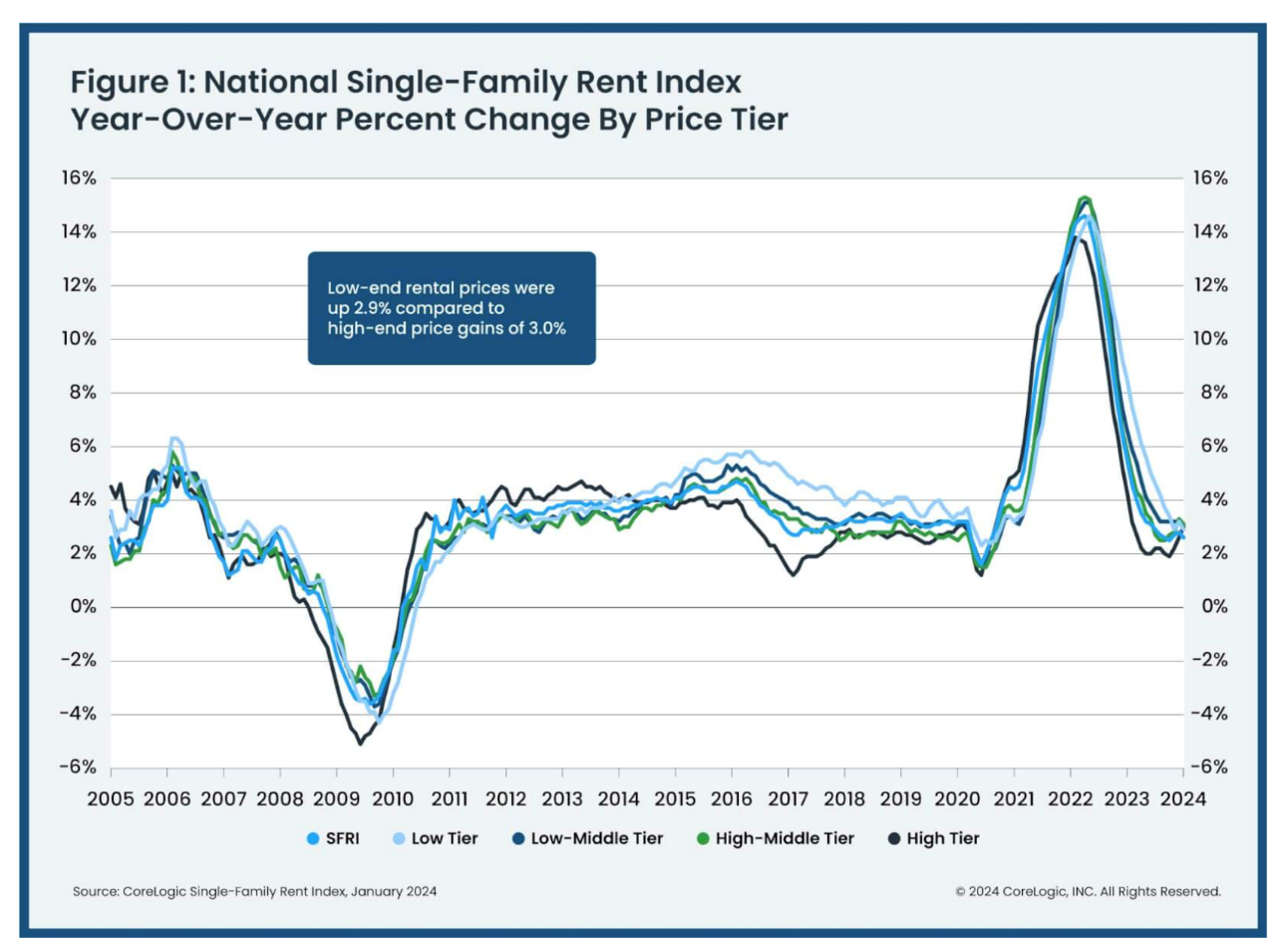
Source: CoreLogic as linked above
Data are actual to January and comparable with the Zillow data to February, because the latter are smoothed.
But where are the hurdles now?
When the Fed says a bunch of dovish things about how they see the economy working and about their own outlook for the economy, it is probably not best practice to claim that they are wrong or fibbing. That would be a good way to get run over by market participants just hearing dovish sounding stuff. But once the knee-jerk reaction has had time to play out, it might be appropriate to apply an important logical distinction. If the Fed lays out for you what their best guess for interest rates is, evidence that such a view is premised on dovish assumptions is hawkish. To see this, take it to the extreme. Imagine Powell said one reason he expects to cut rates “at some point” this year is that he is extremely confident that inflation is going to zero immediately and that the economy might soon be in recession. We would all say, well that guy is going to revise his intention to cut rates as the evidence actually comes in. By going to the extreme like this, you should be able to see the sign we should to the dovish assumption is isolation, given the rate projections, which went up.
So, let’s apply this, starting with an aspect of the outlook that is complicated and does not fit easily into the general template I set out immediately above. The Fed’s median inflation outlook for 2024 is not remarkably low. As a result, it does not pose a particularly difficult hurdle for the Fed to begin cutting rates. By this I mean, that they are not especially likely to be shocked by above-forecast inflation, and to have to revise their rates estimates. On the other hand, Powell’s dovish spin on things suggests that his own inflation forecast may be slightly lower than the median, perhaps at the lower end of the central tendency range. And that would imply a slightly higher hurdle for him. And somewhat related, the Powell view has expressed might be exposed to continued stickiness in wage inflation, the deceleration of which seems central (leaving aside cause and effect) to his benign spin on inflation.
Where the hurdle is more obviously an issue is on the question of the role of “restrictive” policy that is still playing out as a headwind against growth. Gun to head, I would say Powell is wrong on this important forecast point. And here, it is his view that would be the unconventional one. The influence of the funds rate on prospective demand growth works not via the gap between r and r*, as Powell seems to imply, but through financial conditions. And on the Fed’s own metric, not to imply it is dispositive, financial conditions now look easier than they have been on average during the past couple years, which is important, because that average is presumably reflected in the current flow of data.
Policy is obviously “restrictive?”
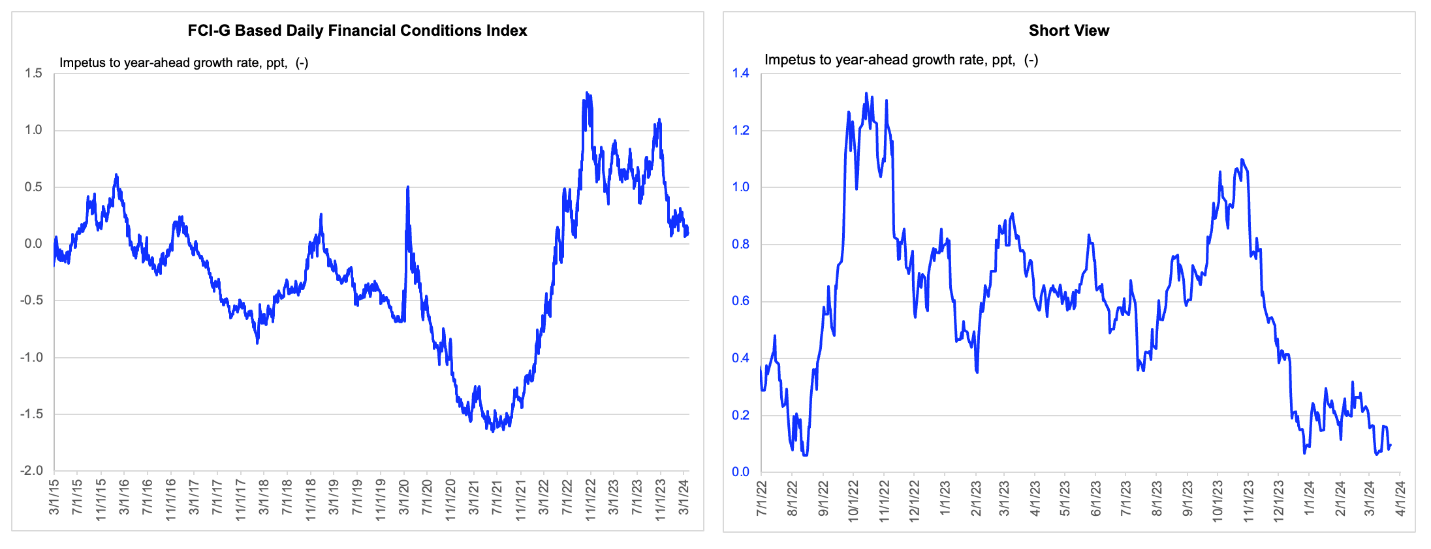
Source: Bloomberg, Federal Reserve (for the formulation), FH conversion to daily frequency
Data are to the Friday close.
The Goldman index is no longer generally available on Bloomberg and is therefore eliminated from the chart, but it is very tightly correlated.
Powell says we can see the influence of that in residential investment. But what that claim misses is that the adjustment in residential investment occurred several quarters ago, which strongly implies that most of the effect on real activity from the earlier rise of interest rates has already happened. If anything, housing is now showing signs of quickening, as is evident from single family starts, as shown below, and from consensus bean counts of the current quarter GDP growth rate, in which housing now enters as a meaningful positive. Rates also influence real PCE, through knock-ons from housing to durable goods demand and from the effect on wealth via the stock market. But wealth has been soaring along with the equity market, taking the ratio of household net wealth relative to personal income back to near the record highs achieved just before the Fed tightening program began. And here is a fun fact to keep in mind when assessing that. The wealth achieved by a gain in a stock market index, say the Wilshire, looks a lot more like the outright change in index points than it does the percentage change in the index.
The confidence that Powell expressed in the notion that the labor market is rebalancing (continuous tense) can be assessed in similar terms. But I will not repeat here the 2-Stage Disinflation perspective, because I have already harped on it plenty. I would just repeat that, while it is an hypothesis, rather than a certainty, the odds we assign to it being valid might be higher than the 0% that Powell seems to assign.
The mean of the probability distribution describing the expected number of rate cuts by year end
(Mode would be fewer)
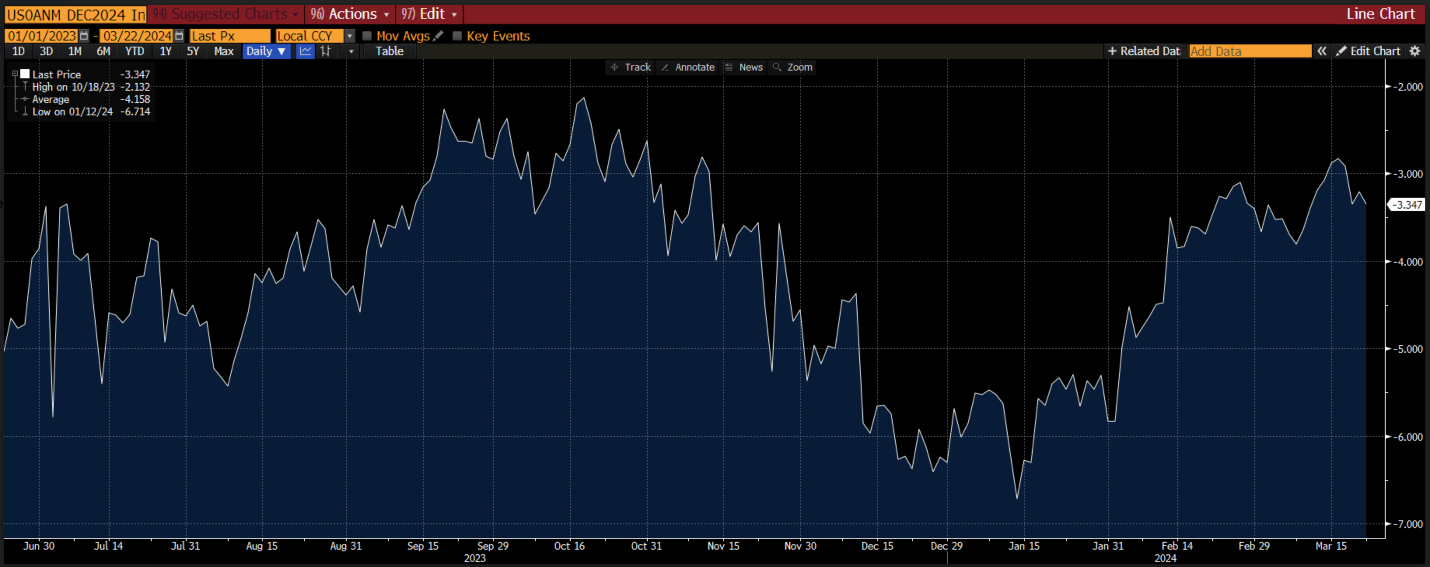
Source: Bloomberg
Data are to Friday close
There is little to fade in rates, though
The foregoing might sound like it tees us up for another stab at being short rates. The problem, though, is that the market is not really priced for rapid rate cuts, despite the dovish tone of the consensus discussion since Wednesday. For example, the market has moved from pricing just under three cuts of the funds rate by the end of the year to pricing just over, as the mean of the distribution. Moreover, the skew in rates is to the downside, which means that the market’s modal view for the rates path may be in line with the Fed’s own view. The Fed reports the medians of the guesses, but those individual guesses are almost certainly about the modes.
The market is now just slightly to the dovish side of where I closed my most recent short take on rates, because valuation seemed closer to reasonable and because the earlier aggregate demand boom seemed to be abating. Since then, the economic data have in fact begun to surprise slightly on the downside, at least as Goldman systematically scores the data. I am not a fan of economic surprise indices, which invariably use rolling windows of some sort, which creates a fake image of time series properties that are not present in the underlying surprise process. But we can get around that falseness by just showing an index capturing an ever-lengthening accumulation of daily surprise. And it has recently hooked a bit lower. Not that we get to extrapolate that. The dopey conventional formulation may imply that, but it is misleading. This is more about just recognizing how things have developed recently with the real side indicators, looking entirely backward.
Properly formulated, economic surprise has tilted a bit lower
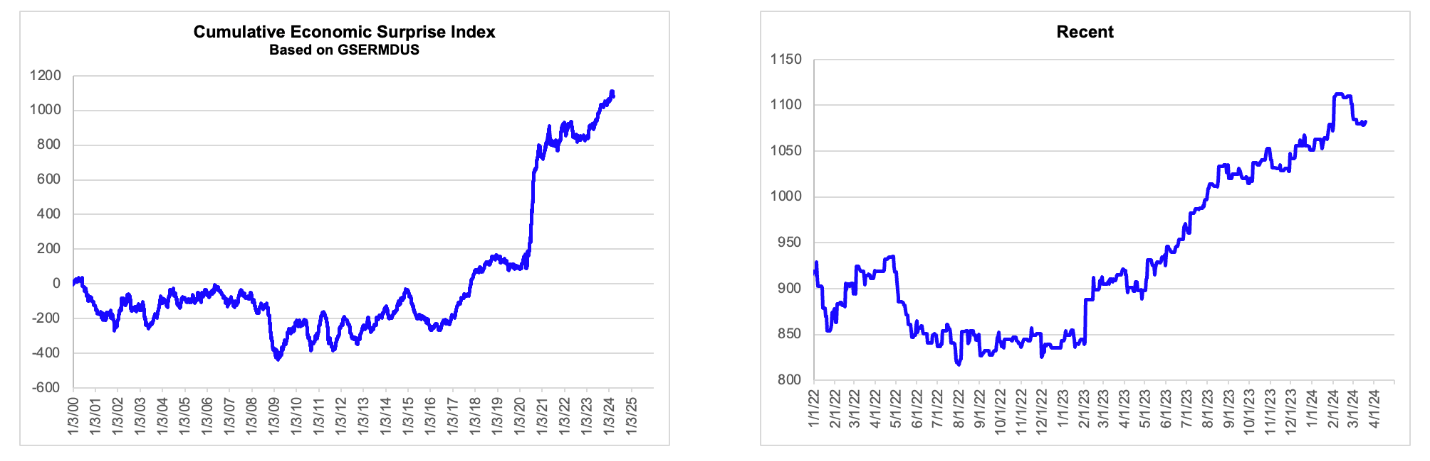
Source: Bloomberg, FH calculations
Data are to the end of last week.
[1] The equity market looks to have taken a buy signal from Powell’s upbeat economic outlook, especially the suggestion that strong growth itself would not be resisted, if driven further by the supply side. But there is a lot of prospective slippage from what the Fed will ultimately deliver and the equity market.
[2] The central tendency funds rate forecast for 2026, in contrast, went up slightly less than the median.
[3] The Goldman index has two key advantages over others. First, it is purely about real growth indicators and does not blend in price data to get all influences on, say, monetary policy or currency rates. Second, the data are available in raw form at a daily frequency, which allows us to avoid the distortions caused by the rolling windows and to develop a more easily interpreted measure of cumulative surprise.

