Back Portfolio Strategy

Powell Laid Out a Risk-On Framework BUT Jan/Feb Inflation Must Prove to Be Seasonal

Published on March 21, 2024

∙ Download the PDF Report

By

Dennis DeBusschere

Brian Herlihy

Kevin Brocks

Sophia Wang

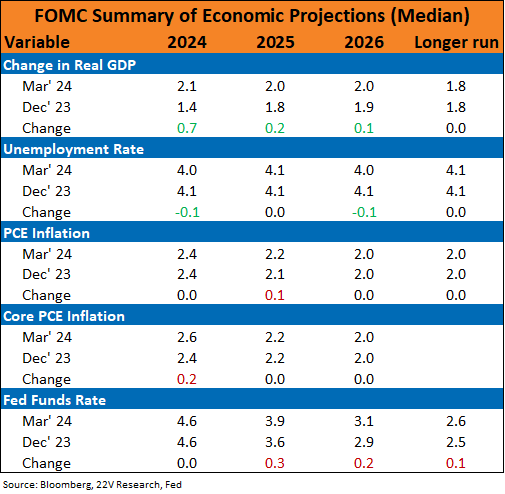
SUMMARY: As Peter put it (HERE), the FOMC substantially reduced its pessimism toward the growth outlook – their median 2024 GDP forecast moved to 2.1% from 1.4% – and is assuming an above trend pace (>1.8%) for all years in the forecast. Yet the FOMC only reduced the 2025/2026 cut forecast mildly. Implicit in those forecasts is policy that is much less restrictive than their old forecasts. Hence the risk-on reaction. If their forecast comes to fruition (a GIANT if), it would favor steeper yield curves and stocks that benefit from an extension of the economic cycle. Some of those groups are Small caps, Cyclicals in general, and Deep Cyclicals now (see the DoD moves below). GARP remains our favorite factor profile given growth uncertainty.

To be fair, the framework that Powell laid out will only remain “risk-on” if the inflation increases seen in Jan/Feb prove to be mostly seasonal. Powell expressed confidence that seasonals influenced the inflation data. We will see when the March CPI data hits on April 10th. For now, there is not much to offset risk-on backdrop until the April 5th payroll report and especially the April 10th CPI.

A blue and white graph

Description automatically generated

Couple of Important Highlights: Powell directly addressed seasonal effects on the Jan/Feb inflation data, emphasizing the bumpy path of inflation. He didn’t dismiss the hot data but put equal emphasis on not extrapolating data. And you don’t get 2.6% core PCE for 2024, the new FOMC forecast, without assuming a seasonal give back of the Jab/Feb data.

Powell also directly addressed the labor market, arguing it doesn’t need to loosen if supply keeps growing. He said wage growth must continue declining (gradually). Gerard has argued wage growth could be an issue (HERE), but Powell didn’t seem concerned. Maybe we have a hawkish surprise on this point with Payroll report on April 5th.

Powell’s insistence that financial conditions are tight is also dovish, albeit a little odd. The Fed’s own financial conditions index doesn’t show a drag on growth, and this week’s housing data was more evidence of a rebound of the most interest rate sensitive sector (HERE). We disagree with leaning on the JOLTS data as proof of weakness (more on that HERE). But Powell’s insistence is dovish. Our call is for inflation to come down as economic growth stays around trend and wage growth slowly decelerates. That is why we forecast 2-2.5% real GDP and 3 cuts for 2024. That FCI is not nearly as restrictive as Powell claims increases the risk of wage growth/inflation getting stuck at too high of a level. That is a CLEAR medium term risk to our forecast and calls.

More in the full report below…

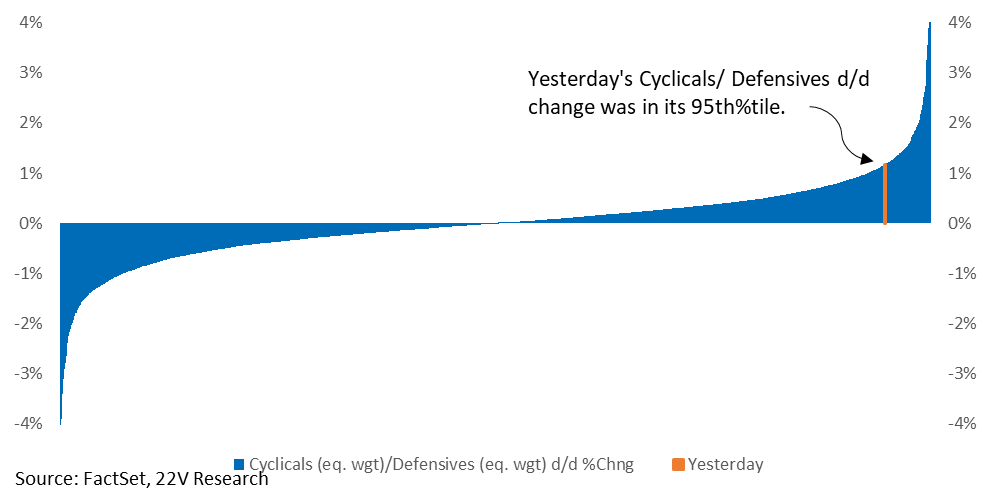
MARKET VIEWS: Following the dovish FOMC summary of economic projections (SEP) and dovish press conference (more on all that below), market internals were firmly risk-on. Cyclicals outperformed Defensives by +1.2%, a 95th percentile return. MS22RISK Index, our risk-on vs risk-off l-s swap, was up +1.34% l-s (also a 95th %tile move).
A blue and white graph

Description automatically generated

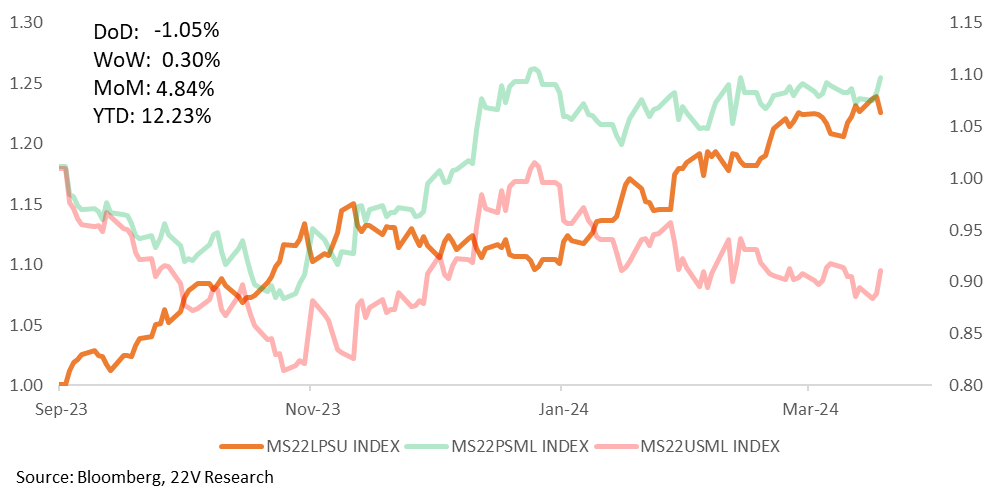
The rally extended to the most economically and interest rate-sensitive equities too, despite the FOMC signaling higher for longer in the dots. Companies with debt problems, MS22DEBT Index on bbg, were up over +2%. Profitable small caps were up +1.3%, and unprofitable small caps were up +2.5%. As Peter put it (HERE), the FOMC substantially reduced its pessimism on the near-term outlook with growth shifting to an above trend pace for all years in the forecast. Implicit in these forecasts is policy that is much less restrictive than under their old forecasts. Stronger growth and a longer business cycle benefit unprofitable companies and companies with debt problems, even if financing costs are higher.
A graph of a graph

Description automatically generated with medium confidence

The FOMC’s economic projections were net dovish – they kept three cuts penciled in for 2024 while raising the inflation and growth forecasts.
A table with numbers and text

Description automatically generated

And Powell didn’t reverse tone during the presser. A couple of snippets we consider the most important here… Powell directly addressed seasonal effects on the Jan/Feb inflation data, emphasizing the bumpy path of inflation. He didn’t dismiss the hot data, but there was equal emphasis on not extrapolating the data. And you don’t get 2.6% core PCE for 2024 in the SEP without Jab/Feb having a season give back assumption. That was great for risk assets, and we are on to the March CPI print next month.
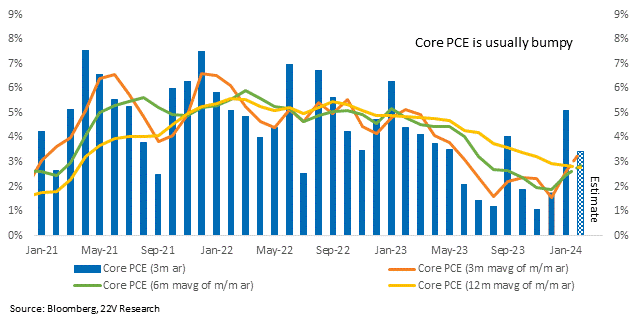
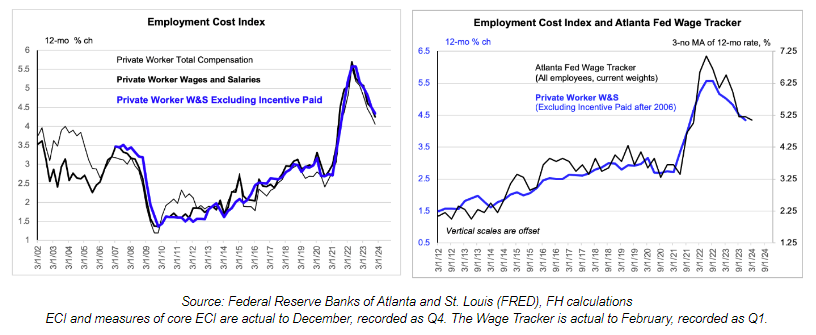
Powell also directly addressed the labor market, arguing it doesn’t need to loosen if supply keeps growing. He said wage growth has to continue declining (gradually). Gerard has argued wage growth could be an issue (HERE), but the trend is still lower for now and we’ll have to continue watching the data.
A graph of two people

Description automatically generated with medium confidence

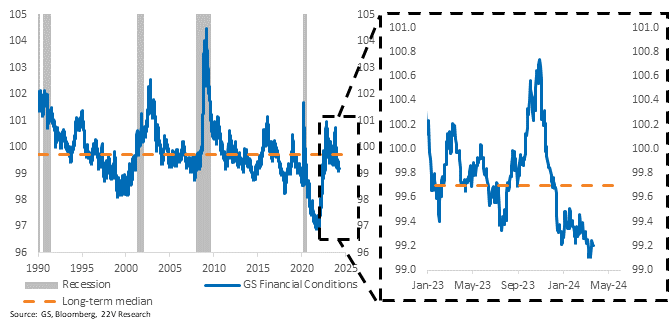
Powell’s insistence that financial conditions are tight is also dovish, albeit a little odd. The Fed’s own financial conditions index doesn’t show a drag on growth, and this week’s housing data was more evidence of a rebound in the most interest rate sensitive sector (HERE). We disagree with leaning on the JOLTS data as proof of weakness (more on that HERE). But his insistence is dovish. Our call is for inflation to come down as economic growth stays around trend and wage growth decelerates, so we’re not going to fight against Powell’s FCI take.
DISCLOSURES AND DISCLAIMERS

Analyst Certification

The analyst, 22V Research Group, primarily responsible for the preparation of this research report attests to the following: (1) that the views and opinions rendered in this research report reflect his or her personal views about the subject companies or issuers; and (2) that no part of the research analyst’s compensation was, is, or will be directly related to the specific recommendations or views in this research report.

Analyst Certifications and Independence of Research.

Each of the 22V Research analysts whose names appear on the front page of this report hereby certify that all the views expressed in this Report accurately reflect our personal views about any and all of the subject securities or issuers and that no part of our compensation was, is, or will be, directly or indirectly, related to the specific recommendations or views of in this Report.

22V Research (the “Company”) is an independent research provider. The Company is not a member of the FINRA or the SIPC and is not a registered broker dealer or investment adviser. 22V Research has no other regulated or unregulated business activities which conflict with its provision of independent research.

22V Research, LLC is a professional services and independent publication organization. 22V Research, LLC is not a securities broker-dealer, not a member of the Financial Industry Regulatory Authority (FINRA), not a registered investment advisor (RIA) and not a member of SIPC.

Securities transactions, when offered, are offered by 22V Securities, LLC through LPS Capital, LLC. Certain employees of 22V Securities, LLC are dually registered as securities representatives of LPS Capital, LLC or Analyst Hub Securities, LLC. 22V Securities, LPS Capital and Analyst Hub Securities are members FINRA, SIPC.

https://brokercheck.finra.org/

Current Ratings Definition.

SECTOR OUTPERFORM: An “outperform” rating anticipates the company will outperform the S&P Regional Banking Index (peer group).

SECTOR PERFORM: A “market perform” rating anticipates the company will perform in line with the S&P Regional Banking Index (peer group).

SECTOR UNDERPERFORM: An “underperform” rating anticipates the company will underperform the S&P Regional Banking Index (peer group).

Limitation Of Research And Information.

This Report has been prepared for distribution to only qualified institutional or professional clients of 22V Research Group. The contents of this Report represent the views, opinions, and analyses of its authors. The information contained herein does not constitute financial, legal, tax or any other advice. All third-party data presented herein were obtained from publicly available sources which are believed to be reliable; however, the Company makes no warranty, express or implied, concerning the accuracy or completeness of such information. In no event shall the Company be responsible or liable for the correctness of, or update to, any such material or for any damage or lost opportunities resulting from use of this data. Nothing contained in this Report or any distribution by the Company should be construed as any offer to sell, or any solicitation of an offer to buy, any security or investment. Any research or other material received should not be construed as individualized investment advice. Investment decisions should be made as part of an overall portfolio strategy and you should consult with a professional financial advisor, legal and tax advisor prior to making any investment decision. 22V Research Group shall not be liable for any direct or indirect, incidental or consequential loss or damage (including loss of profits, revenue or goodwill) arising from any investment decisions based on information or research obtained from 22V Research Group.

Reproduction And Distribution Strictly Prohibited.

No user of this Report may reproduce, modify, copy, distribute, sell, resell, transmit, transfer, license, assign or publish the Report itself or any information contained therein. Notwithstanding the foregoing, clients with access to working models are permitted to alter or modify the information contained therein, provided that it is solely for such client’s own use. This Report is not intended to be available or distributed for any purpose that would be deemed unlawful or otherwise prohibited by any local, state, national or international laws or regulations or would otherwise subject the Company to registration or regulation of any kind within such jurisdiction.

Copyrights, Trademarks, Intellectual Property.

22V Research Group, and any logos or marks included in this Report are proprietary materials. The use of such terms and logos and marks without the express written consent of 22V Research Group is strictly prohibited. The copyright in the pages or in the screens of the Report, and in the information and material therein, is proprietary material owned by 22V Research Group unless otherwise indicated. The unauthorized use of any material on this Report may violate numerous statutes, regulations and laws, including, but not limited to, copyright, trademark, trade secret or patent laws.
