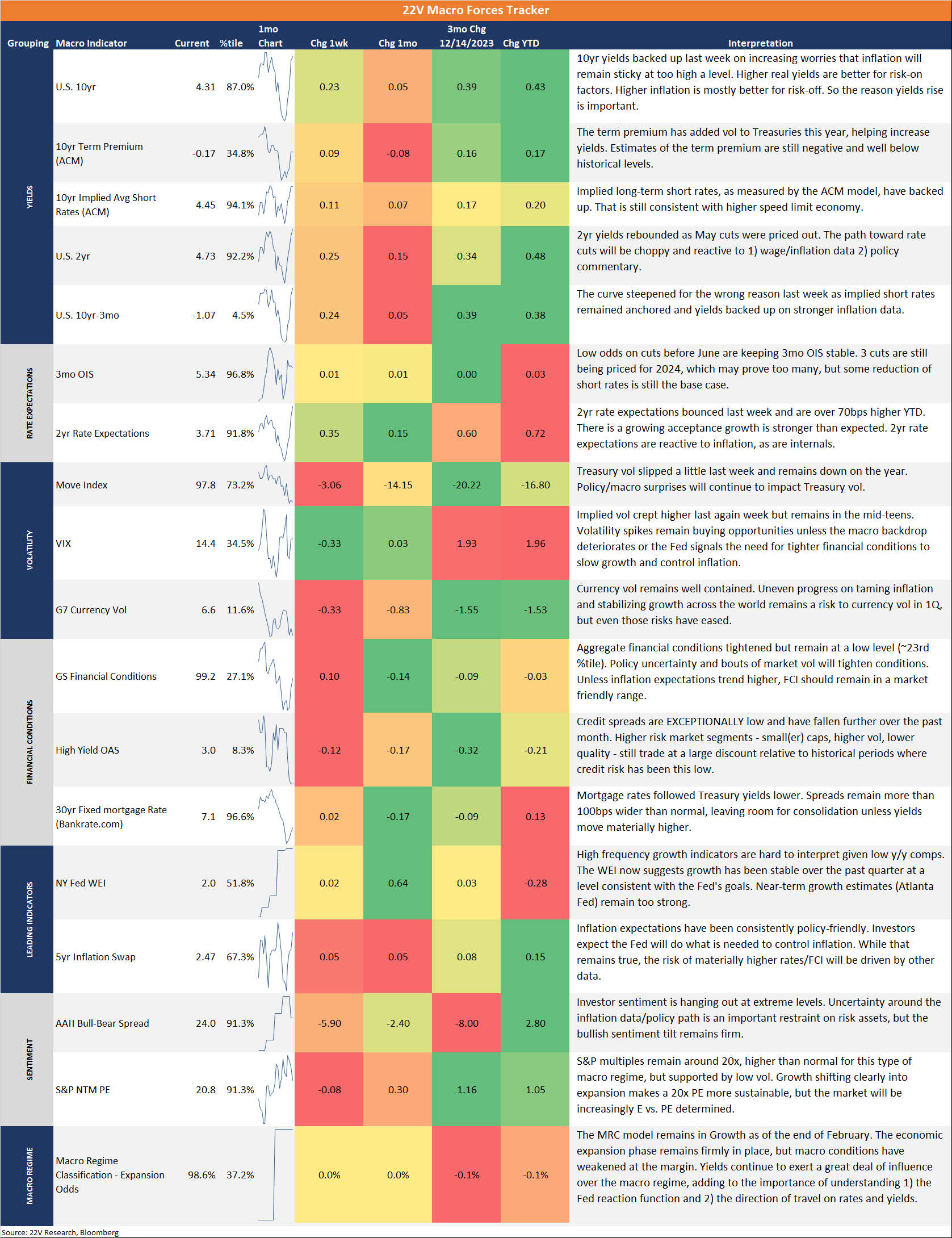
SUMMARY: Above-trend GDO growth was the reason for higher yields, but now it is more about inflation. As Gerard summed it up (HERE) “the consumer spending boom that held throughout the second half of last year appears now to be abating…. But the price data are finally providing some support to the view that the last mile of disinflation will be difficult. This is roughly the opposite mix of what had been in place for the past several months.” For the latter half of 2023 and through January and parts of February of 2023, inflation was surprising to the downside and economic growth was firm.
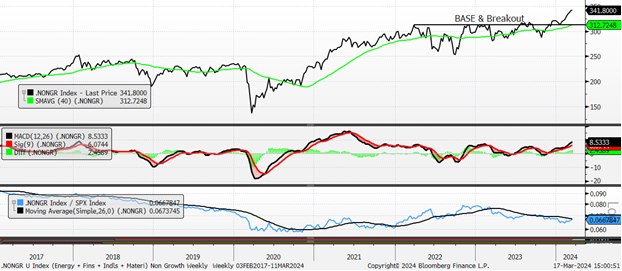
Consumers experienced a positive real income shock that helped support Early Cyclicals (Tech, Discretionary, Communications). Deep Cyclicals (Energy, Industrial, Materials), which we highlighted as a favorite 2024 theme in our Outlook (HERE), have significantly outperformed as real GDP growth appears to be downshifting, but inflation sticky. Deep Cyclicals are outperforming Early Cyclicals by 2.7% equally weighted YTD. John Rogue has an interesting chart showing the breakout of non-growth ETFs. The combo of Energy (XLE) + Financials (XLF) + Industrials (XLI) + Materials (XLB) has broken out, after a long base, relative to the S&P.

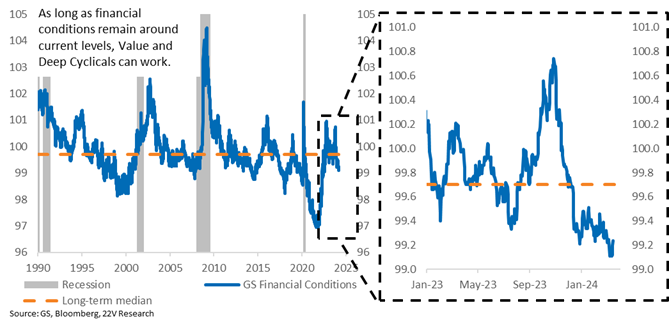
Value has outperformed since mid-February and investors were buying higher beta Value names last week. There is a growing interest in a Value rotation, but it hasn’t turned into a broad allocation. That would change if inflation remains sticky. We think Value continues to catch up and remain long Deep Cyclicals.
IMPORTANT POINT: Inflation is slowing, not reversing the Fed’s path. That is why Deeper Cyclicals and Value can outperform as inflation remains sticky, but not at an alarming level. The Fed’s Core PCE forecast for 2024 should come up to 2.7%, from 2.4%, this week, but they will still signal 2-3 cuts. We are not at a point where the Fed needs to tighten financial conditions based on inflation remaining too high. If we get to that point, risk assets would come under pressure and deeper Cyclicals would lead to the downside. Tightening of financial conditions to slow economic growth and inflation would lead to higher recession risk.
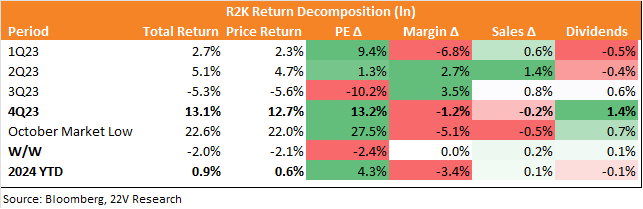
Small caps fell about -2% last week, and ALL that decline was a result of PE compression. IWM’s negative beta to the S&P is about 1, and large caps were down about -0.1% last week. Barring a shock specific to smaller caps, the significant underperformance of smaller caps relative to large would suggest some catchup in the IWM this week. A large, small cap move is possible after the FOMC meeting IF Powell doesn’t surprise.
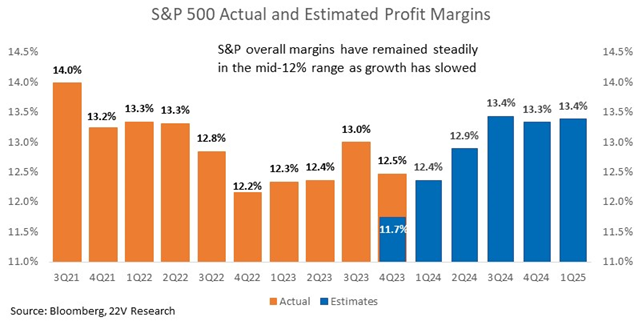
Margins are ending 4Q 80bps better than expected. Given the stickiness of inflation and less goods disinflation ahead (HERE), margins contraction should not be a base case.
Full report below…
MARKET VIEWS: Economic demand growth measures are moving back to trend, but inflation measures are sticky. As Gerard summed it up (HERE) “the consumer spending boom that held throughout the second half of last year appears now to be abating…. But the price data are finally providing some support to the view that the last mile of disinflation will be difficult. This is roughly the opposite mix of what had been in place for the past several months.” For the latter half of 2023 and through January and parts of February of 2023, inflation surprised to the downside and GDP growth was firm. Consumers experienced a positive real income shock that helped support Early Cyclicals. Deep Cyclicals, which we highlighted as a favorite 2024 theme in our Outlook (HERE), have significantly outperformed as real GDP growth appears to be downshifting, but inflation remains sticky.
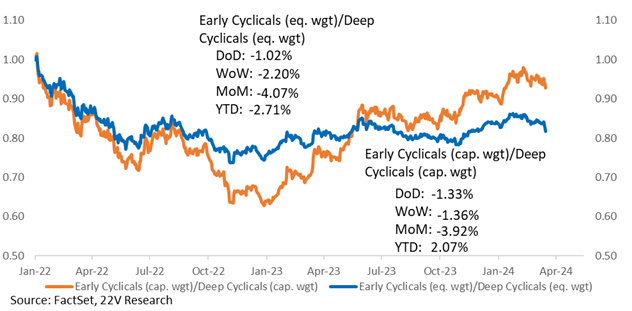
Inflation is slowing, not reversing the Fed’s path. That is why Deeper Cyclicals and Value can outperform as inflation remains sticky, but not at an alarming level. The Fed’s Core PCE forecast for 2024 should come up to 2.7% from 2.4% this week, but they will still signal 2-3 cuts. We are not at a point where the Fed needs to tighten financial conditions. If we get to that point, risk assets would come under pressure and deeper Cyclicals would lead to the downside. Based on the idea that tighter financial conditions, to slow economic growth and by extension inflation, would lead to higher recession risk.
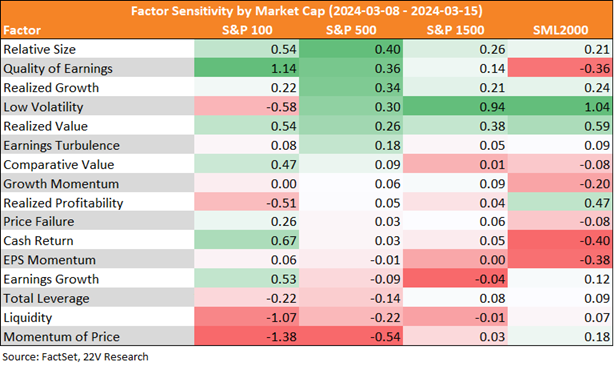
Last week Low Vol and high Mo underperformed while Value gained. Beta adjusted, Low Vol positively contributed to returns, so the factor remained an effective screening tool along with Size, Mo, and Quality. That means the risk-off tilt of market internals remained in place, but investors were buying higher beta Value names. There is a growing interest in a Value rotation, but it is not yet a broad allocation. That would change if inflation remains sticky to the upside. We think Value continues to catch up and remain long Deep Cyclicals.
As John Roque pointed out, the Non-Growth Charts look interesting. Below is John’s Non-Growth Index – Weekly – Energy (XLE) + Financials (XLF) + Industrials (XLI) + Materials (XLB) w/ 40-Week MA, Weekly MACD and Growth Relative to S&P 500. From John “The chart in the top panel is in an encouraging position – notice the BASE & Breakout – and has gained for 8 weeks in a row adding 10% in the process. The MACD momentum indicator in the middle panel is still pushing higher. Non-Growth Relative to the S&P, in the bottom panel, is up 4% since the week ending Feb 9, 2024.”
FYI On Small Caps: Small caps fell about -2% last week, and ALL that decline was a result of PE compression. IWM’s negative beta to the S&P is about 1, and large caps were down about -0.1% last week. Barring a shock specific to smaller caps, the significant underperformance of smaller caps relative to large would suggest some catchup in the IWM this week.
Extras: Margins are going to end 4Q 80bps better than expected. As growth and inflation slowed, S&P profitability has remained steadily in the mid-12% range. The margin expansion required to hit 2024 consensus estimates is lower now than was expected just a few months ago. One important takeaway – the importance of sustainable margins (pricing power) is lower today. That would change IF margins compress more than expected in 1Q. Given the stickiness of inflation and less goods disinflation going forward, margins contraction should not be a base case.
Macro Tracker: Investors moved out of small caps and risk-on factors last week amid hotter economic data. There is a growing divergence between large cap and small cap internals and trends with Small caps significantly underperforming large caps last week. Economic indicators have slowed, but inflation remains sticky. What is driving bond yields changed as a result. Above-trend growth was the reason for higher yields, but now it is more about inflation. While inflation risk remains low, those trends favor Value over Growth, and is also a tailwind for small cap names once policy uncertainty eases. For now, beta adjusted, the best factors across the 1500 were still Low Vol, Relative Size, Mo, and Quality. Those are the same factor groupings that have led market internals for most of this year.