Back Economic Research

Follow-on CPI Data Flags a Bit More Caution

Published on March 12, 2024

∙ Download the PDF Report

By

Peter Williams

Follow-on CPI Data Flags a Bit More Caution

Today’s CPI report was obviously a bit of a mixed bag with some volatility that reads a bit dovish when extrapolated out but also had a number of somewhat more hawkish components. On net, I read it as a bit hawkish but not so obviously so as to definitively change any of my qualitative views on the economy or the near-term trajectory of Fed policy.

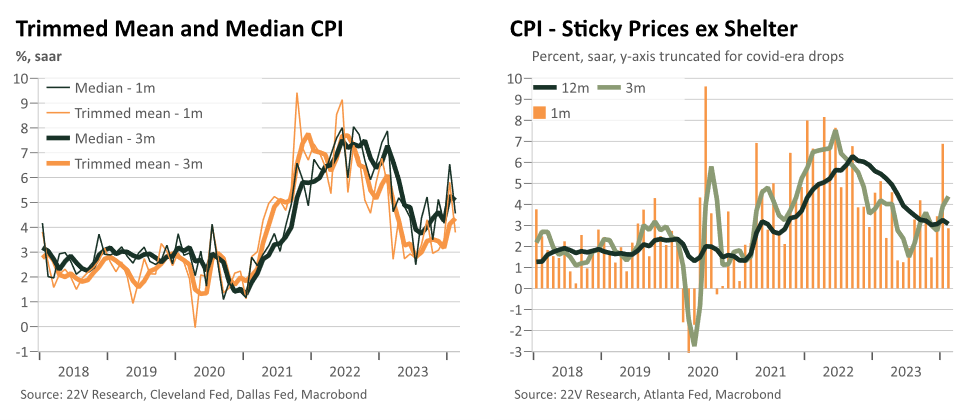
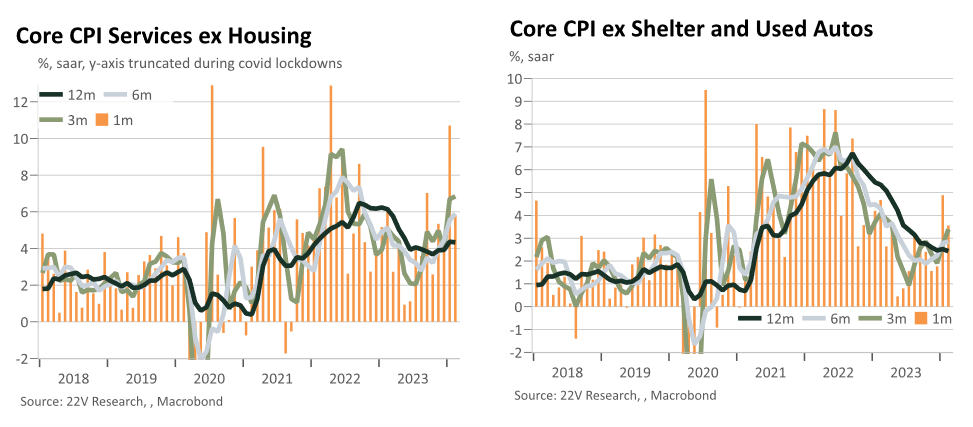
As happens later in the morning, the trimmed mean and median measures came out as did the Atlanta Fed’s sticky and flexible prices measures. While the trimmed mean and median measures deserve a lower weight than usual given their tendency to cluster towards CPI shelter inflation (given its large weight and fairly low m/m vol) they don’t’ deserve 0 weight because Fed officials still reference them with some regularity. The Atlanta Fed’s sticky prices ex shelter presents a similar concept as the more popular core services ex housing but does so in a more useful way in my opinion.[1]

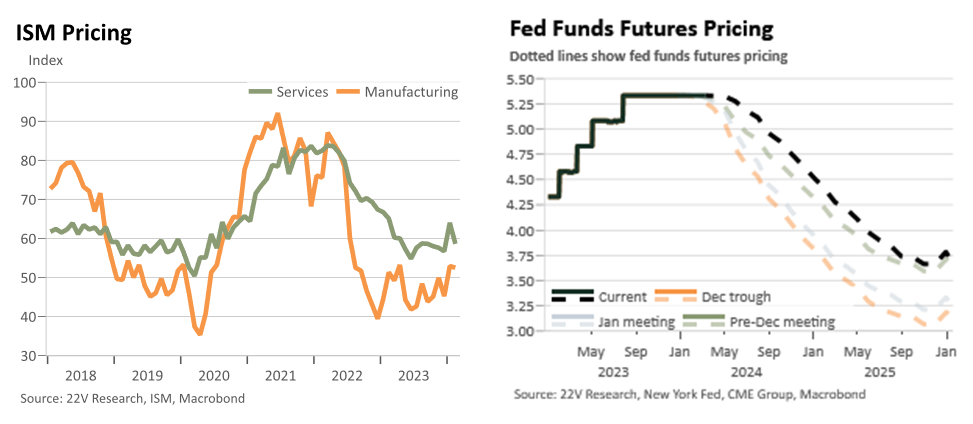
When looking at these 3 measures, as well as core services ex housing and core ex shelter and used autos, one somewhat troubling pattern looks to be common across all of them: it looks like their higher frequency growth rates all found a bottom in summer 2023 and have since perked up, to varying extents. This lines up reasonably well with the bottom and trough seen in the ISM pricing measures. Some of this could be lagged-inflation dependent residual seasonality[2] but that doesn’t go all the way in explain it in my view and fails to account for the late-23 upticks seen in these CPI measures.

Inflation is likely still on a broad, if quite bouncy, downwards trend but any shifts to underlying inflation dynamics and the very long-lived effects of the covid- and Ukraine invasion-related shocks makes assessing its medium-term dynamics very challenging. This is why the Fed is giving us macro forecasts and the dot plot as a base case and guide to the reaction function, but telling us they are primarily data dependent. I don’t think the recent upturn in some of these measures of underlying inflation is enough to break the Fed’s momentum towards cuts but this data, along with the broader outlook for cyclical outperformance relative to the Fed’s December forecasts, puts the skew towards fewer cuts, relative to a 3 cut 2024 baseline, rather than more.

Currently, the Fed is more concerned about inflation than growth, but their default next move has been signaled as a cut. Hawkish (inflation) or less dovish than expected (growth and labor) data seems to be more about pushing cuts farther out than anything else. This pattern of falsifying dovish moves rather than pricing outright hawkish policy will likely to continue until the Fed cuts enough for the default next policy move to become more symmetrically balanced between hikes and cuts (obviously a recession or a clear and persistent reacceleration in the underlying inflation data would change this too).[3]

Further out in the forecast, these signs of somewhat stickier inflation, along with my views on the neutral rate, the current and expected financial conditions impulse, and probable growth outperformance, suggest that the Fed is apt to underdeliver on cuts. With my own view of nominal neutral centered around 3.5%, I expect, as an admittedly quite tentative and imprecise baseline, the Fed will ultimately deliver around 6 cuts before the next recession hits, with perhaps 8 cumulative cuts a reasonable non-recessionary floor.
  1. I’m generally of the view that ex ante categorical exclusions make less sense than do volatility or cyclicality-based ones. Here other central banks, especially the BoC and RBA, are more in the lead than the Fed. ↑

  2. The frequent references to residual seasonality seem to explain it away too flippantly; the issue isn’t just a January effect but rather a Jan-Feb pricing reset dependent upon the lagged level of inflation. This positive feedback loop is different than a pure residual seasonality effect and deserves partial but not full down-weighting, even if it was entirely responsible for all the inflation bump seen in Jan and Feb. ↑

  3. This same dynamic is what keeps medium-term option-implied distribution negatively skewed below the modal outcomes. I doubt that STIR distributions can be symmetric for <3y forward rates until roughly 4 cuts have taken place, then reacceleration and hawkish risks might be able to balance out the downside recessionary tail. ↑


DISCLOSURES AND DISCLAIMERS

Analyst Certification

The analyst, 22V Research Group, primarily responsible for the preparation of this research report attests to the following: (1) that the views and opinions rendered in this research report reflect his or her personal views about the subject companies or issuers; and (2) that no part of the research analyst’s compensation was, is, or will be directly related to the specific recommendations or views in this research report.

Analyst Certifications and Independence of Research.

Each of the 22V Research analysts whose names appear on the front page of this report hereby certify that all the views expressed in this Report accurately reflect our personal views about any and all of the subject securities or issuers and that no part of our compensation was, is, or will be, directly or indirectly, related to the specific recommendations or views of in this Report.

22V Research (the “Company”) is an independent research provider. The Company is not a member of the FINRA or the SIPC and is not a registered broker dealer or investment adviser. 22V Research has no other regulated or unregulated business activities which conflict with its provision of independent research.

22V Research, LLC is a professional services and independent publication organization. 22V Research, LLC is not a securities broker-dealer, not a member of the Financial Industry Regulatory Authority (FINRA), not a registered investment advisor (RIA) and not a member of SIPC.

Securities transactions, when offered, are offered by 22V Securities, LLC through LPS Capital, LLC. Certain employees of 22V Securities, LLC are dually registered as securities representatives of LPS Capital, LLC or Analyst Hub Securities, LLC. 22V Securities, LPS Capital and Analyst Hub Securities are members FINRA, SIPC.

https://brokercheck.finra.org/

Current Ratings Definition.

SECTOR OUTPERFORM: An “outperform” rating anticipates the company will outperform the S&P Regional Banking Index (peer group).

SECTOR PERFORM: A “market perform” rating anticipates the company will perform in line with the S&P Regional Banking Index (peer group).

SECTOR UNDERPERFORM: An “underperform” rating anticipates the company will underperform the S&P Regional Banking Index (peer group).

Limitation Of Research And Information.

This Report has been prepared for distribution to only qualified institutional or professional clients of 22V Research Group. The contents of this Report represent the views, opinions, and analyses of its authors. The information contained herein does not constitute financial, legal, tax or any other advice. All third-party data presented herein were obtained from publicly available sources which are believed to be reliable; however, the Company makes no warranty, express or implied, concerning the accuracy or completeness of such information. In no event shall the Company be responsible or liable for the correctness of, or update to, any such material or for any damage or lost opportunities resulting from use of this data. Nothing contained in this Report or any distribution by the Company should be construed as any offer to sell, or any solicitation of an offer to buy, any security or investment. Any research or other material received should not be construed as individualized investment advice. Investment decisions should be made as part of an overall portfolio strategy and you should consult with a professional financial advisor, legal and tax advisor prior to making any investment decision. 22V Research Group shall not be liable for any direct or indirect, incidental or consequential loss or damage (including loss of profits, revenue or goodwill) arising from any investment decisions based on information or research obtained from 22V Research Group.

Reproduction And Distribution Strictly Prohibited.

No user of this Report may reproduce, modify, copy, distribute, sell, resell, transmit, transfer, license, assign or publish the Report itself or any information contained therein. Notwithstanding the foregoing, clients with access to working models are permitted to alter or modify the information contained therein, provided that it is solely for such client’s own use. This Report is not intended to be available or distributed for any purpose that would be deemed unlawful or otherwise prohibited by any local, state, national or international laws or regulations or would otherwise subject the Company to registration or regulation of any kind within such jurisdiction.

Copyrights, Trademarks, Intellectual Property.

22V Research Group, and any logos or marks included in this Report are proprietary materials. The use of such terms and logos and marks without the express written consent of 22V Research Group is strictly prohibited. The copyright in the pages or in the screens of the Report, and in the information and material therein, is proprietary material owned by 22V Research Group unless otherwise indicated. The unauthorized use of any material on this Report may violate numerous statutes, regulations and laws, including, but not limited to, copyright, trademark, trade secret or patent laws.