

SUMMARY
- With the National People’s Congress likely to start on March 5, China’s leadership continues to signal that stimulus will remain moderate
- There is growing speculation that Beijing may soon hold a much-delayed meeting on economic reforms; however, we would caution against high expectations given few signs that the leadership has a reinvigorated reform agenda
- Consumption activity during the lunar new year holiday showed that households remain cautious about their level of spending, and there is little to suggest that this trend will reverse soon
- Some analysts and policymakers are calling for Beijing to use its affordable housing programs to boost the property market, but political and economic trade-offs make it unlikely that this will be a game-changer for housing sales and prices in coming quarters
The period between the end of the lunar year holiday (Feb. 15) and start of the National People’s Congress (NPC) on March 5 is always highly fluid for China-watchers. This year especially so: investors are checking for the strength of economic activity during the holiday and parsing every statement from China’s leadership as to stimulus and reform plans ahead of the NPC.
We will have a preview of the NPC later this week. In this note we take stock of the latest high-level political signaling and readings on the economy. The bottom line is that we see little on these fronts to change our subdued views on the outlook. Stimulus measures will remain incremental and focused on sustaining fixed investment: infrastructure, affordable housing, and manufacturing capacity. This support will be enough to put a floor under GDP growth of around 4.5% this year, but it will not be of the necessary scale or type to forcefully boost private sector demand – particularly consumption – or decisively put an end to deflationary pressures.
Politics and policies: Xi is staying the course
With Xi Jinping focused on a “high-quality development,” stimulus will remain underwhelming. Clients frequently ask whether Xi Jinping is sufficiently worried about the state of the economy and financial markets as to aggressively ramp up stimulus. He implicitly answered that question by leading a widely publicized study session of the Politburo (the Party’s top 24 members) on January 31. The meeting focused on Xi’s core theme of “high quality development,” and in particular a recent buzz phrase of “new productive forces.” This framing is a clear message that Beijing will not seek to aggressively prop up growth through broad-based stimulus. The leadership’s priority is promoting advanced manufacturing, particularly strategically important sectors such as clean tech, semiconductors and biotech, as well as upgrading traditional manufacturing sectors such as steel and aluminum.
This targeted, investment-driven approach will do relatively little to spur consumption, meaning a continuation of the last year’s pattern of growth in which supply outpaces that of demand. That translates to a macro environment of deflationary/disinflationary pressures, weak nominal economic growth, and significant excess capacity in some sectors, particularly the clean tech complex (electric vehicles, batteries, solar energy). The combination of excess capacity and surging Chinese exports in clean tech, especially EVs, is fueling trade tensions with the EU and is quickly rising to the top of trade policy concerns in Washington.
Beijing is not ignoring consumption entirely. On Friday, Xi chaired a meeting of the Central Financial and Economic Commission that called for “studying the issue of large-scale equipment renewal and replacement of old consumer goods,” such as through vouchers that would encourage households to trade in old cars and appliances. This area is worth watching but probably not getting excited about. The verb “study” is underwhelming and does not suggest big announcements coming at the NPC. More broadly, local governments will be responsible for executing such programs and their finances are under heavy strain from the collapse of real estate investment. Beijing is stepping up to help fund their infrastructure spending but is unlikely to shell out big bucks for consumption programs. In short, promoting upgrading is as much about industrial policy (promoting high-end manufacturing) as it is an effort to boost domestic demand.
The two most effective ways to accelerate consumption would be: (1) direct income support to households; and (2) promoting growth in the labor-intensive service sector, which would help reverse lackluster employment and income growth (see further below). But neither of these approaches fits into Beijing’s investment-driven, manufacturing-focused agenda.
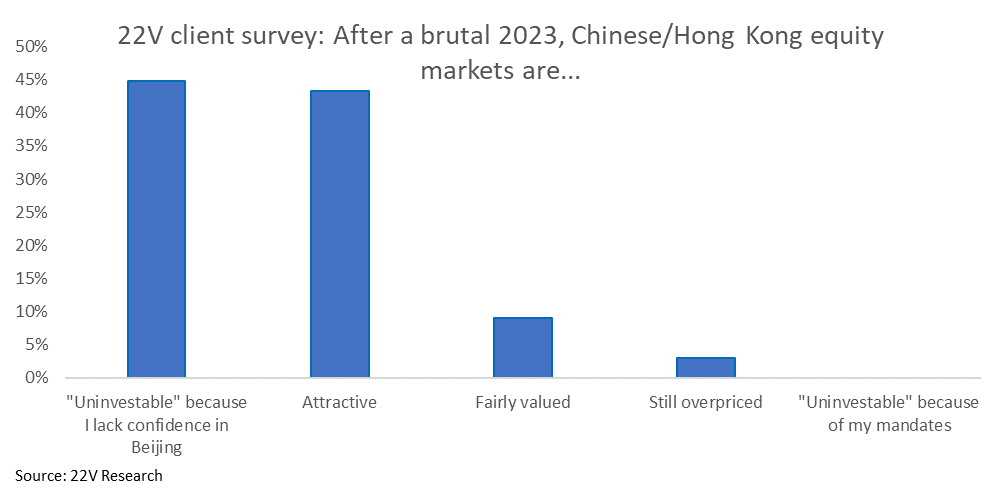
Beijing will look to muddle through when it comes to the equity market. Clients also continue to ask about whether China’s weak equity markets will compel the leadership to reevaluate its policies. In our view, the equity sell-off that started the year has been embarrassing for Beijing but not critical enough to the economy (China’s financial system is dominated by bank lending) or to politics to trigger major changes such as an expansion of stimulus. Beijing swapped out the head of the securities regulator before the lunar new year holiday but will largely look to “muddle through” with a combination of formal/informal limits on selling shares, leaning on state firms to buy shares, and hoping that a recent stabilization will put an end to the self-reinforcing dynamics of the sell off. That selloff does indeed look overdone relative to the state of the economy, which is not good but still better than last summer. Policymakers and to some extent market participants in China are focusing attention on the role of domestic quant funds liquidating small caps as a key factor behind the selloff (see for example THIS coverage from Bloomberg). In any case, we would highlight a finding from our client survey on China published on Friday (link HERE): views on Chinese and Hong Kong equities are highly polarized, with investors roughly split between those who think equities are now attractive and those who think they are “uninvestible” at any price. It seems not many investors are waiting for equities to get cheaper from here.
As speculation over a “third plenum” meeting mounts, few signs of an invigorated reform agenda. In addition to the potential for stimulus, recent market and media attention has focused on whether Beijing will look to update its economic reform plans by convening a much delayed “third plenum” meeting. Plenums are annual meetings of the Party’s 205-member Central Committee. In China’s five-year political cycle, the third plenum meeting lays out the medium-term economic reform agenda and is typically held in the autumn of the year following a Party Congress. But Beijing skipped a plenum last fall.
A plenum will happen eventually, and there is a chance that the leadership could squeeze it in before the March 5 start of the NPC. A meeting that Xi chaired last week could be interpreted as previewing such a meeting but the wording was very ambiguous (see for example THIS article from the South China Morning Post).
We would caution against high expectations for such a meeting – if confirmed. First, there is no guarantee that a third plenum would even focus on the economy as traditional calls for, given Xi’s willingness to flout other Party norms. Second, there are no signs since the 20th Party Congress in late 2022 that China’s leadership has major new reform ambitions. The Congress focused on a broad theme of balancing “development” and “security” and seeking to integrate them, such as through industrial policies that reduce reliance on US technologies. Some of the most needed changes in China’s economy – such as putting the private sector on a level playing field with state-owned firms – are hard to square with Xi’s fundamental governance agenda.
That does leave areas of reform that are possible to envision under Xi and would be very welcome for boosting China’s medium-term growth prospects, including fiscal reform (reducing local government reliance on real estate development), investments in the social safety net, and liberalizing internal migration and land use (Bert Hofman, former World Bank country director for China, has an excellent list of needed “third plenum” reforms in a Substack post from last fall, link HERE). But all of these areas involve difficult political and economic tradeoffs, which has Xi not yet demonstrated a strong sense of urgency to confront.
Economic update: Households are still crouching in the year of the dragon
Consumption activity during the Lunar New Year holiday was mixed. Big crowds gathered for domestic travel and entertainment; the number of domestic tourists was up 34% from the holiday last year and 19% from the pre-pandemic baseline in 2019. Revenues were up but not as much. That is, the big caveat is that average spending per tourist was still low – in fact, 9% below the 2019 level (see chart below). This gap was larger than during the “golden week” holiday in October 2023, in which the average spend was only 4% below the 2019 equivalent. A similar trend can be seen at the box office (the number of moviegoers and overall revenues up, but average ticket prices down). In short, Chinese households are readily partaking in the service economy but remain frugal in their spending. They have been particularly reluctant to spend on goods in the last year. Cautious household spending and investing has been a key factor behind weak domestic demand since the post-Covid reopening and we see few catalysts to reverse it anytime soon.

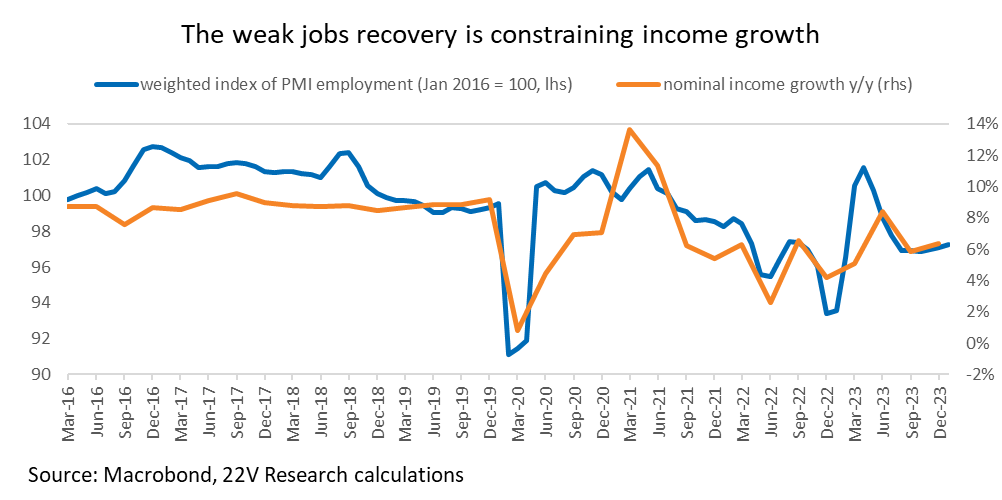
Households are cautious about their finances for a very understandable reason: per capita income growth fell during the pandemic and has yet to fully recover amid a weak job market. Below we update one of our favorite charts, which shows employment activity as captured in the monthly PMI survey (a more revealing measure than the official unemployment rate) along with per capita income growth. It shows that weak job growth is holding back a recovery in incomes and thus spending power. And of course, the negative wealth effect from falling housing prices doesn’t help households feel more secure economically. China is going through its own version of what the US economy experienced in the aftermath of the Global Financial Crisis: a bad equilibrium of weak consumption growth that in turn constrains the willingness of firms to expand employment. With Beijing opposed to direct stimulus to households, and focused more on supporting manufacturing than the labor-intensive service sector, this dynamic is likely to linger.
Property: Affordable housing programs won’t be a game-changer for the broader property market this year. Households also remain cautious about buying property, with muted sales and property visits during the holiday period. The signs are not all bad: housing prices declined month-over-month in January (-0.7%) but with a shallower fall than in the last two months, and household mortgage growth also improved. Still, there are few green shoots to suggest that property prices and activity are close to bottoming.
The continued trouble in property is stoking hopes among some analysts that Beijing will use its affordable housing initiative – a major focus of stimulus this year – to support the residential market. The government could do so in two ways: (1) by purchasing vacant/stalled projects from developers to convert to affordable housing, thus clearing excess housing inventory from the market; and (2) funding purchases of new homes for residents who are being resettled, particularly as part of the “urban village renovation” program.
Whether Beijing exercises these options is indeed an important policy watchpoint, which we discussed in our recent note (link HERE) on PBOC’s balance sheet activities. The PBOC’s newly reactivated PSL program provides a potential source of financing from the central government for such moves. However, we would caution against viewing this possibility as a “game-changer” for the property market, at least anytime soon, for several reasons:
- To meet its economic growth targets this year and support construction and employment, China’s leadership has strong incentives to build new affordable housing rather than just purchasing existing property from developers.
- The urban village program and associated resettlement is likely to progress gradually, as it is by design more targeted than the “shantytown redevelopment scheme” that juiced property sales in 2015-2019.
- Even if local governments do purchase housing from developers, they are likely to do so at very low prices given their fiscal constraints; in other words, this will not be a backdoor bailout of developers. Beijing does not appear any closer to a comprehensive restructuring of developer debt or other steps to address their insolvency. Without such an approach, households and creditors will continue to be reluctant to buy from or lend to private developers, a key stumbling block for a housing recovery.
- Looking out over the long term, it is worth noting that the biggest problem for the property market is not oversupply but falling demand due to a shrinking population and slowing urbanization. For those interested in a deep dive, we would recommend a recently published paper by the IMF on the ten-year outlook for the property market (link HERE). The authors project that housing starts to China in the next ten years will on average be only 45% of the level of 2019-2021. Reducing inventory would help, but the drag from housing supply accounts for only a quarter of the decline, while falling demand and other factors accounts for three quarters.

