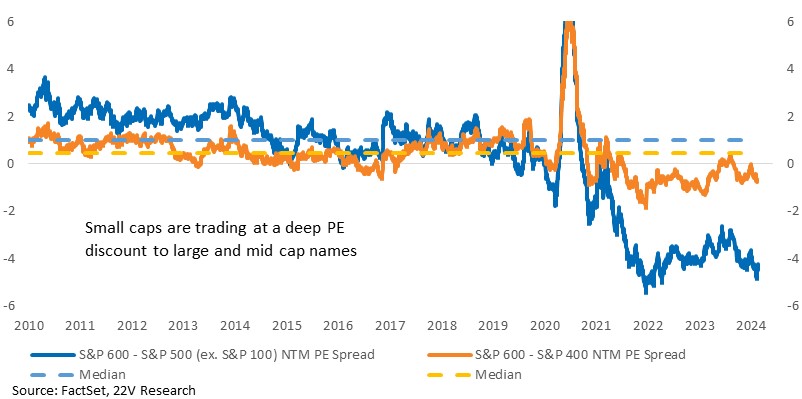
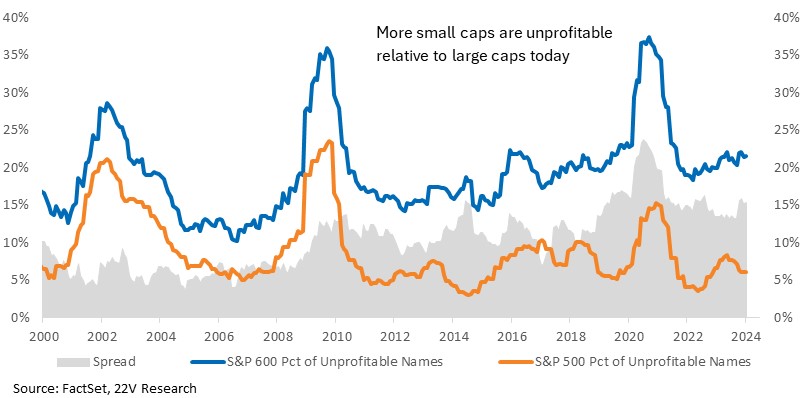
Since late October, equities across the cap spectrum have rallied, but Small cap names are still trading at a large discount to both large and mid cap stocks. Some of that weakness can be attributed to macro uncertainty and concerns about growth. Firm economic data has assuaged those concerns. A more persistent issue is that the percentage of small caps that are unprofitable (about 21% today) has increased, adding a fundamental drag to the recovery of small cap Indices.
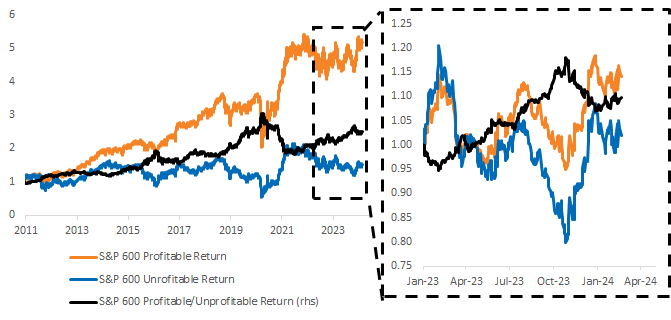
Historically, returns to profitable S&P 600 names (defined as positive trailing 12mo EBEX) have been stronger than that of the unprofitable small cap basket. Over the past few quarters, profitable small caps have gained about 2% relative to the unprofitable S&P 600 names despite having much greater exposure to Banks, which have struggled as yields have backed up and rate cuts have been priced out of the futures market.

Source: FactSet, 22V Research
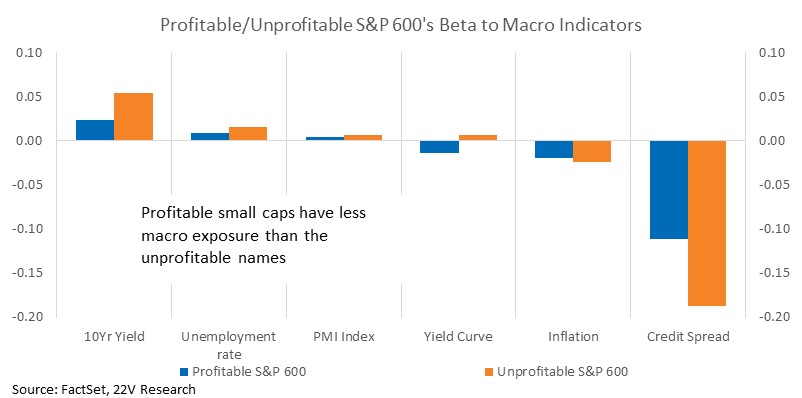
Better returns to profitable small caps are consistent with history. The profitable group has higher returns and lower volatility over time, leading to better risk adjusted returns. They are also less impacted from macro reading volatility with lower betas to macro indicators. Part of the reason for that is the makeup of profitable companies.
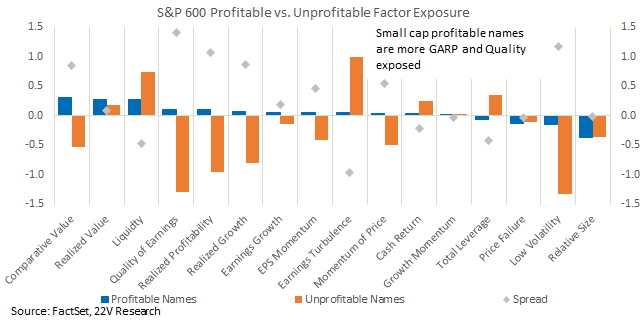
Factor exposure for profitable small caps tends to be and is today more tilted towards fundamental factors and less exposed to risk factors. profitable names are more exposed to Earnings Quality and Realized Profitability. In addition, small cap profitable names are also more exposed to fundamental factors including Value, Growth, and Momentum with less volatility exposure. As we discussed (HERE), fundamental factors tend to perform better than risk factors in expansionary economic backdrops while risk factors bring more volatility.
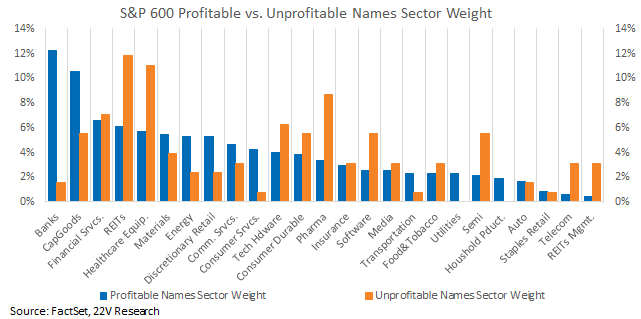
Relative to the total S&P 600 index, profitable S&P 600 names have much more exposure to Banks and Cap Goods, and less to REITs and Health Care. That leaves the basket more likely to be impacted by rate vol. Stabilization of the policy backdrop is a support for all risk assets, but would specifically benefit profitable Small cap names.
Focus on Profitable Small Caps for Better Risk Adjusted Returns: Small caps are trading at a deep discount to larger (large and mid) cap names, even if we exclude mega caps. The S&P 600 Index NTM PE spread with the S&P ex the top 100 market cap stocks is near the low end of its post-GFC era range. The spread reflects concerns towards the economic cycle and any evidence supporting the cycle extension should support small cap laggard catch-up (HERE). That helps explain the volatility between small vs. large cap names and recent small cap improvement in February.
One of the drags on small caps is the expanding proportion of the space that is unprofitable. The percentage of large cap S&P names that are unprofitable spiked during COVID, but has moved lower as the global economy has recovered. The percentage of small caps with negative EBEX, however, has expanded in absolute terms and relative to larger cap names.
Breaking the S&P 600 into profitable and unprofitable groups shows returns for profitable names have been consistently stronger over time. We define profitability using trailing 12mo EBEX, rebalancing monthly to capture new earnings data. There are more sophisticated ways of parsing this universe, but the point we mean to illustrate is that focusing on profitability is a straightforward and easy-to-apply method of boosting returns within small caps.
Source: FactSet, 22V Research
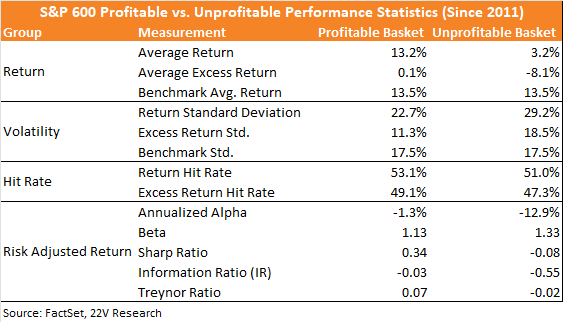
Return and volatility statistics since 2011 backup the index returns. Profitable names consistently show higher nominal returns with volatility. As a result, the sharp ratio, IR, and Treynor ratios for profitable names are all higher than that of the unprofitable basket.
Focusing on profitable small caps also helps mitigate macro risks. The betas of the profitable basket relative to macro indicators are all lower on an absolute basis compared to the unprofitable group. The largest macro headwind to small caps is credit spreads, which remain exceptionally low today. If spreads were wide, unprofitable small caps would benefit more from an easing of macro uncertainty/rebound in growth prospects. From where spreads are today, we would rather hold the lower macro vol profitable small caps.
Factor exposure of profitable small caps is tilted toward Earnings Quality and Realized Profitability, and have more fundamental factor exposure (Value, Growth, and Momentum). Unprofitable names have greater risk exposures as well with more Turbulence and less Low Vol. The bottom line is focusing on profitable small caps is a better way to position for a longer-term rotation into fundamental factors.
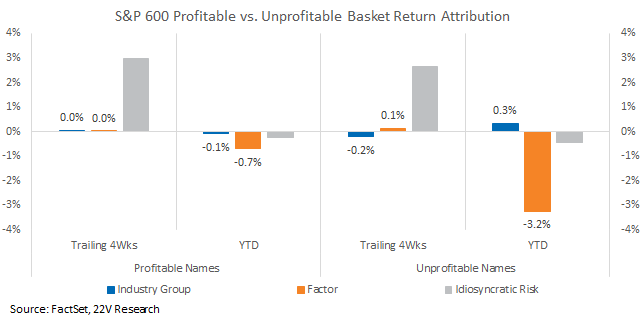
Looking at the return attribution of profitable vs. unprofitable small caps illustrated the point above. The returns to unprofitable small caps have been largely a function of the groups factor exposures. Profitable small cap returns are almost all a result of idiosyncratic exposure.
There are noticeable differences between the industry exposures of profitable vs unprofitable small caps. Relative to S&P 600, currently profitable S&P 600 names are MUCH more exposed to Banks and Cap Goods. Easing of policy concerns would reduce the headwinds facing those names, but we would expect Bank vol to be high as the policy outlook debate continues. Investors looking to focus on profitable small caps might want to reduce gross bank exposures. A full list of the names is available by emailing us.