SUMMARY: It is a really big macro week, and every investor seems to be talking about it. At least the investors we talk to. Risk-on and more Cyclical factors (Value, small size) worked last week. Low Vol was a drag across all segments outside of Mega caps. That shift is consistent with market internals catching up to macro trends like rising yields, steepening curves, and narrowing spreads (easier FCI in general). There is more room for risk-on factors to “catch up” to the current level of financial conditions in a normal economic expansion, which is what we are in right now according to our Macro Regime Classification Model (HERE). Fundamental factors (Earnings and Growth momentum, Value and Growth. Hence, we like GARP), should show more persistent outperformance.

The above being noted, we need to get through this week’s Fed, Payroll, ECI, mega-cap earnings and QRA (Quarterly Refinancing Announcement – where the US Treasury Department announce and quantify its financing needs for the quarter ahead) without a reason for FCI to tighten before investors are comfortable embracing further the sectors, factors, and market cap segments that benefit from a normal economic expansion.
I.e., what happens if we get a slightly hawkish Fed and something from the QRA that leads to a large spike in yields? Or a very weak payroll report and earnings disappointment that increases recession risk? Or some weird combination we are not thinking about? Market internals could just flip back to risk-off. People are still concerned about the two tail risks (6+ cuts because of a recession or 1 cut and done, or something like that, that leads to much tighter FCI because inflation persists at two high of a level for the Fed).
As we noted yesterday (HERE), the odds of one of the tail scenarios coming to fruition need to be reduced further for risk-on leadership to sustain momentum and this week COULD provide some support for lower tail risk if there are no large surprises from the Fed, major earnings announcements, ECI, QRA and the payroll report.
Given our strong economy and strong wage growth leaning, we would be worried if Powell emphasis firm wage growth this week and dismisses some of the signs of labor market weakness (JOLTS, Quits and Private Payroll revisions). Otherwise, the base case of an uneventful Fed meeting, which would be defined as nothing new learned on March cut leanings and consensus payroll data, 180k on the headline, a urate of 3.8%, and wage growth that moves down a touch MoM, would be a good thing from a clearing event point of view.
Full report below….
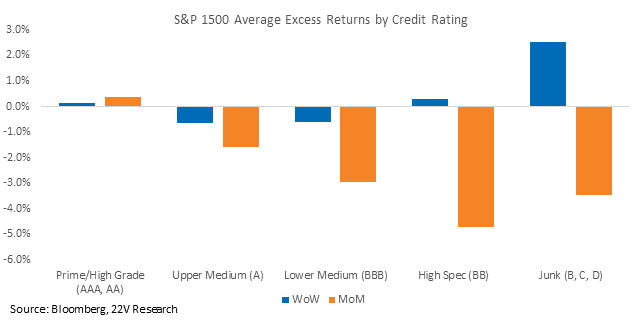
MARKET VIEWS: Factor sensitivities last week show Value worked across market cap groupings (from mega to smalls, Value was a positive contributor to returns) and all sector groupings (Cyclicals, Defensives, Rate Sensitives). Low Vol was a drag across all segments outside of Mega caps. That shift is consistent with market internals catching up to macro trends like rising yields, steepening curves, and narrowing spreads (tighter FCI in general). There is more room for risk-on factors to “catch up” to the current level of financial conditions, but we will need to get through this week’s Fed, Payroll, ECI, mega-cap earnings, and QRA (Quarterly Refinancing Announcement – where the US Treasury Department announce and quantify its financing needs for the quarter ahead) without a reason for FCI to tighten before investors are comfortable embracing that. It is a big week.
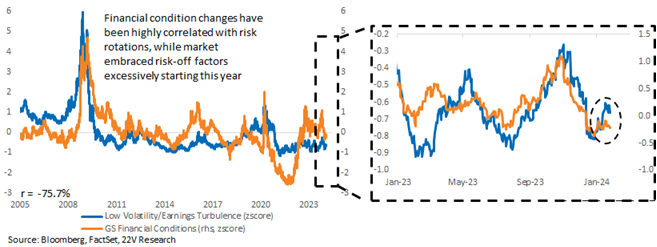
In a normal economic expansion, which is what we are in right now according to our Macro Regime Classification Model (HERE). Fundamental factors (Earnings and Growth momentum, Value and Growth. Hence, we like GARP), should show more persistent outperformance. The risk is that something happens to change the financial conditions/economic/earnings outlook this week. I.e., what happens if we get a slightly hawkish Fed and something from the QRA that leads to a large spike in yields? Or a very weak payroll report and earnings disappointment that increases recession risk? Or some weird combination we are not thinking about? Spec parts of the market could just flip back to risk-off again.
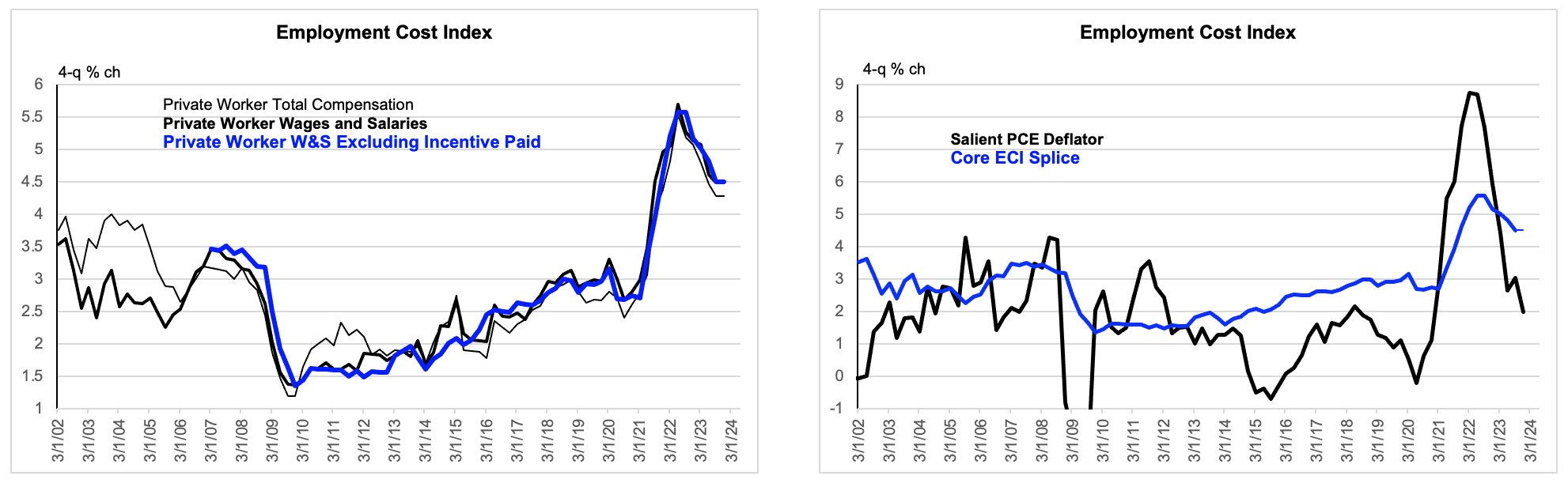
Our fundamental fear, but certainly not our base case, is that the failure of wages to catch down to goods and services prices, FOR NOW, may be evidence that the labor market is more overheated than generally recognized. The combination of well above trend economic growth (IF economic growth stays above the 2.5%ish level) and current wage trends could lead to a much more hawkish than expected Fed. This is not a risk that will be priced this week, especially if the benign payroll estimates are roughly correct, but it is a RISK over time.
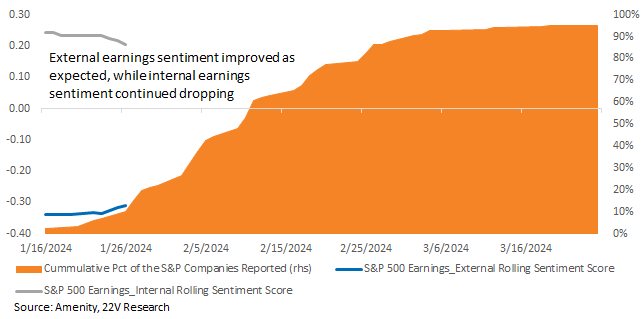
Company Sentiment: As we highlighted in a Quant report last week (HERE), we break earnings sentiment into two groups, external earnings sentiment (macro influenced) and internal earnings sentiment (company specific, long-term charts HERE). That distinction is useful during periods of macro recoveries like we are in today. Generally, company commentary about their own business’s has been significantly better than what companies are saying about the broader macro backdrop. Firm macro trends should reduce management negativity overtime, resulting in an upward bias to sentiment and estimates. Of course, getting through huge event weeks, like this week (and we have plenty of more event weeks in the future), will probably help improve management sentiment toward the outside world.
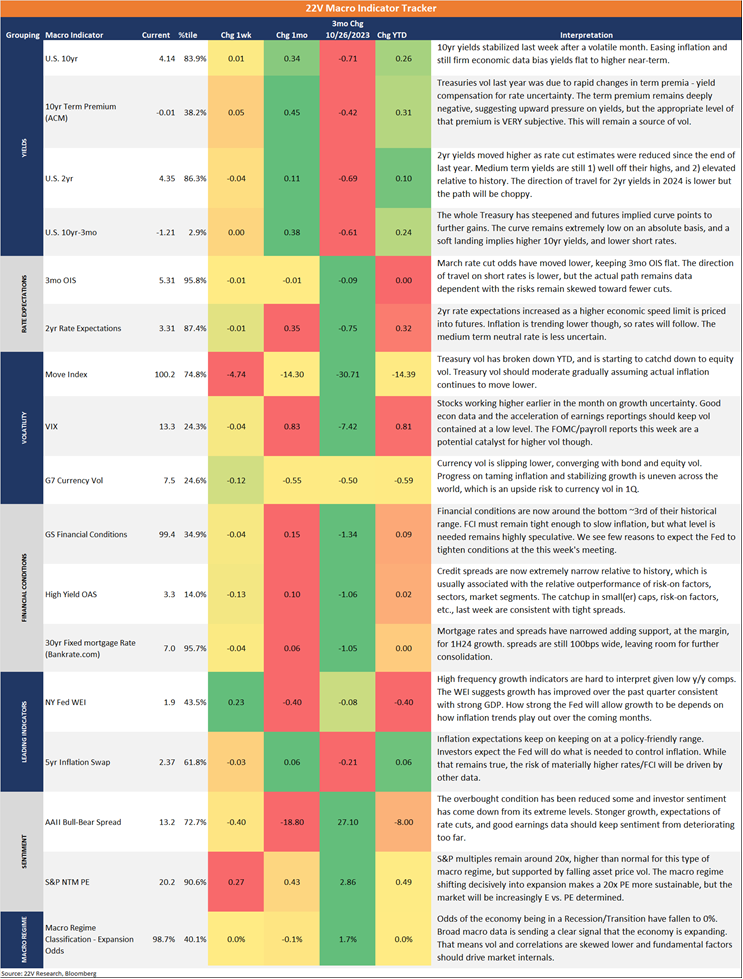
Macro Tracker: Broad stock indices are moving higher again as economic data again pushes back against concerns that growth is slowing too fast. The much more likely risk is that growth is TOO STRONG. More on that below. For now, the equally weighted S&P kept pace with the cap weighted index last week, with both rising more than 1%. Small caps did even better, gaining 180bps on the week. The IWM is still down -2.4% YTD vs. the SPX gain of 2.5%. Closing the valuation gap between large and small caps implies ~10% IWM outperformance, and we still expect to see that play out over the coming months. Internals were risk-on as well. Factor sensitivities last week show Value worked across market cap groupings (from mega to smalls, Value was a positive contributor to returns) and all sector groupings (Cyclicals, Defensives, Rate Sensitives). Low Vol was a drag across all segments outside of Mega caps. That shift is consistent with market internals catching up to macro trends like rising yields, steepening curves, and narrowing spreads. Macro internals continue to improve, adding further support for a risk-on bias. Bond vol fell last week, deepening the decline in implied vol across assets (VIX and currency vol are in their bottom 25th %tiles). Lower bond vol is helping compress spreads from high yield to mortgages. Housing has become a support for growth, and GDP estimates are increasingly likely to be revised higher, especially after the better than expected GDP report. Better growth, specifically growth that is too strong for the Fed’s comfort zone, is a much bigger risk medium term than much slower growth. We don’t see that as a problem near-term, though, and the FOMC is more likely to reiterate their data-dependent stance this week than to try to tighten financial conditions. For now, the trends to play remain 1) a risk-on rebound across equities, 2) a bias toward small(er) cap names over larger, and 3) a better than expected earnings reporting season.