SUMMARY: To re-highlight (HERE), two important factors have driven near-term recession risk lower; 1) The stabilization and a slight improvement in housing data, and 2) personal consumption expenditure growth settling in around a 2.5% growth rate. The bottoming of housing data suggests most of the negative impacts from rate hikes (which affect the economy through financial conditions) are already in the economy. That means the lagged impacts of monetary policy are much less likely to drive the economy into a recession going forward. The major risk policy risk, and the main recession risk, is the Fed needing to hike more FROM HERE. On consumer spending, the improvement in the real labor income proxy from last Friday’s payroll report and the actual personal consumption data the week before suggests the underlying trend (in real terms) of personal consumption expenditures now looks to be 2.5%. That is NOT a recessionary level of consumption growth.
The above suggests a 5%ish Fed funds rate is not as restrictive for economic growth as feared. A higher debt to GDP ratio, lower household savings rates (thanks to a positive net worth shock of plus $34 trillion vs Jan 2020), and full employment suggest R*, the equilibrium fed funds rate, is higher. Stocks that benefit from easier financial conditions have significantly outperformed this year and the Fed funds rate is expected to remain above 5% until June of 2024. Again, that suggests 5% fed funds is not as IMMIDIATLY restrictive as feared. Cyclicals have outperformed Defensives all year and more recently, the 22V basket of destocking losers (retail/transports) and destocking losers + deep Cyclicals have outperformed.

Inflation remaining too high would likely lead to the Fed tightening financial conditions further. That is the main risk to the risk-on internal market rally. 65% of investors we surveyed (HERE) think core CPI will be lower than bbg consensus today. Recessions odds decreasing with inflation expected to move lower has been a major support for risk assets. The risk is inflation not moving lower quickly enough. Or remaining sticky at a high level. Unless today’s CPI is a shocker, that stubbornly high inflation risk is likely to be more of a 4Q issue. When inflation comps get harder.
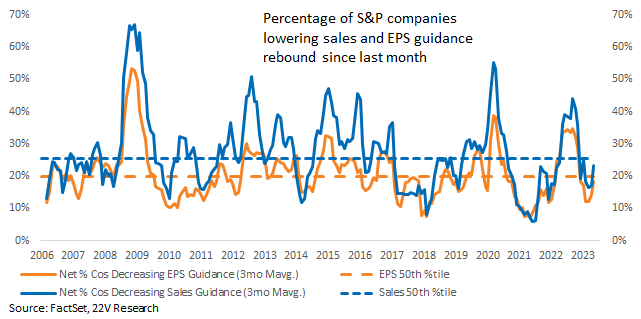
Once we get through CPI expect earnings to be the driver of the market and idiosyncratic to be the focus. After a SHARP decline in the past few quarters, the percentage of S&P companies lowering sales and EPS guidance has moved back up some. Expect much more differentiation in earnings vs broad-based beats or misses.
Full report below…
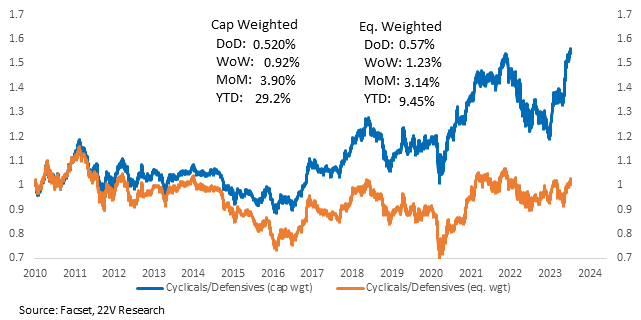
MARKET VIEWS: As we noted in our report discussing the 2H23 (HERE), two important factors have driven near-term recession risk lower; 1) The stabilization and a slight improvement in housing data suggest most of the impact from rate hikes (which affect the economy through financial conditions) are already in the economy. That means the lagged impacts of monetary policy are much less likely to drive the economy into recession in the near term. Housing data has been important. 2) Although consumer spending has cooled, the underlying trend (in real terms) now looks to be 2.5%. And given the improvement in the labor income proxy from last Friday’s payroll report, don’t expect that level of consumer spending to change. A bottoming in housing and unusually strong net worth effects (plus $34 trillion vs Jan 2020) will continue to support the economy. That is why Cyclicals have significantly outperformed Defensives…
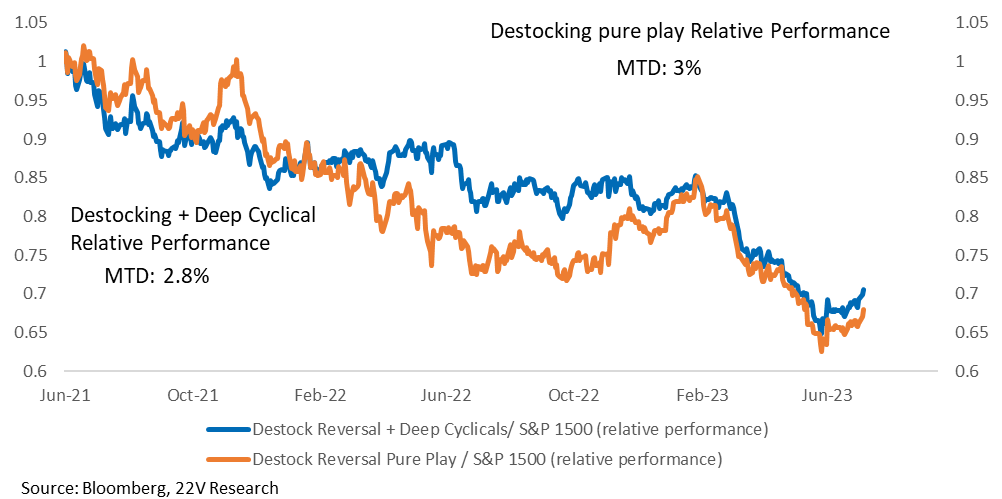
…and more recently, our basket of destocking losers and destocking losers + deep Cyclicals have outperformed over the last month and a half.
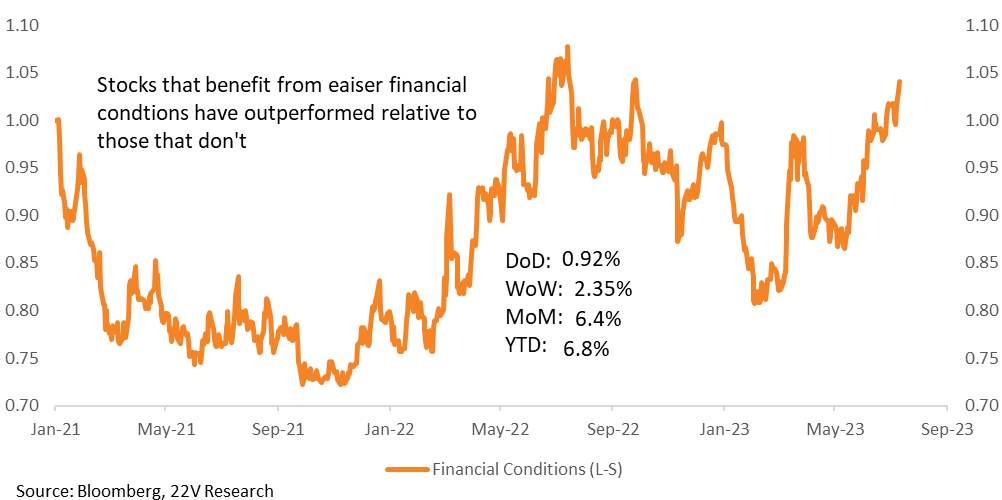
All the above suggests 5%ish Fed funds rates is not as restrictive for economic growth as feared. Higher debt to GDP ratio, lower household savings rates (thanks to a positive net worth shock of plus 34 trillion vs Jan 2020), and full employment suggest R*, or the equilibrium fed funds rate is higher. Stocks that benefit from easier financial conditions have significantly outperformed and the Fed funds rate is expected to remain above 5% until June of 2024, suggesting 5% Fed funds is not as IMMIDIATLY restrictive as feared.
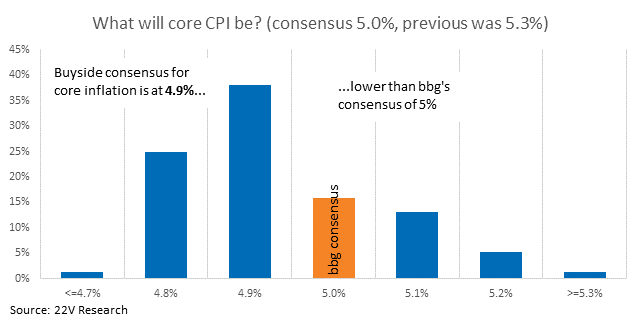
Inflation remaining at too high of a level would likely lead to the Fed tightening financial conditions. That is the main risk to the risk-on internal market rally. 54% of the investors we polled expect tomorrow’s CPI will be risk-on (HERE) and 65% of our survey respondents think core CPI will be lower than bbg consensus. Only 20% expect core CPI to be higher than consensus. Overall, expectations are heavily skewed toward a lighter number. Recessions odds decreasing with inflation expected to move lower has been a major support for risk assets. The risk is inflation not moving lower quickly enough. Unless today’s CPI is a shocker, that stubbornly high inflation risk is likely to be more of a 4Q issue.
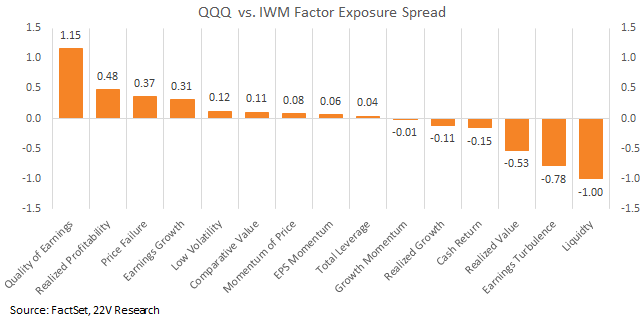
We like small caps relative to large right now. As the quant team noted (HERE), small caps have a more risk-on factor profile, particularly relative to the NASDAQ. If Financial conditions aren’t going to tighten and remain stable at current levels (that is our call), expect small caps recent outperformance to continue.
Once we get through CPI expect earnings to be the driver of the market and idiosyncratic to be the focus. We expect markets to be range bound with plenty of Volatility underneath the surface. After a SHARP decline in the last few quarters, the percentage of S&P companies lower sales and EPS guidance has moved back up some. They are both at the historic median. Expect much more differentiation in earnings vs broad based beats or misses.