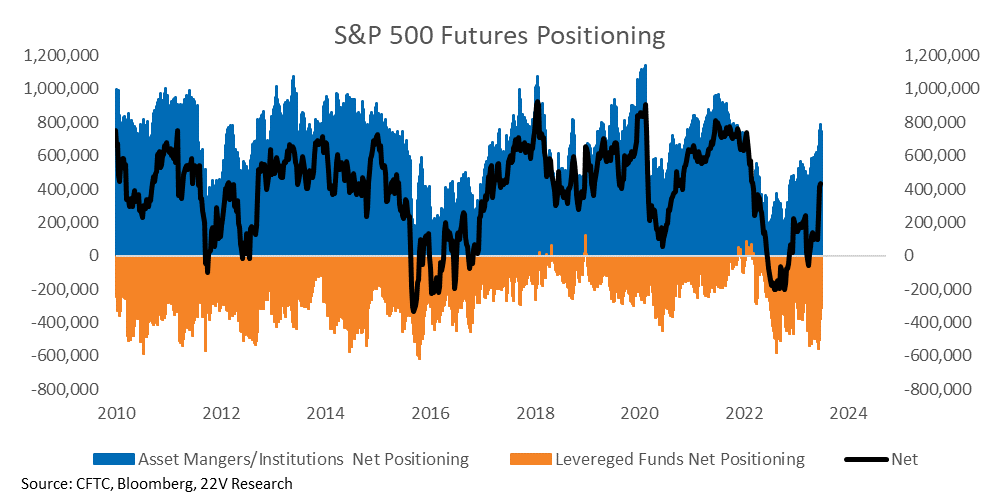
SUMMARY: The Fed minutes yesterday were credited for rate and currency moves (10yr +4bps, DXY +29bps), but the moves were small and there was no reaction in the futures market. As Gerard has been arguing this week (HERE), long and variable lags are not an important headwind to growth anymore. What seems to be being “priced” is a 5%+ fed funds rate for much longer while avoiding a recession (the yield curve steepens bond volatility doesn’t increase. Both have happened this week). That being noted, if payroll or CPI data are “too hot”, with wages readings being particularly important on Friday, the odds the Fed needs to increase rates more than what is currently price would increase. That would push bond vol higher with UST yields and financial conditions would tighten further, which would be risk-off.
MEAN REVERSION RISK: We think the current trend of risk-on, Cyclical leadership with a Deep Cyclical rebound will continue in 2H, but it is important to acknowledge that macro influence and volatility remain high, and the economy is still in “Transition” (more HERE). That is a risk to our call this month. Economic Transitions are prone to mean reversion. Consistent with that, a dummy portfolio that goes long the prior month’s worst performing industry groups and short the best has outperformed for two years, illustrating the danger in extrapolating economic narratives that drive market internals from month to month.

Last month, risk-on factors worked and if mean reversion holds, it favors being long Food & Tobacco, Utilities, Media, Telecom, Pharma, and Food & Staples. Short Autos, Cap Goods, Transportation, Materials, Consumer Durables, and Tech Hardware. The mean reversion backdrop worked very well yesterday.
We still like selling S&P calls vs being outright short the market, being long the average stock vs the mega caps, and Cyclicals over Defensives. That would change IF labor data is an outlier one way or the other. Extremely strong or extremely weak would be an issue for risk-on factors and sectors.
Full report below.
MARKET VIEWS: The Fed minutes yesterday were credited for rate and currency moves (10yr +4bps, DXY +29bps), but the moves were small and there was no reaction in fed funds futures. As Gerard has been arguing this week (HERE), long and variable lags are not an important headwind to growth. The Fed would have to signal a higher fed funds curve to tighten financial conditions again as markets are already pricing higher for longer. Data will dictate the path going forward, starting with Payrolls on Friday. There are headwinds building from global policy too – EU fiscal policy is set to become more restrictive (HERE) while China’s stimulus is likely only going to defend its 5% growth target (HERE). We don’t expect global headwinds to trigger new lows in the S&P, but it does highlight the limits to the current risk-on rally.
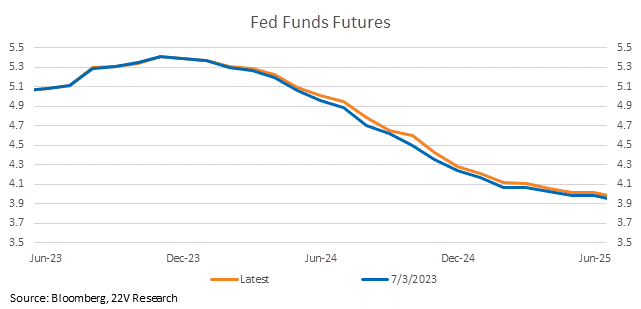
MEAN REVERSION RISK: We think the current trend of risk-on, Cyclical leadership with a Deep Cyclical rebound will continue, but we have to acknowledge macro influence and volatility are high, and the economy is in a Transitionary backdrop (more HERE). That is a risk to our call. Mean reversion has been a trend for two years now. The chart below is a dummy portfolio that goes long the prior month’s worst performing industry group and short the best. It’s not meant to be a real strategy, but rather an illustration that weakly held macro views should still be the motto.
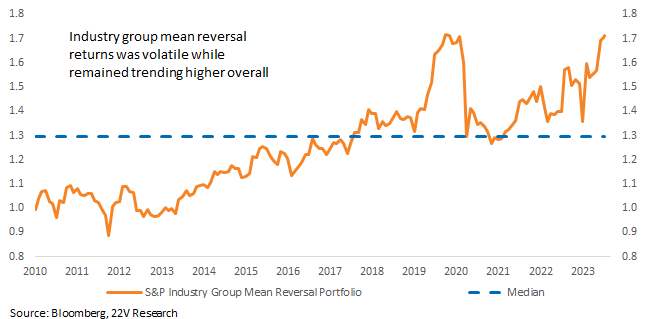
FYI this month, mean reversion would mean going long Food & Tobacco, Utilities, Media, Telecom, Pharma, and Food & Staples. Short Autos, Cap Goods, Transportation, Materials, Consumer Durables, and Tech Hardware. The trade has worked, at least through the first couple of days of July.
The risk heading into Friday is growing complacency as macro forces have stabilized over the past few months. We don’t have a reason to expect Friday’s labor data will be the start of another bout of macro volatility. The WEI, our favorite high-frequency estimate of trend demand growth, has been stable. But 1) the economy is still in Transition while 2) per our survey work, investors think labor data won’t start to falter until September or October (100k Payrolls is about what the labor market needs to stay stable).
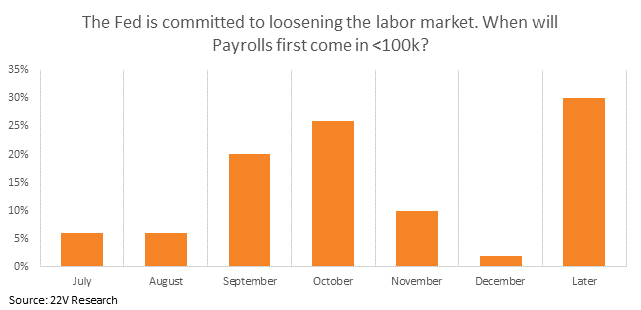
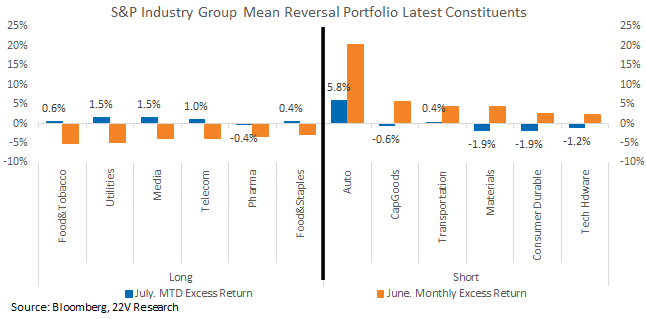
3) S&P net exposure, based on CFTC data from actively managed money, has jumped back to its median. Payrolls may prove to be a non-event, but we would not press themes here. Weakly held macro views is still our motto, and we are wary of more mean reversion. Market and macro narratives change quickly.