Back Portfolio Strategy

Macro Extrapolation Problem Remains, Preventing High Conviction Calls on Internal Trends

Published on July 5, 2023

∙ Download the PDF Report

By

Dennis DeBusschere

Brian Herlihy

Kevin Brocks

Sophia Wang

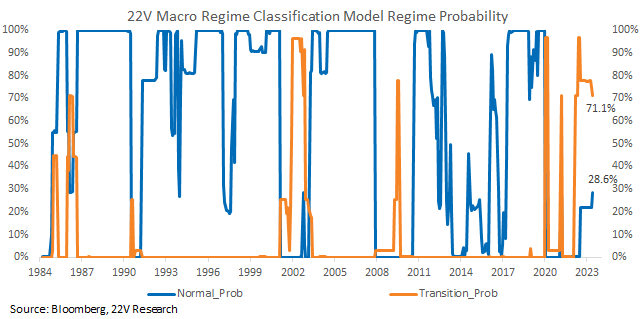
SUMMARY: For US risk assets, one question is if what is going on in the rest of the world – economic growth concerns in Europe and China – drag the US down with it (we will have more on this later, but we don’t think this will be the case). As covered in the quant report today (HERE) our Macro Regime model suggests the US economy remains in “Transition” (i.e. data is not giving a clear recession or normal economic signal), but the probability of moving into a “Normal” economic backdrop increased over the past month. That is in line with other macro growth indicators such as NY Fed Weekly Economic Index and the stabilization in PMIs.

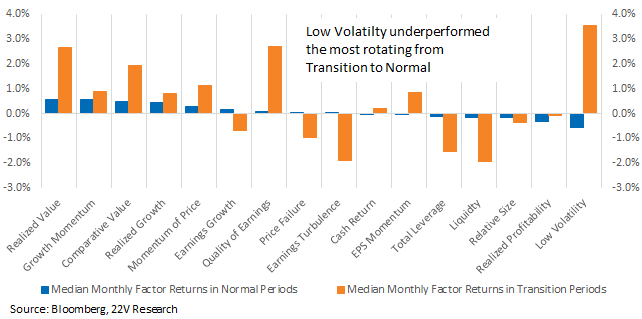
Value and Momentum factors have outperformed during Normal periods historically, while returns to Low Volatility diverged the most between Transition and Normal. That makes sense, uncertain “transition” periods should favor de-risking and the Low Volatility factor. Since mid-May, risk-on factors have outperformed and Low Vol has been one of the worst performers, consistent with higher odds of moving into a more normal backdrop.

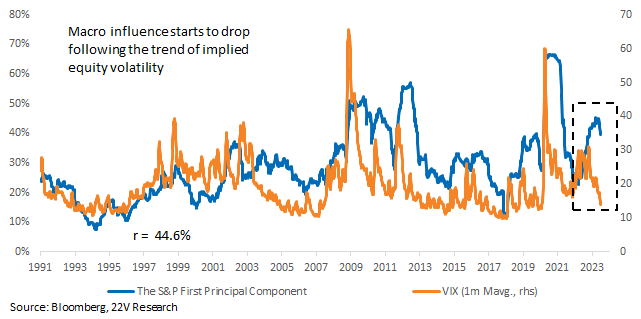
The above being noted, there is still an extrapolation problem, which has plagued markets for OVER A YEAR. First, there is still a historical divergence between how much the S&P is driven by “macro” (as seen in the first principal component) and the low level of the VIX. When macro influence is very high, typically the VIX is also higher. And vice versa. Our read of this divergence is as follows. The stability of macro forces over the past few months has allowed equity vol to decline, but market trends remain tied to those macro forces. Market vol (and internals) will remain tied to unpredictable shifts in macro data and transition periods tend to see unpredictable shifts in the data. Hence, we need to be careful with extrapolation of current trends. FYI: A continued decline in macro influence on the S&P (Blue line) would make us feel better about extrapolation.

Since we are still technically in a “transition” phase with high macro influence over the S&P, we don’t want to get too carried away with pricing in a normal economic backdrop. ​Our Tactical call of being long destocking losers, Earning Turbulence relative to Low Volatility, and a bias toward Deep Cyclicals, remain, but we are conscious of how quickly the economic ground can shift.

Full report below…

MARKET VIEWS: Global economic headwinds, as US growth prospects stabilize, has been the conversation the past few weeks. Data overnight reinforced that focus. The China Caixin Services PMI was much weaker than expected and the final European service PMI reading was weaker than expected (both still in expansion, but weaker). For US risk assets, the question is if the rest of the world drags the US down with it (we will have more on this later). Quantitively, our Macro Regime model suggests the US economy remains in “Transition” (data is not giving a clear recession or normal economic signal), but the probability of moving into a “Normal” backdrop increased during the last month. That is in line with other macro growth indicators such as NY Fed Weekly Economic Index and the stabilization in PMI readings.
Value and Momentum factors have outperformed during Normal periods historically, while the performance of Low Volatility diverged the most between Transition and Normal. That makes sense, uncertain “transition” periods should favor the Low Volatility Factor. Since mid-May, risk-on factors have outperformed and Low Vol has been one of the worst performing factors, which has been in line with the slight increase in odds of the economy moving towards a more normal backdrop.
Extrapolation Problem: There has been a divergence between macro influence and market vol and it has reached extreme levels. This can be seen by looking at the divergence between how much the S&P is driven by “macro” (as seen in the first principal component) and the low level of the VIX. When macro influence is very high, typically the VIX would be higher. And vice versa. Our read of this divergence is as follows. The stability of macro forces over the past few months has allowed equity vol to decline, but market trends remain tied to those macro forces. Market vol (and internals) will remain tied to unpredictable shifts in macro data and transition periods tend to have unpredictable shifts in the data. Hence, we need to be careful with extrapolation of current trends.
A graph of blue and orange lines

Description automatically generated

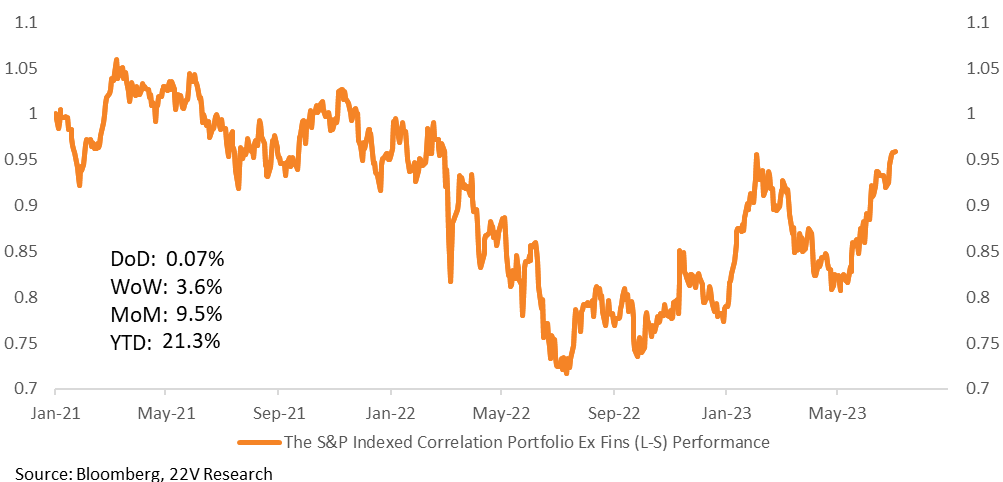
Since we are still technically in a “transition” phase with high macro influence over the S&P, we don’t want to get to carried away in pricing in a normal economic backdrop. ​Our Tactical call of being long destocking losers. Earning Turbulence relative to Low Volatility and a bias toward Deep Cyclicals, remains, but we are conscious of how quickly the economic ground can shift. Stocks that benefit from lower correlations have had a great run recently and we would expect that to continue in 2H23. Unless the economic backdrop deteriorates much quicker than we are expecting.
A line graph with orange lines

Description automatically generated

DISCLOSURES AND DISCLAIMERS

Analyst Certification

The analyst, 22V Research Group, primarily responsible for the preparation of this research report attests to the following: (1) that the views and opinions rendered in this research report reflect his or her personal views about the subject companies or issuers; and (2) that no part of the research analyst’s compensation was, is, or will be directly related to the specific recommendations or views in this research report.

Analyst Certifications and Independence of Research.

Each of the 22V Research analysts whose names appear on the front page of this report hereby certify that all the views expressed in this Report accurately reflect our personal views about any and all of the subject securities or issuers and that no part of our compensation was, is, or will be, directly or indirectly, related to the specific recommendations or views of in this Report.

22V Research (the “Company”) is an independent research provider. The Company is not a member of the FINRA or the SIPC and is not a registered broker dealer or investment adviser. 22V Research has no other regulated or unregulated business activities which conflict with its provision of independent research.

22V Research, LLC is a professional services and independent publication organization. 22V Research, LLC is not a securities broker-dealer, not a member of the Financial Industry Regulatory Authority (FINRA), not a registered investment advisor (RIA) and not a member of SIPC.

Securities transactions, when offered, are offered by 22V Securities, LLC through LPS Capital, LLC. Certain employees of 22V Securities, LLC are dually registered as securities representatives of LPS Capital, LLC or Analyst Hub Securities, LLC. 22V Securities, LPS Capital and Analyst Hub Securities are members FINRA, SIPC.

https://brokercheck.finra.org/

Current Ratings Definition.

SECTOR OUTPERFORM: An “outperform” rating anticipates the company will outperform the S&P Regional Banking Index (peer group).

SECTOR PERFORM: A “market perform” rating anticipates the company will perform in line with the S&P Regional Banking Index (peer group).

SECTOR UNDERPERFORM: An “underperform” rating anticipates the company will underperform the S&P Regional Banking Index (peer group).

Limitation Of Research And Information.

This Report has been prepared for distribution to only qualified institutional or professional clients of 22V Research Group. The contents of this Report represent the views, opinions, and analyses of its authors. The information contained herein does not constitute financial, legal, tax or any other advice. All third-party data presented herein were obtained from publicly available sources which are believed to be reliable; however, the Company makes no warranty, express or implied, concerning the accuracy or completeness of such information. In no event shall the Company be responsible or liable for the correctness of, or update to, any such material or for any damage or lost opportunities resulting from use of this data. Nothing contained in this Report or any distribution by the Company should be construed as any offer to sell, or any solicitation of an offer to buy, any security or investment. Any research or other material received should not be construed as individualized investment advice. Investment decisions should be made as part of an overall portfolio strategy and you should consult with a professional financial advisor, legal and tax advisor prior to making any investment decision. 22V Research Group shall not be liable for any direct or indirect, incidental or consequential loss or damage (including loss of profits, revenue or goodwill) arising from any investment decisions based on information or research obtained from 22V Research Group.

Reproduction And Distribution Strictly Prohibited.

No user of this Report may reproduce, modify, copy, distribute, sell, resell, transmit, transfer, license, assign or publish the Report itself or any information contained therein. Notwithstanding the foregoing, clients with access to working models are permitted to alter or modify the information contained therein, provided that it is solely for such client’s own use. This Report is not intended to be available or distributed for any purpose that would be deemed unlawful or otherwise prohibited by any local, state, national or international laws or regulations or would otherwise subject the Company to registration or regulation of any kind within such jurisdiction.

Copyrights, Trademarks, Intellectual Property.

22V Research Group, and any logos or marks included in this Report are proprietary materials. The use of such terms and logos and marks without the express written consent of 22V Research Group is strictly prohibited. The copyright in the pages or in the screens of the Report, and in the information and material therein, is proprietary material owned by 22V Research Group unless otherwise indicated. The unauthorized use of any material on this Report may violate numerous statutes, regulations and laws, including, but not limited to, copyright, trademark, trade secret or patent laws.
