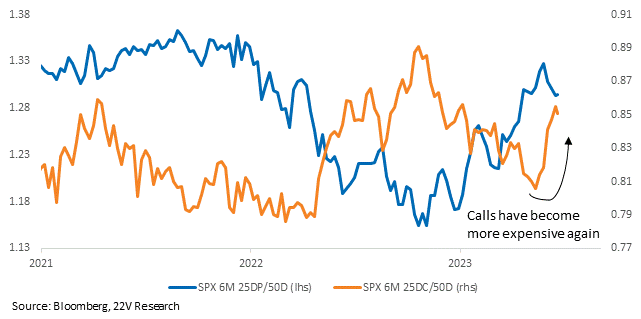
SUMMARY: UK inflation printed another hot number and bond yields outside the UK have not really moved. Oil prices are flat despite widespread press disappointment on China stimulus and calls for policymakers to do more. Neither the inflationary nor deflationary stories overnight are having much of an impact. At least for now. Yesterday was mixed internally. Energy and Tech underperformed, but Discretionary and Industrials outperformed. Correlations and recession odds are lower today, which favors risk-on factors and Cyclicals, and we continue to favor recent “destocking losers” (HERE). Micro themes remain more important than market direction. Market calls are unexciting to us and at these levels and now would be a good time to sell calls on the S&P. They have gotten more expensive (details below).
FYI: With commodity prices stable and at low YoY levels and inflation expectations collapsing on a 1-year forward basis, investors seem reluctant to push UST yields much higher from HERE. Expected Fed funds would need to be repriced significantly higher to push UST yields to new highs. However, we don’t see a near-term catalyst to push UST yields lower either. Expect bond vol to continue trending lower.
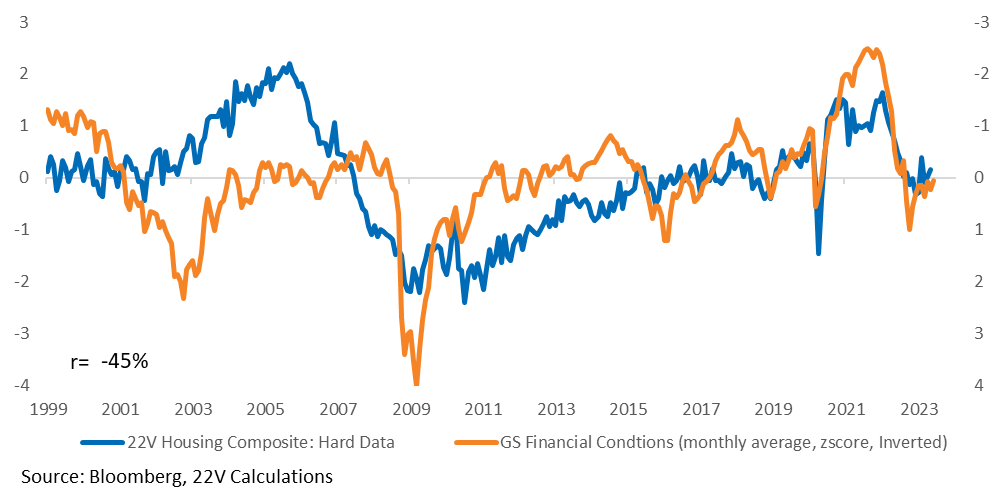
Housing data has been much stronger than expected and two important points need to be made, 1) As Gerard notes (HERE) it “was probably wrong to think of there still being major lagged effects on real output growth from the earlier Fed tightening…by far the most interest-sensitive sector of aggregate demand (housing) has already done its face plant and the majority of the real effects from the Fed are already in the economy.” Below are the financial conditions index and an aggregation of hard housing data points. FCI has stopped tightening and hard housing data points have stabilized.

2) There probably isn’t much upside from here related to housing, which means stronger housing data does not create a fresh problem for the Fed. The main takeaway is housing isn’t an economic growth headwind anymore. Unless financial conditions tighten more, expect the economy to be ok. The risk is still that inflation remains too high, causing the Fed to further tighten FCI.
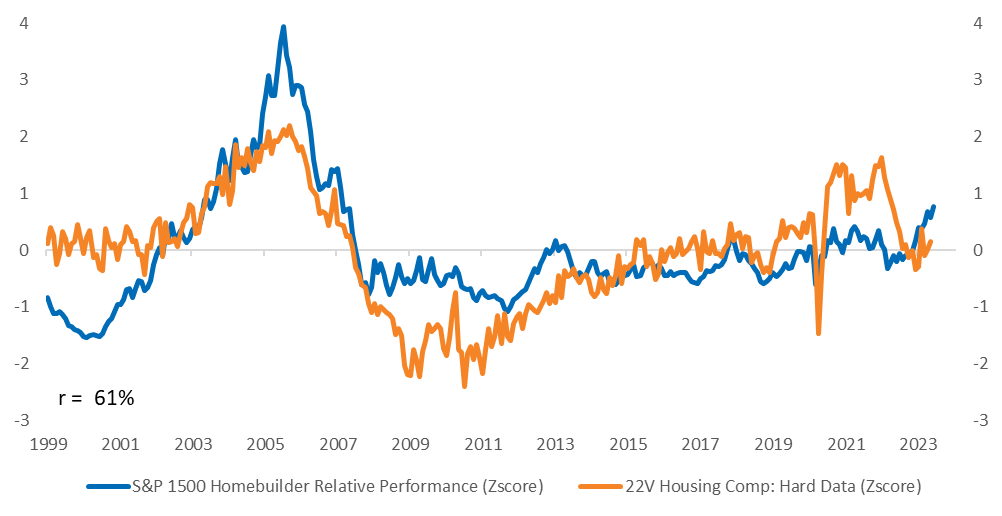
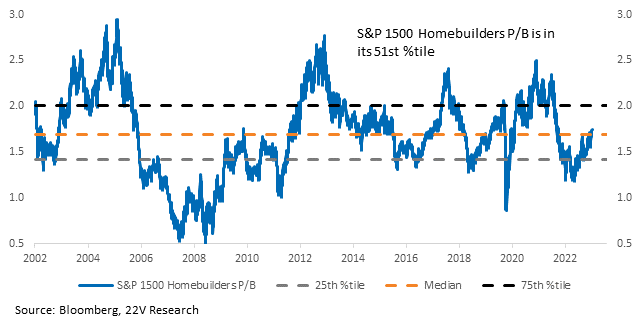
On housing stocks, Homebuilders have outperformed the S&P 1500 by +25% YTD as aggregated housing data has stabilized. But the Homebuilder Price to Book (P/B) ratio is right at its median. The valuation of homebuilders suggests they are not a great short. Even though the performance has outpaced the hard housing data.
Full report below…
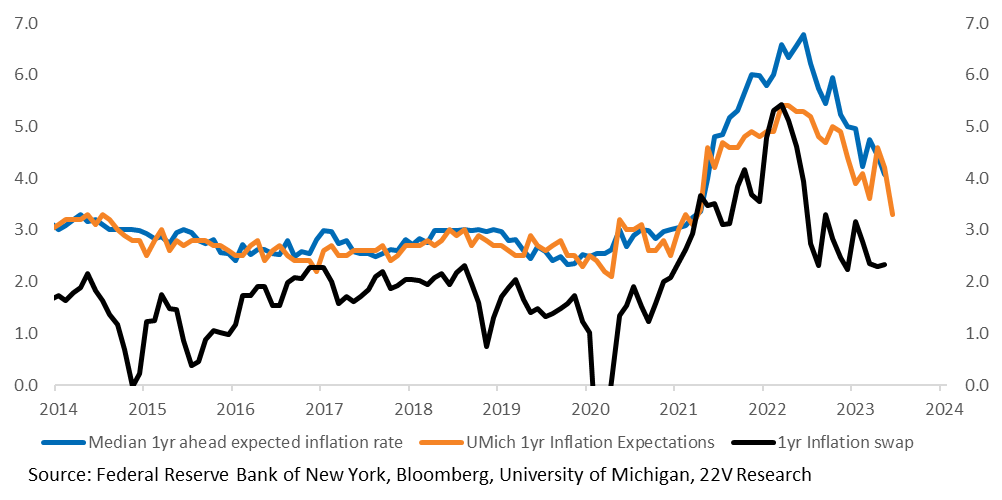
MARKET VIEWS: It is an unusually quiet overnight session. UK inflation came in hotter than expected, impacting UK yields, but not having a large impact on broader European or UST yields. There are plenty of articles on the disappointing China stimulus, and the need for the Chinese government to do more and lower China oil demand growth, but oil prices have been basically flat for a week. With commodity prices stable and at low YoY levels and inflation expectations collapsing on a 1-year forward basis (see all 3 measures below), investors seem reluctant to push UST yields much higher from HERE. Expected Fed funds would need to be repriced significantly higher to push UST yields to new highs.
Housing starts and building permit data were much better than expected yesterday. That follows a stronger NAHB reading on Monday. Two important points, 1) As Gerard notes it “was probably wrong to think of there still being major lagged effects on real output growth from the earlier Fed tightening. Abstract theoretical models might imply as much within the historical record. But a practical person could simply look out the window and recognize that – by far – the most interest-sensitive sector of aggregate demand had already done its face plant and that the majority of the real effects from the Fed were already in the economy.” Below is the financial conditions index and an aggregate index of hard housing data points. FCI has stopped tightening and hard housing data points have stabilized.
2) From here, the economic upside related to housing should be limited, and that means housing is NOT going to create a fresh problem for the Fed. The main takeaway is housing isn’t an economic growth headwind anymore. Unless financial conditions tighten more, expect the economy to be ok. The risk is still inflation remaining too high, causing the Fed to further tighten FCI. On the housing stocks, Homebuilders have outperformed the S&P 1500 by +25% YTD as aggregated housing data has stabilized. The chart of Homebuilders relative to housing data might worry some investors (returns have moved too far too fast being the concern)…
Source: Bloomberg, 22V Research
…but Homebuilder Price to Book (P/B) ratio is right at its median. The valuation of homebuilders suggests they are not a great short.
HEDGING WITH CALLS: A couple of weeks ago, we calculated ~4600 as fair value under a soft landing (methodology HERE). The market could clear 4600, but that level is reasonable even if the macro data breaks the right way (loosening labor markets, lower inflation, no signs of a growth collapse). Considering 1) The S&P has broken out of its 3800-4200 range and risen to 4400 and 2) as we noted in an options report last week (HERE), index calls have become more expensive relative to puts, now is a good time to sell calls to protect gains. Two weeks ago, selling calls would’ve netted a lot less.