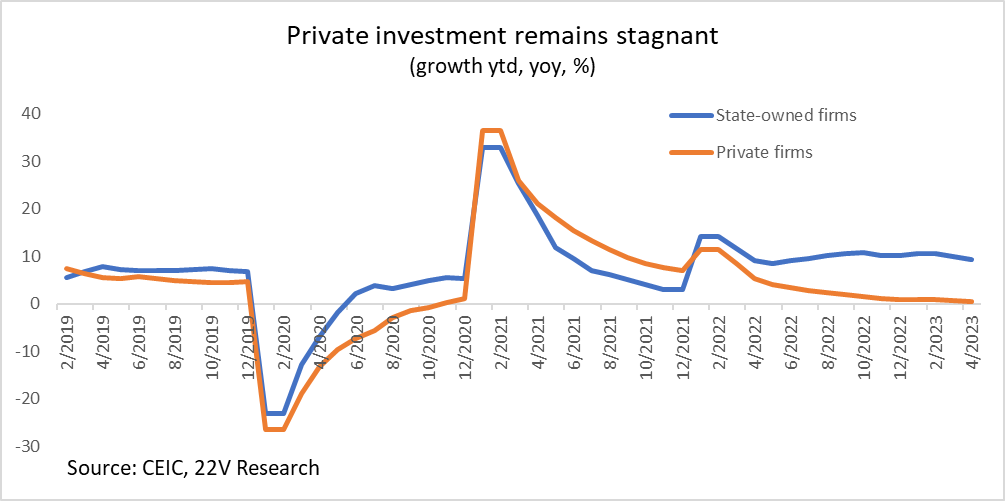
SUMMARY: China’s economic activity last month was worse than consensus forecasts and the comps were easy MoM. Michael Hirson, 22V China analyst, has been forecasting a weak demand story from China all year given the reliance on household spending, not stimulus, to drive growth. Per Michael, isolated strength in services means less positive spillovers from China to the rest of the world, particularly hard commodities. Industrial commodities (copper, iron) rolled over following the release. Private investment in China remains stagnant.
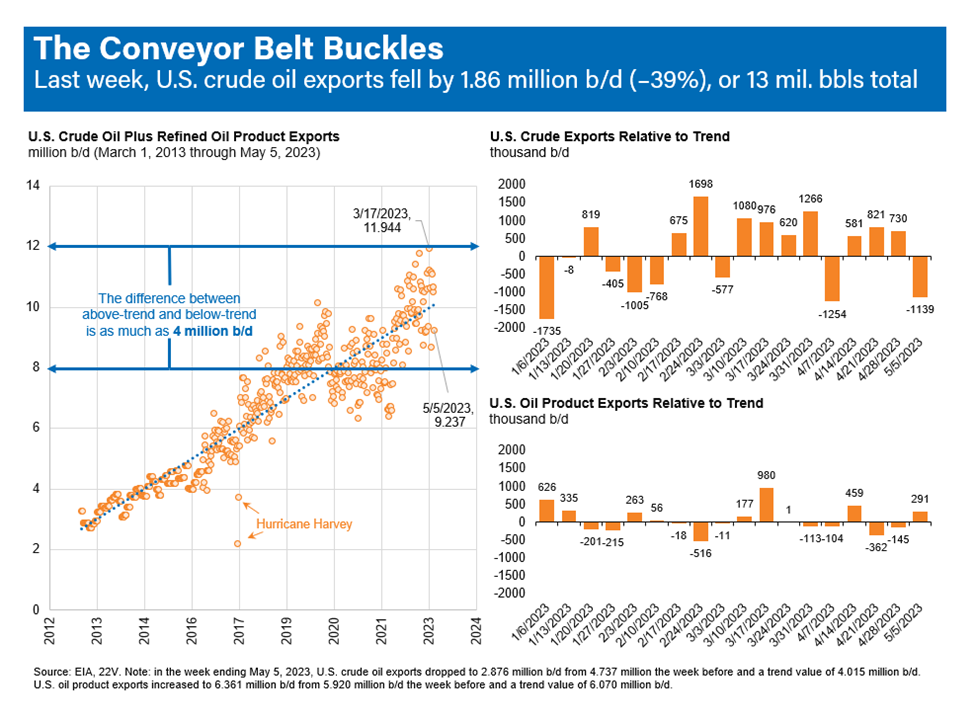
Oil prices have hung in better overnight. IEA boosted its oil demand estimate largely because of the post-pandemic rebound in China (HERE), a stance 22V does not agree with. China data aside, Colin Fenton, 22V commodities analyst, notes “The system’s presently booming rate of output is not prepared for a prolonged period of below-trend export demand. If a durable slump were to eventuate, spot crude oil prices worldwide would fall swiftly.” (HERE).
Commodity prices in general could have gone a long way in discounting bad China data and slowing US demand, but we don’t have a catalyst for an improved economic growth outlook that would support commodity prices. From a US perspective, that will come when the Fed is trying to support economic growth through easier monetary policy. Maybe the Fed becomes more supportive of economic growth in late 2023 or early 2024.
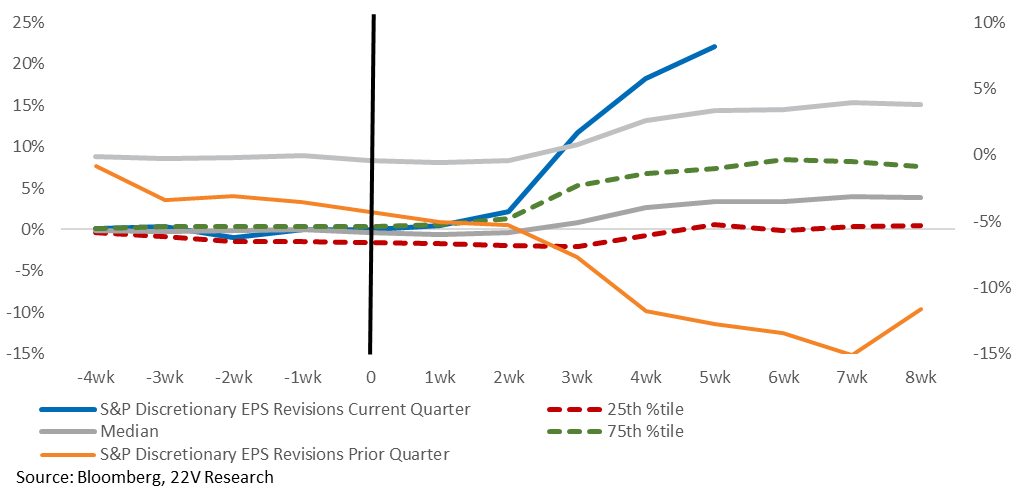
CONSUMER STOCKS: Broadly speaking, consumer stocks are winning on fundamentals. Estimate revision for Discretionary in 1Q are in their 93rd percentile. Staples have been exceptionally strong as well. Consumption is set to downshift and the labor market will loosen, making it more important to focus on fundamental trends within consumer groups. Importantly, the Discretionary sector is diverse. What happens in specialty retail as an example (which is weak) should not be extrapolated to the broader economy.
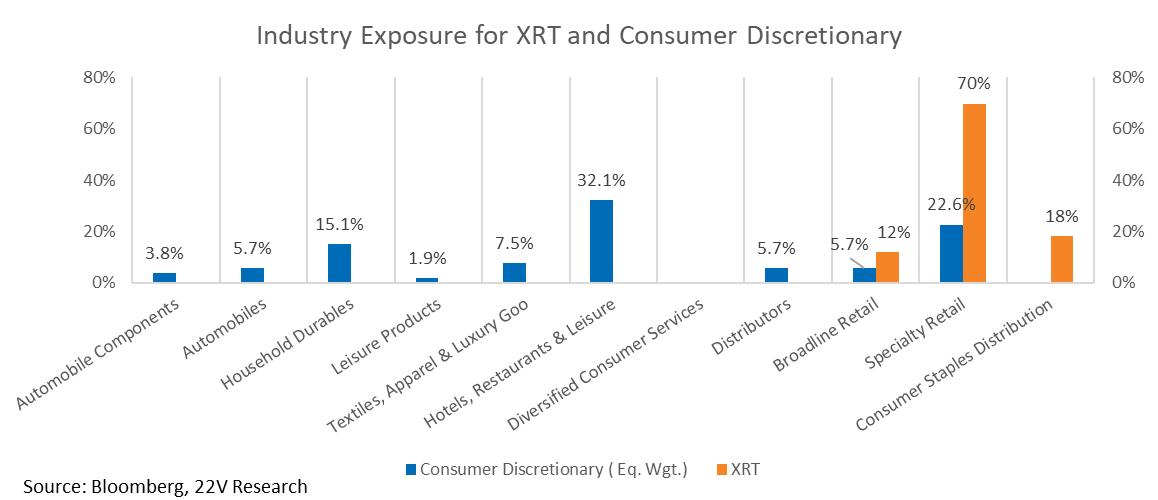
Retail Is Weak, But Don’t Extrapolate That To All Discretionary: XRT is struggling in part because it is almost entirely Specialty Retail (the biggest Industry in Discretionary is Retail). Discretionary (equally weighted for a better comparison with XRT), has more exposure to industries with better earnings sentiment. Consumer Discretionary is 1) different than XRT, and 2) in a better positioned. We are still long Discretionary but would be selective within Retail.
Earnings sentiment, measured with the Amenity natural language processing tool, suggest, Household products, Durables, Staples, and Auto earnings will remain ok, faring better than Consumer Services and Retail. Part of correlations breaking down are divergences WITHIN as well as between groups. Separating relative winners within consumer groups (Staples and Discretionary) is important and fits with our lower correlations call.

Full report below…
MARKET VIEWS: China’s economic activity last month was much worse than consensus forecasts. Michael Hirson, 22V China analyst, has been all over this. From Michael, “Services activity is strong, while industrial activity is suffering from a lack of end-demand given slowing exports, weak domestic investment, and modest household spending on goods. That pattern of growth means less positive spillovers from China to the rest of the world, particularly hard commodities, given services are less import- and commodity-intensive than industry.” Industrial commodities (copper, iron) rolled over following the release.
Oil prices have hung in better overnight. IEA boosted its oil demand estimate largely because of the post-pandemic rebound in China (HERE), a stance 22V does not agree with. China data aside, Colin Fenton, 22V commodities analyst, notes “The system’s presently booming rate of output (see chart below) is not prepared for a prolonged period of below-trend export demand. If a durable slump were to eventuate, spot crude oil prices worldwide would fall swiftly.” (HERE).
CONSUMER STOCKS: Broadly speaking, consumer stocks are winning on fundamentals. Estimate revision for Discretionary in 1Q are in their 93rd percentile. Staples have been exceptionally strong as well. As a general rule, in the current backdrop, we prefer companies that are closer to the consumer. Households remain strong because unemployment is low, wage growth is firm, and household net worth is still exceptionally high. All that helps insulate consumer facing companies from slowing growth. That will not last though, making it more important to focus on fundamental trends within consumer groups.
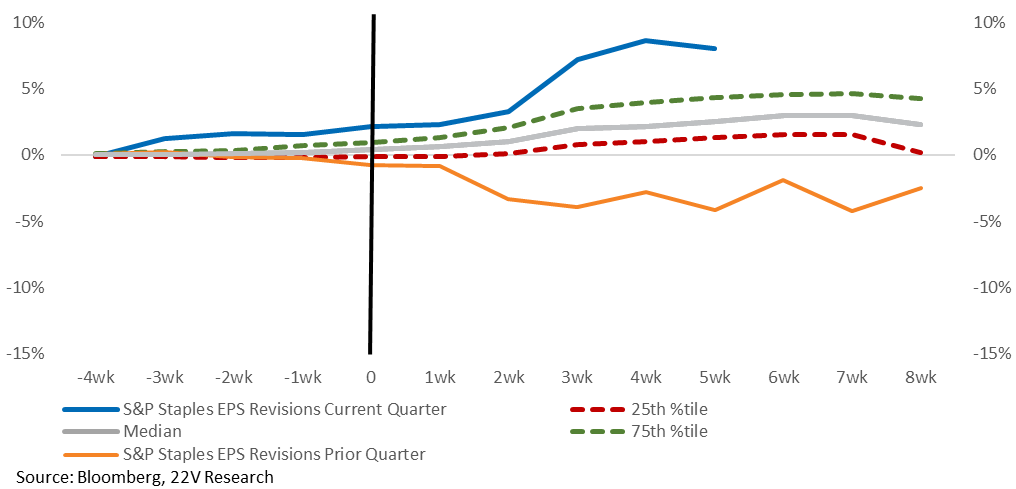
XRT RISKS: Last week, we discussed why we would be underweight Retail (XRT, HERE). In short, consumption is set to downshift and the labor market will loosen. Consumer concerns will likely continue to weigh on retail stocks (they have been relative losers over the past month).
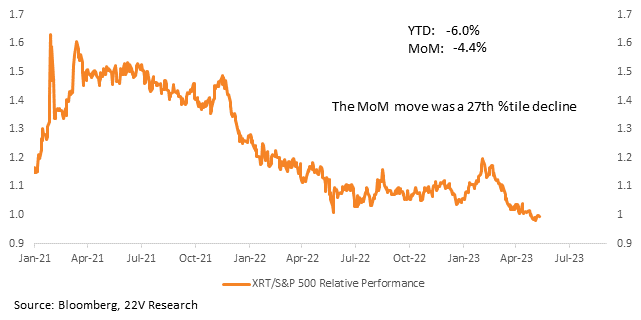
We are long Early Cyclicals (Discretionary, Comm Svcs, Tech) because those groups are better positioned to weather falling inflation falling than Deep Cyclicals (Industrials, Materials, Energy, HERE). To be clear, our call isn’t just long Tech, but we don’t like XRT here. The headwinds to Discretionary industry groups are not equal. Earnings sentiment, measured with the Amenity natural language processor, suggests Staples and Auto earnings will remain ok, faring better than Consumer Services and Retail. Part of correlations breaking down are divergences WITHIN as well as between groups. Separating relative winners within consumer groups (Staples and Discretionary) is important.
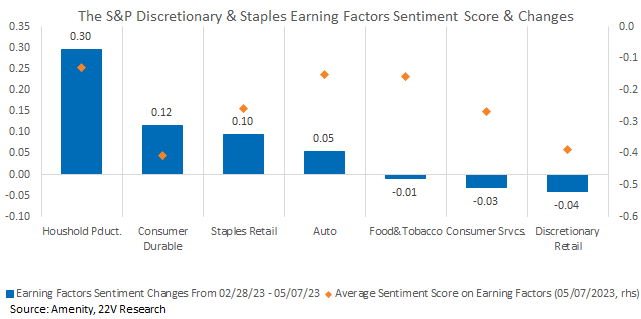
XRT is struggling in part because it is almost entirely Specialty Retail (the biggest Industry in Discretionary Retail). Discretionary (equally weighted for a better comparison with XRT), has more exposure to industries with better earnings sentiment. Consumer Discretionary is 1) different than XRT and 2) in a better position. We are still long Discretionary, but away from Discretionary Retail.