

SUMMARY
- Recent data suggest that China’s headline Q1 GDP growth, which will be released Monday evening at 10pm ET, could come in on the strong side of expectations. However, to the extent that the performance is driven by service sector activity and helped by a recent uptick in exports, it may present an overly flattering view of the strength of China’s recovery – particularly in terms of the benefits for global growth.
- We would suggest investors focus on indications that private sector demand is strengthening and broadening out beyond service sector activity. Recent signs here have also been trending positive, but the Q1 and March data will offer a better gauge.
On Monday at approximately 10pm ET, China will release its Q1 GDP report and activity data for March. Below are some top-line points on expectations for the report and how we’ll be reading it.
The latest flow of data suggests the headline number for Q1 GDP may come in on the positive side of analyst expectations (the median Bloomberg consensus is 3.4% y/y). This isn’t a forecast, just an observation that recent releases have trended positive. March exports surprised to the upside (+14.8% y/y), with a large trade balance; this will flatter GDP growth, though there are reasons to be cautious about how sustainable this trend will be. The composite PMI indices have been strong, led by services. Electricity consumption in March (released on Friday) was up 5.9% y/y compared to 3.6% y/y overall in Q1. The data haven’t all been strong – we noted that the PMI manufacturing surveys and inflation in March point to softness in private sector demand.
For global investors, the key watchpoints in today’s release should be indications as to whether private sector demand is strengthening and broadening out. Economic data in January and February showed a recovery in China powered by the lifting of Covid restrictions, but with broad-based private sector demand still subdued. Households have been spending on services previously suppressed under zero-Covid (such as travel and entertainment) but, outside of luxury spending by wealthy households, not yet spending on big ticket goods such as autos and appliances. Among firms, the service sector is doing well but manufacturing has lagged and private investment has been much weaker than state-led investment (please see: China’s recovery still has a “missing middle”, 15 March 2023). The fact that demand has thus far been slow to recover is not a surprise, of course. We have cautioned against expectations for major ‘revenge spending’ by households, noted headwinds for private sector investment, and flagged Beijing’s relatively restrained stimulus stance.
Evidence of a broader-based recovery in private sector demand will be important to investors for three main reasons:
- A recovery in demand for manufactured goods, not just services, would benefit global growth. A recovery in which only services are performing well would keep most demand within China, with some exceptions (e.g., demand for oil due to increased mobility).
- Private demand is important for avoiding a growth slowdown in China in H2 after the initial reopening rebound fades. Government stimulus has helped support the rebound, but Beijing is also focused on reining in financial risks, which limits the willingness to lean on infrastructure and other stimulus measures over the course of the year.
- A recovery in demand could also be an important catalyst for Chinese equities, which rocketed up after the initial reopening but have been largely range-bound since late January. Part of the reason is that the micro foundations of the recovery, key for corporate earnings, have been weaker than the headline macro data suggests.
With that backdrop, positive signs to watch for in today’s report would include:
- Strong growth in retail sales of goods (not just catering, the proxy for dining out)
- An acceleration in fixed asset investment by private firms, not just state-owned enterprises
- An acceleration in growth of industrial production and manufacturing activity, not just service sector activity
- Further signs of stabilization in property activity
- Evidence of further improvement in labor market conditions
While those watchpoints will be key to the assessment, some of the early data from March suggest that the recovery in private demand is gradually gaining strength:
- Trade data in March showed imports holding up better than expected at -1.4% y/y versus -10.2% in Jan/Feb. In volume terms, imports of crude and iron ore increased by 22.5% y/y and 14.8% y/y respectively.
- Household sentiment towards income and employment, while still below pre-pandemic levels, showed strong gains in Q1 (chart 1). This is important because the hit to household income growth and employment during the pandemic has been a key headwind for spending.
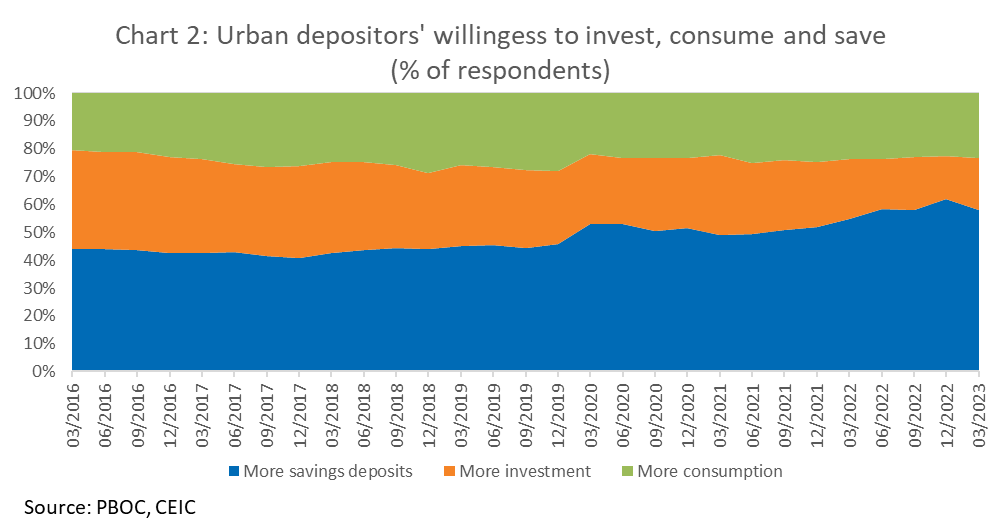
- Lending data showed early signs of a revival in household demand for credit in March, both for mortgages and short-term loans. The PBOC’s survey of urban depositors (chart 2) shows that the share of households expressing a desire for “more saving” edged down in Q1, while the share expressing a desire for “more investment” increased (the share expressing a desire for “more consumption” stayed flat).

Our overall view of China’s growth outlook for 2023 remains one in which services and consumption, rather than manufacturing and investment, lead the recovery. The spillovers to global growth will be smaller than in a cycle driven by accelerating investment. This year will be more about a gradual repair of China’s economy than one in which demand comes roaring back; firms, households and local governments all face balance sheet pressures that pose headwinds for demand and the strength of the recovery. Still, recent signs suggest that the ‘repair job’ is at least underway, and we’ll be looking closely at the March data for confirmation.
A final note on trade data: Some of the strong performance in March is likely due to pent up export orders that moved into production and shipping in March as workers returned from Covid absences and the lunar new year holiday. The clear bright spot was exports to ASEAN countries, up 35.4% y/y. “Emerging and development Asia” will have the strongest growth this year according to the IMF’s recent WEO projections, and China’s strong exports to the region reflect in part efforts to expand trade and extend supply chains such as through the recent RCEP trade deal. Exports to Russia more than doubled, which of course will only further raise eyebrows in Washington and European capitals. But it will be hard for China’s exports to emerging economies and Russia to offset weakening demand from advanced economies, particularly in H2. Simply put, exports won’t provide the lift to China’s economy in 2023 as they did in 2020-2022 – private sector demand will be key to powering the recovery.

