Activity data released on Wednesday provided a long-awaited view into China’s initial post-Covid rebound. That view still has some limitations: China’s statistical bureau combines January and February data to remove the distortion from the lunar year holiday. That mixes together the tail end of the Covid wave (January) with the first month of more normal life in February, somewhat clouding visibility into actual post-Covid momentum.
The data show the economy stabilizing and off to a decent start in 2023. But what also strikes me is the extent to which the rebound depends on two drivers:
- The recovery in services due to reopening. While retail sales grew 3.5% y/y in Jan-Feb, there was a stark divergence between very robust growth in catering services (9.2% y/y) and the slow growth in sales of goods (2.9% y/y). Our analysis has noted a clear case for pent-up demand in services due to lifting of Covid restrictions, whereas the willingness and ability of households to engage in “revenge spending” on big ticket items is more questionable until employment, income growth and confidence improve (see link to that report HERE). The same divergence is seen on the production side: the service sector production index was up 5.5% y/y, while industrial production grew only 2.4% y/y (below consensus expectations). A key implication of growth led by services rather than industry is that much of China’s demand is staying within the country rather than spilling out overseas, with some notable exceptions including oil (due to increased mobility) and tourism (particularly to Southeast Asia).
- Government-led investment. Fixed asset investment (FAI) beat consensus, growing 5.5% y/y in Jan-Feb vs. 5.1% y/y in 2022, but this largely reflects government-led investment. Infrastructure investment grew by 9% y/y (slightly slower than 9.4% in 2022), fueled by accelerated issuance of local government special bonds. Investment by state-owned companies grew by 10.5% y/y, while private investment was virtually flat (0.8% y/y). The risk with government-led investment is the problem of sustainability (and in the long run efficiency): Beijing set a conservative GDP growth target (“around 5%”) and disciplined stimulus targets at the National People’s Congress precisely to avoid a further run-up in debt by local governments and their affiliated enterprises (please see our NPC wrap-up report HERE). Given Beijing’s caution around stimulus, sustained investment growth this year will require private firms to pick up the baton in H2.
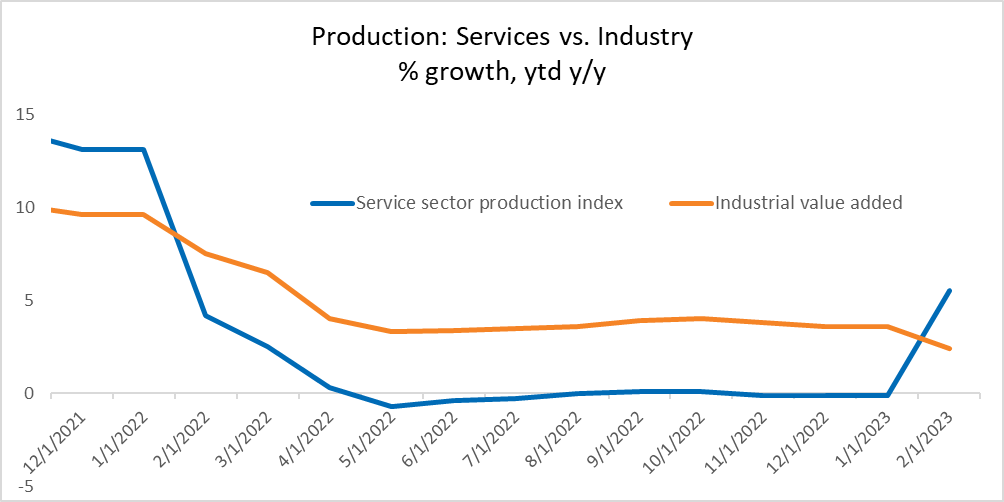
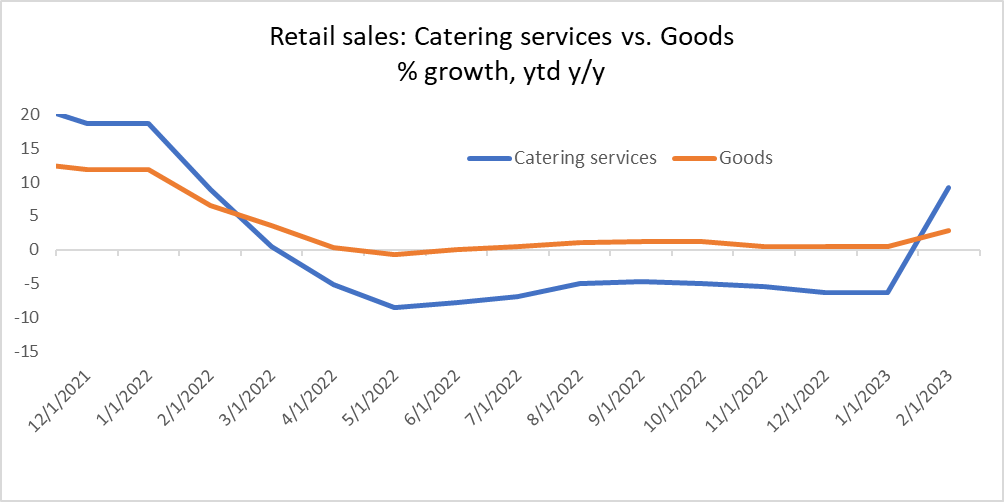

Between pent-up demand for services and government-led investment is an important “missing middle” of broader private sector activity, especially (1) private investment in manufacturing and real estate investment and (2) household spending on goods. Until those areas pick up, China’s rebound will be somewhat limited in strength and sustainability. This is particularly true in terms of driving demand from China for imports, which fell -10.2% y/y in Jan-Feb from 1% y/y growth in December.
Prospects for the “missing middle” to fill in soon are unclear:
- Private investment: Recent property data show significant signs of improvement, including housing starts (-8.7% y/y, vs -39.8% y/y for 2022) and residential floor space sold (-1% y/y vs. -31.5% y/y in December). But private developers will need to use sales proceeds to pay back maturing debt and complete stalled housing projects before they can invest in new projects at scale: real estate investment remains negative (-5.7% y/y vs. -10% y/y in 2022) and is unlikely to swing back into positive territory this year. Private manufacturing investment also faces headwinds given weak export growth.
- Household consumption: Growth in retail sales of goods is likely to improve due to base effects (China’s zero-Covid debacle started to bite in March of last year) and eventually a pickup in auto sales, which have been down due to cancellation of subsidies for new energy vehicles at the end of the year. But a strong recovery likely depends on sustained employment gains, given that direct government support for household incomes isn’t forthcoming.
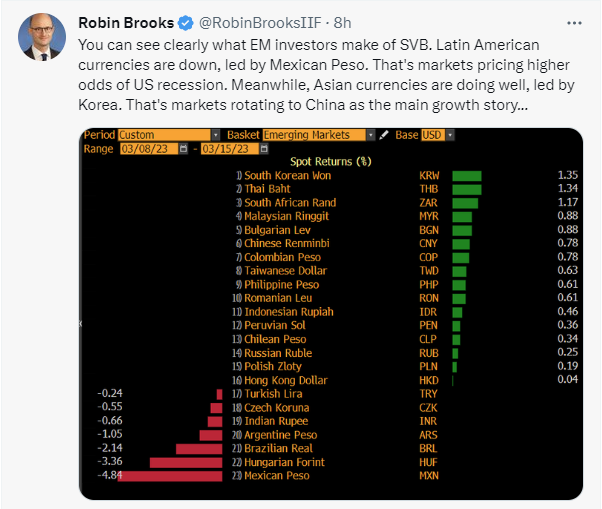
For this week at least, even a somewhat subdued recovery in China is looking attractive in relative terms given concerns over banking sector weakness in the US and Europe. Robin Brooks at the Institute of International Finance described how this is playing out in EM currencies in a tweet earlier today: