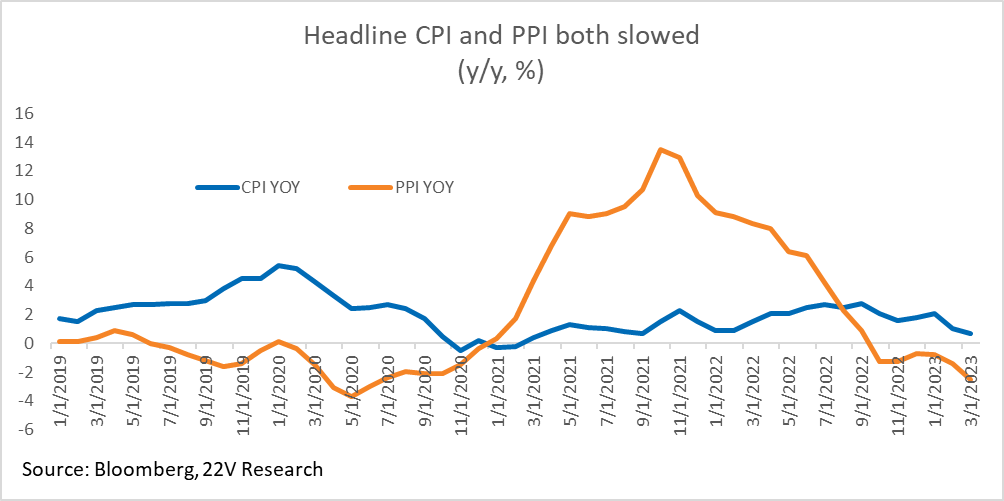
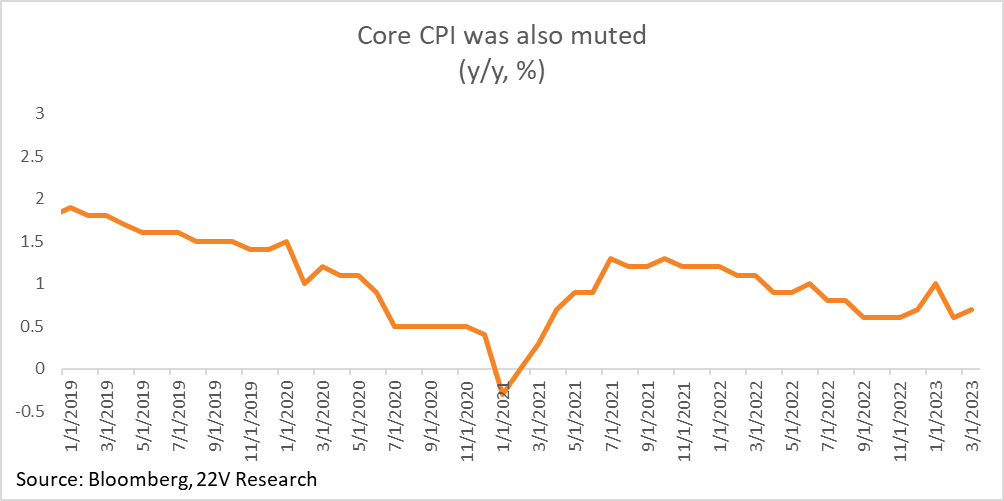
Data releases on Tuesday present a mixed picture of the outlook for China’s recovery. Credit data was very strong and beat expectations, including long-awaited signs of an initial recovery in mortgages. But inflation readings surprised to the downside, suggesting underlying demand is still somewhat weak.
What’s the takeaway? Policymakers are keen to support the recovery by keeping credit conditions loose. But the impact on real activity will be limited in strength and duration unless it is accompanied by a rebound in underlying demand – particularly by households.
It remains early to conclude that broader demand is on a solid footing, given:
- Weak underlying inflation, with core CPI edging up to 0.7% y/y, from 0.6% y/y in February.
- Broader signs that while consumers are readily partaking in services (such as travel and entertainment), spending on goods remains subdued. Autos, for example, are in a brutal price war, with the price of gas-powered cars falling -4.5% y/y. As we have been emphasizing, healthy consumer spending will take time to develop, requiring a recovery in the labor market and household income given lack of direct support for consumption from the government.
- Slowing exports, with new export orders in manufacturing slipping into contractionary territory in the March manufacturing PMI surveys (see our write-up HERE). China’s domestic demand needs to compensate for weak external demand this year, reversing the 2020-2022 trend in which strong export growth provided much-needed support during zero-Covid.
- Restrained fiscal stimulus, given Beijing’s renewed focus on local government debt risks. Local government revenues are strained by weak land sales, which will be slow to turn around given that property developers will need to use sales proceeds to pay back maturing debt and complete stalled projects.
Chinese media had previously reported that PBOC gave window guidance to banks to slow the pace of lending in March after a blowout January and February. That clearly wasn’t the case, but there are limits to Beijing’s willingness to lean on banks to lend given a focus on containing long-term financial risks; the private sector will have to take over the baton from stimulus in H2 for the recovery to sustain momentum.
In sum, the overall data are still consistent with a rebound this year that is gradual and driven more by services than accelerating industrial activity. It will be important to look at March activity data and Q1 GDP, which come out together on 17 April, for a broader gauge of the health of private sector demand.
From a global perspective, muted CPI and PPI data suggest that China will not be exporting inflation to the rest of the world anytime soon.
A few more details of note:
Credit data:
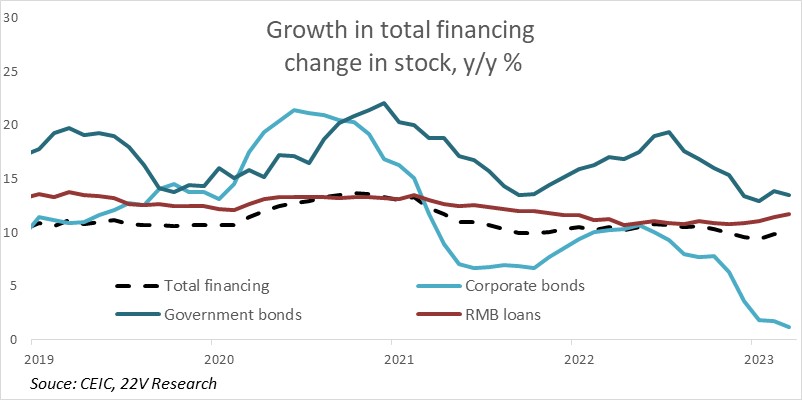
March is traditionally a strong month, with banks pushing out loans to meet their end-quarter quotas. But the scale of new loans (RMB 5.4 tn) was close to all-time monthly high and brings the three-month total to a record RMB 14.5 tn. Lending in March was strong both to corporates and households, with the latter particularly notable: new household loans were the strongest in two years.

Overall, bank lending was enough to offset a slowdown in government and corporate bond financing, with total social financing increasing by 10% y/y in March vs. 9.9% y/y in February.
Inflation:
The slowdown in the headline CPI in March, 0.7% y/y vs. 1% y/y in February, was due in part to slowing food prices and falling energy prices. But the core CPI reading – essentially flat at 0.7 y/y – also shows relatively muted demand. Falling commodity prices were also a factor in PPI, which slowed from -1.4% y/y in February to -2.5% y/y in March, the lowest reading since late 2020.