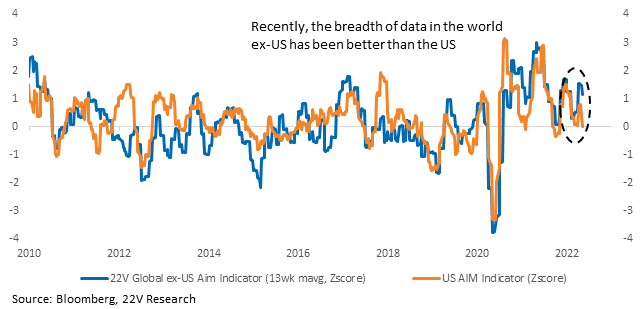
SUMMARY: With the breadth of US/Global data starting to roll over (FINALLY), the odds commodity prices keep increasing and 10yr yields keep moving higher are lower. Yesterday we talked about inflation risk premium helping push 10yr yields higher (inflation WAY above target and extreme bond volatility will do that). That being said, inflation expectations are biased lower as the breadth of economic data deteriorates, which COULD help stabilize markets near term. It would be negative for Deeper Cyclicals on a relative basis though.
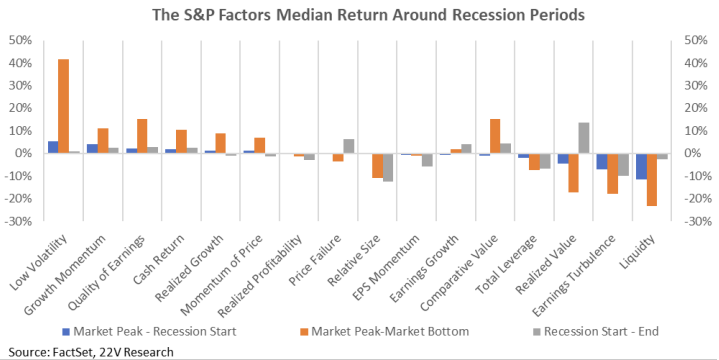
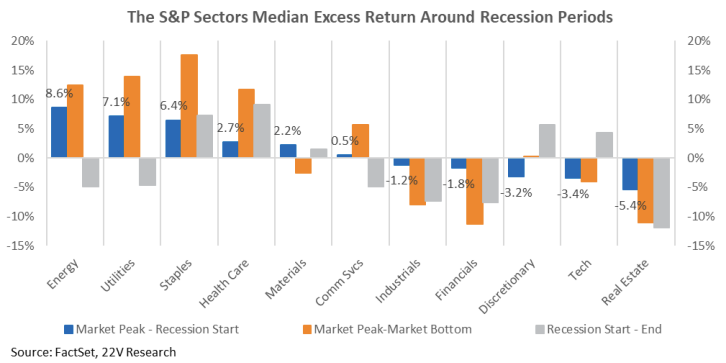
FYI on Internals: A few months back (full Quant report here), we looked at performance around recessions broken down into three periods: 1) market peaks to the official start of recessions, 2) market peaks to market bottoms, and 3) official recession starts to ends. Markets tend to peak before a recession officially start, and bottom well before the recession is declared over. For today’s backdrop, we would focus on periods 1 & 2. Historically, Energy and Defensives have led into recession starts, consistent with leadership so far this year. Defensive leadership reverses once the bottom in economic growth becomes clearer.
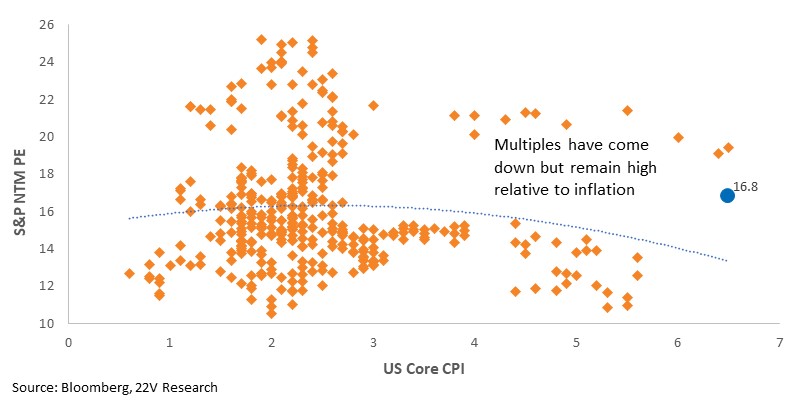
Inflation & PEs: Historically, inflation has a negative impact on PEs when core CPI is either too high (above ~3%) or too low (~1.5% or lower). The forward S&P PE is 16.8x today, a level consistent with a benign inflation backdrop. Investors we have surveyed (here) think the S&P PE should fall to ~16x, which would leave the market down about -5% from yesterday’s close, and a level consistent with inflation moving back toward the 3-4ish percent range. Bottom line, market valuations are about in-line (precision is not reasonable with this relationship) unless economic activity collapses and inflation looks like it is heading to a level much lower than 2%.
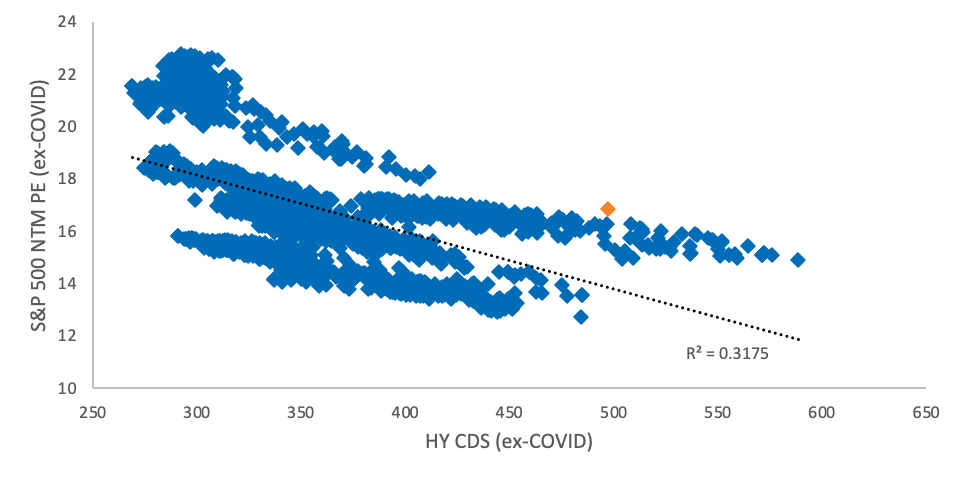
HY CDS Spreads & PEs: The market PE is roughly in line with the move wider in HY CDS spreads. Financial conditions have tightened aggressively and as noted above, the breadth of economic data is starting to slow. As economic growth slows, inflation will start to move lower and financial conditions will not need to tighten further, which would limit the downside pressure on PE from wider spreads. Yes, HY CDS spreads will move wider in a recession (default risk increases rapidly, which we have not witnessed yet) and we would not use any of the above as a timing tool. We are in the shoot first and ask questions later part of the market, but it was important to put some context around the changes in PE relative to inflation and HY spreads.
Full report below…
MARKET VIEWS: Global equities and rates are reversing some of yesterday’s moves, but there hasn’t been overnight news that has significantly changed the outlook. European recession risk is still a concern – the German ZEW improved slightly but is still deeply net negative. China slowdown risk is also still a concern – Chinese Vice Premier Sun Chunlan reiterated China’s commitment to dynamic zero-COVID while Shanghai restrictions have been tightened again. The breadth of US data is slowing as well. With global and US data starting to roll over, odds that commodity prices keep increasing and 10yr yields keep moving higher are reduced. Inflation expectations are biased lower as the breadth of data deteriorates, which COULD help stabilize markets near-term while being negative for Deeper Cyclicals on a relative basis.
Historically, inflation has a negative impact on PEs when core CPI is either too high (above ~3%) or too low (~1.5% or lower). The forward S&P PE is 16.8x today, a level consistent with a benign inflation backdrop. Investors we have surveyed think the forward PE should fall to ~16x, down about -5% from yesterday’s close, and a level consistent with inflation moving back toward the 3-4ish percent range. Bottom line, market valuations are about in-line (precision is not reasonable with this relationship) unless economic activity collapses and inflation plunges and is heading to a level much lower than 2%.

The market PE is roughly in line with the move wider in HY CDS spreads. Financial conditions have tightened aggressively and as noted above, the breadth of economic data is starting to slow. As economic growth slows, inflation will start to move lower and financial conditions will not need to tighten further, which would limit the downside pressure on PE from wider HY spreads. HY Spreads can still move wider near term (we are in a shoot first and ask questions later phase for markets), but it was important to point out the relationship.
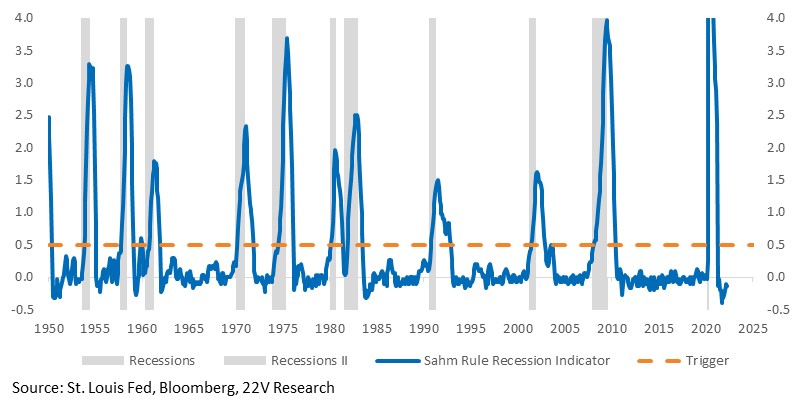
Recession Positioning: Based on multiple measures, near-term recession risk remains low. The employment-based Sahm indicator puts 6mo recession risk at 5%, consistent with rates/curve-based models from the New York and Cleveland Fed, and the St. Louis Fed composite. Economic data is declining, which is NEEDED to slow inflation, but the absolute level of economic data does not indicate an imminent recession. The latest update from the San Francisco Fed this past Monday puts recession risk at 4%.
BUT investors are preparing for a recession, so thinking about how markets rotate around recessionary periods is important. We looked at performance around recessions broke down into three periods: 1) market peaks to the official start of recessions, 2) market peaks to market bottoms, and 3) official recession starts to ends. Markets tend to peak before a recession officially starts and bottom well before the recession is declared over. For today’s backdrop we would focus on periods 1 & 2. Historically, Energy and Defensives have led into the start of a recession, consistent with leadership so far this year.
As noted in previous Quant reports (here), factors returns have been extremely volatile this year, but the outperformance of Low Volatility, Growth Momentum, and Quality have also been consistent with peak to recession and market-peak to market bottom periods. Expect more rotations throughout the year, but quality/growth mo leadership until the bottom in growth is clearer.