Bottom Line: Our Call
The Fed and/or 10yr yields will keep pushing rates to a place that accomplishes the goal of slowing economic growth and inflation. Our call is 10yr yields around current levels WILL deliver a mild slowdown. The RISK is the current level of 10yr yields doesn’t slow economic growth enough to respect the economic speed limit (~2% real GDP growth).
Relevant News: Risk if Growth More Resilient
IF growth proves more resilient than we expect, 10yr yields will move higher as the Fed shifts to “doing what it takes” to lower inflation, accepting the higher recession probabilities that come with that stance. We don’t think this is the modal path, but the risk is emerging. A lower unemployment rate (below 4%) with still well above 2% Real GDP growth and above 3% core PCE inflation would increase those odds.
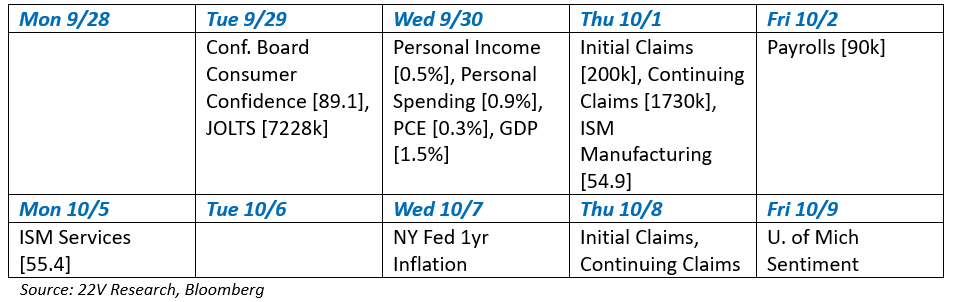
Things to Watch [Consensus, Results]:
Strategy:
Options Strategies to Risk Manage Higher Treasury Yields – (HERE)
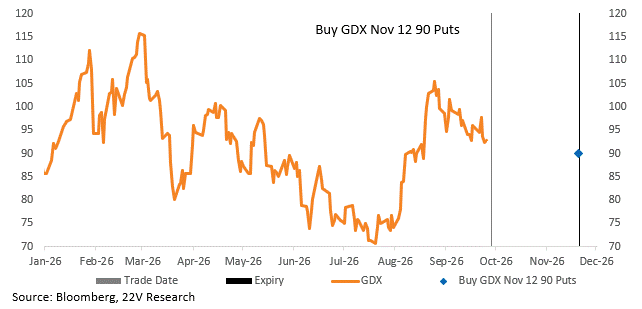
One of our preferred methods for positioning for lower probability outcomes is through options where the vol setup is favorable. Jeff Jacobson, 22V Derivatives specialist, thinks that the options on the S&P 500 or NASDQ are not the best vehicle to hedge against higher rates because of Tech’s resilience to higher rates and large index weight. We agree given AI activity will NOT be the source of weakness. Financials (XLF) puts have worked well, but now Jeff thinks the risk reward in the options has deteriorated. The vol setup is better for short EFA (Europe) and short GDX (Gold), both of which come under pressure from a stronger Dollar (a likely outcome from higher US yields).
Data Infrastructure / Commodities:
AI Infrastructure and Commodities Monitor – (HERE)
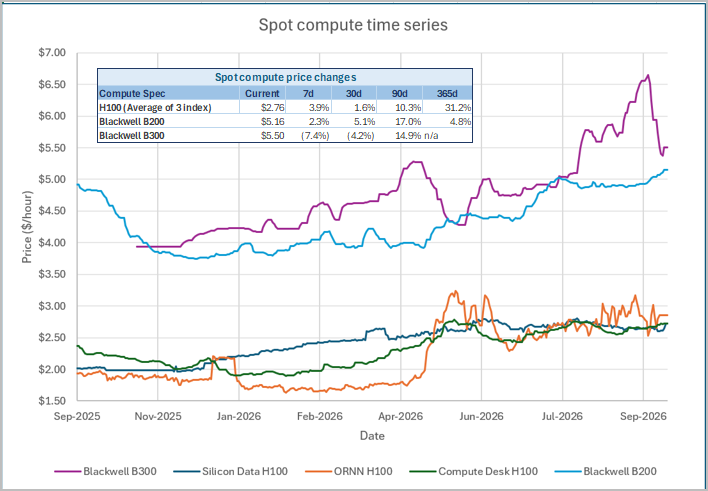
Meta’s viral Muse launch provided an early example of how consumer agentic AI can quickly translate into greater compute demand, while Anthropic’s expected IPO should bring increased disclosure and greater clarity around frontier lab economics. At the same time, catalysts are building across the Space Economy, with SpaceX’s Flight 14 and Google’s upcoming orbital TPU test highlighting growing interest in orbital data centers as launch and terrestrial infrastructure cost curves converge. Powered shell pricing also remains strong, with CIFR’s revised Barber Lake contract setting what appears to be a new high, while Maryland and Virginia are providing early examples of regulators favoring clearer development processes over outright data center moratoriums. Compute fundamentals remain supportive as B200 and B300 spot prices continue to rise, and improving revenue-per-MW economics suggest potential upside to longer-term neocloud estimates as AI demand continues to outpace the buildout of new capacity.