

Important news this week and thoughts:
Consumer AI / Muse and Agents: Meta’s release and the viral nature of Muse show how agentic AI combined with the consumer desire to utilize AI can come together and provide a positive demand signal very quickly. This is a positive demand pull for infrastructure demand (GPU’s and CPU’s in this case). As a user of Muse for a week now, I can confidently say it has some strong capabilities that will continue getting my attention, and for general consumers, it will shift the process and way in which we interact with the internet. This is the first inning here of consumer agentic products and services and we should expect OpenAI, Google and possibly Anthropic to follow on the consumer side. Business models will change and disruption from AI will continue. This is not calling winners and losers, but Booking.com (BKNG), Expedia (EXPE) and Airbnb (ABNB) all will be re-evaluated for how they are positioned within just a travel booking sleeve.
Anthropic’s IPO: Expecting an S-1 mid-October and an IPO post-midterms in the first half of November. The AI safety and regulatory noise has continued but appears to have died down to some level. The focus can now be on factors we have been highlighting in the past, and we continue to believe this is a positive event for the AI trade: increased disclosure, confidence around revenue growth and a clearer understanding around the frontier lab business model.
Space Economy: Catalysts for space are on the horizon. This week (Monday AM), we are expecting to see SPCX launch Flight 14, which will break new ground for Starship 13. Notably, this will be the first orbital test of this larger payload vehicle. Additionally, Google has moved up their orbital data center early test of TPUs with Planet Labs (PL). October 1st will see their Falcon 9-launched test of a very small TPU in space. Google is notably behind SPCX in terms of planning a full ODC test, but this demonstrates two larger players moving forward on ODC initiatives. The higher terrestrial cost vs. potential for lower launch costs to space is creating a convergence of the cost curves and increasing the discourse around ODCs.
Powered shell pricing trends: On Friday, CIFR announced a revised Barber Lake contract after the initial Fluidstack 10-year agreement. While this new tenant supplants the prior lease extensions, this was a price increase on a $/MW/yr basis of 30% and sets what appears to be a new high for powered shells.

Source: Company filings; 22V Research
Regulatory and Midterms: Midterms are heating up, and at the same time we have seen some important states move in directions that indicate some clarity on what lies beyond the midterms.
On Friday, Maryland’s Governor Moore opted for a state task force to create a process for data center developers and did not move for a moratorium. In the past week, Virginia’s governor created EO22, which set out five pillars for data center developers that include community engagement, NDA bans, excluding state incentives and other focuses around generation types, noise and water use.
These are some emerging examples favoring process over moratoriums.
Planned IPOs: There has been a series of filings and announcements for data center developers/operators to come public between now and year end. These could have valuation implications for powered shells and infrastructure names. Names include Nscale, Firmus and SB Energy. Crusoe recently completed a round in anticipation of a future IPO as well.
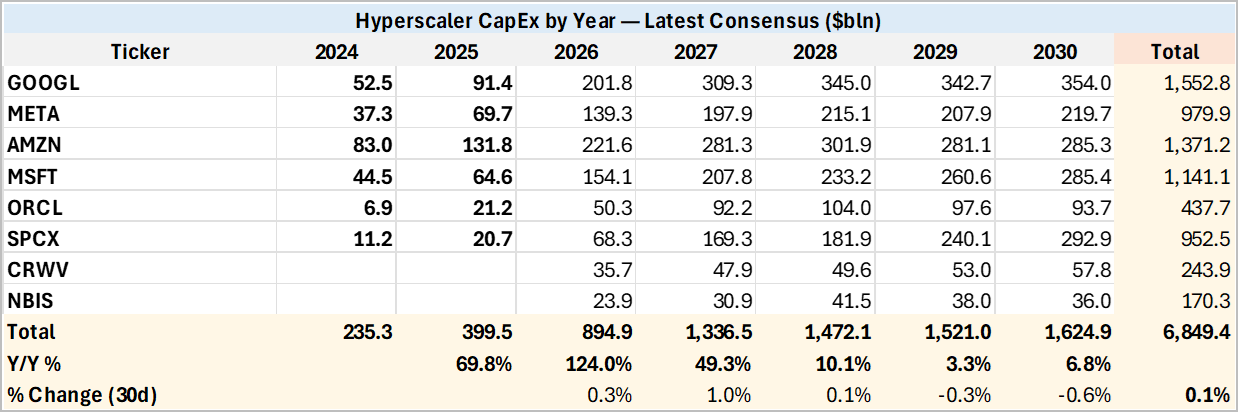
Hyperscaler Capex: No surprises here, but very limited consensus changes or updates as we head into Q3 earnings season.
Source: Bloomberg; 22V Research
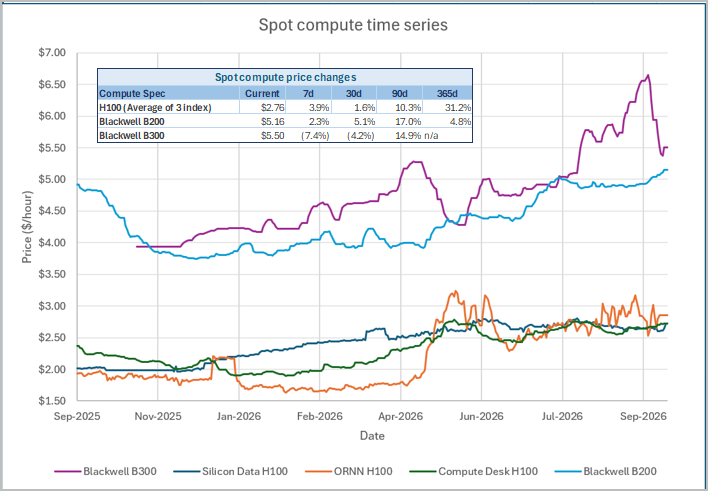
Compute spot prices: As we await compute futures (expected later this year), please see the updated spot indexes. B200 and B300 are continuing to press higher per the Compute Desk rates. B200 and B300 are now in closer parity.
Source: Bloomberg; 22V Research
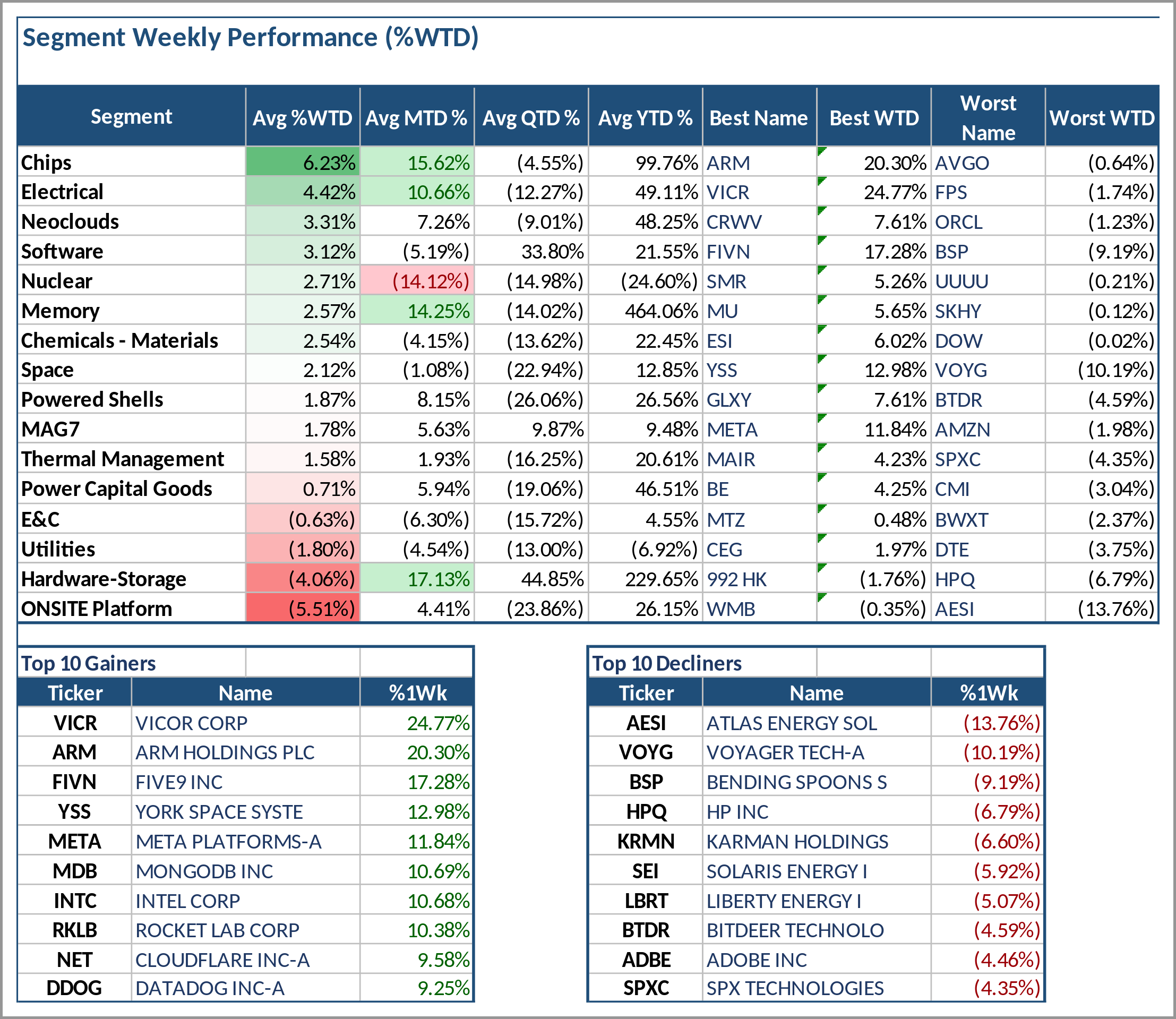
Weekly Performance
Source: Bloomberg; 22V Research
Notable points on performance:
- Hardware and chips performance was driven by Meta’s viral uptake of Muse plus Google announcing an AI-adjacent laptop.
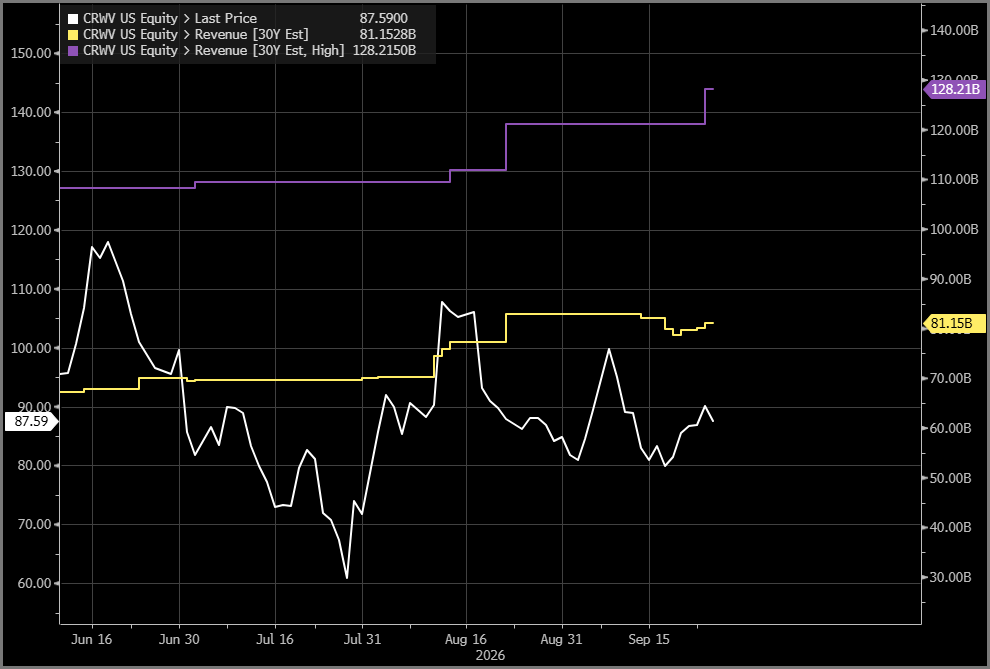
- Neoclouds started to perform better this week. AI fundamentals and slower build out of data centers are posing a long term supply vs demand imbalance in favor of compute pricing. While there continue to be rate concerns, we did see analysts start to recognize the need for higher revenue per MW realizations for neoclouds. CRWV 2030 consensus versus high consensus revenue estimates imply a gap for revenue realization per MW of $10–12M/MW/year on the low end and ~$14M/MW/year on the high end. One example of upside potential is that the market is now north of $25–30M/MW/year (and even $16M/MW/year for long-term base deals such as Anthropic’s); therefore, given their open future capacity, these estimates likely trend higher.
Source: Bloomberg
Week ahead:
- 22V hosting: Silicon Data webinar with Steve Hou, Head of Research — Monday 9/28, 11:00 AM ET. Compute supply and demand, the status of compute futures, and token pricing across open and closed models. Register HERE.
- MU earnings (Wed AMC).
Recent Research:
OpenAI: Bigger Targets, Bigger Burn — Margin Expectations are the Story, 9/21/26 — OpenAI raised its 2030 revenue target but raised capex and cumulative burn by more, which implies gross margins have to climb from the 40% range to north of 70% to fund the plan.
The AI Trade: Finding the Coiled Springs, 9/18/26 — Across 81 AI capex names, NTM EV/EBITDA has compressed 26% from this year’s peaks while FY2 EBITDA estimates rose 12.3%, with chips, memory and select neoclouds screening as the most coiled.
Compute Futures — Updates on the Emerging Market and Timing, 9/15/26 — We expect one or two cash-settled Nvidia compute contracts by year-end, with ICE and Nodal likely to self-certify ahead of the CME, whose CFTC comment window closes 10/20.

