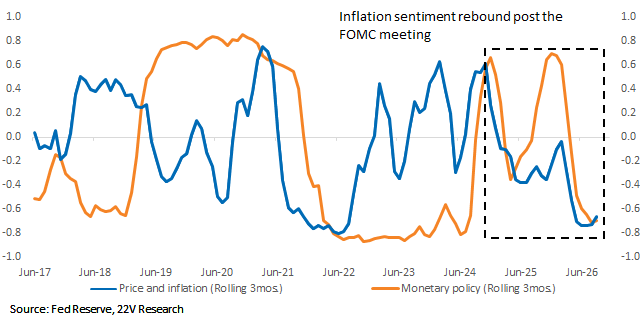
The Fed raised rates by 25 basis points, affirming the extremely negative monetary policy sentiment reading picked up in our Fed Sentiment Model (FRSS, HERE). Both monetary and inflation sentiment have improved marginally since the meeting. During previous rate hiking cycles, inflation sentiment bottomed roughly three months after the first hike, suggesting continues recovery over the coming quarters as inflation eases.
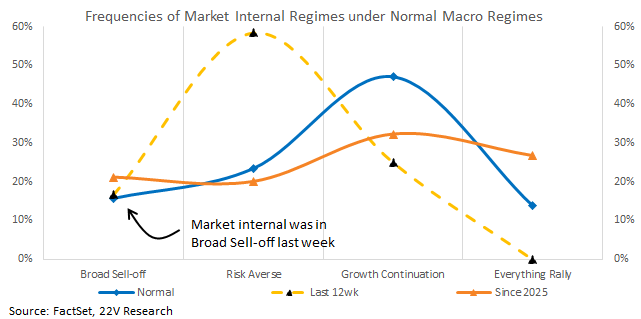
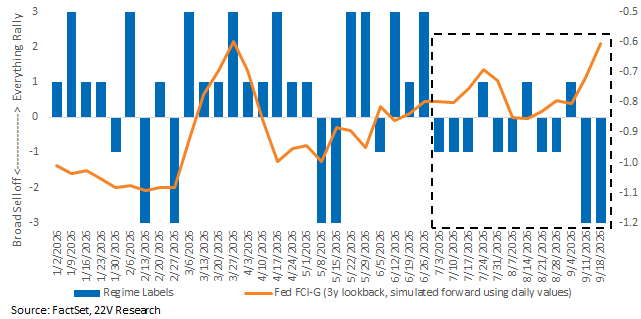
Warsh’s view that financial conditions were not restrictive contributed to a clear post-meeting tightening, pushing conditions near the upper end of this year’s range. The Market Internal Regime Classification model shifted from Risk Averse to Broad Selloff as financial conditions tightened further.
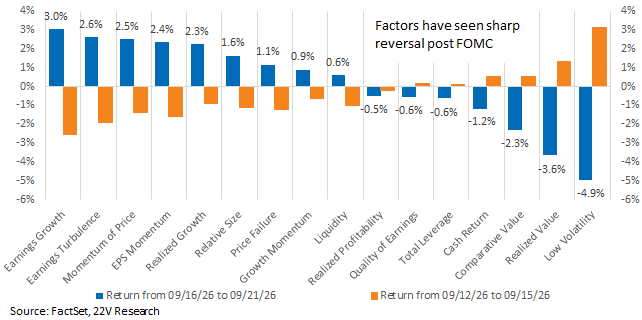
Beneath the surface, however, factor leadership reversed sharply after the FOMC meeting and became notably more risk-on. Momentum, Growth, and Risk-on factors rebounded sharply, while Risk-off and Value weakened. Investors favored Early Cyclicals—particularly Technology—over Deep Cyclicals, consistent with historical behavior after an initial rate hike (HERE).
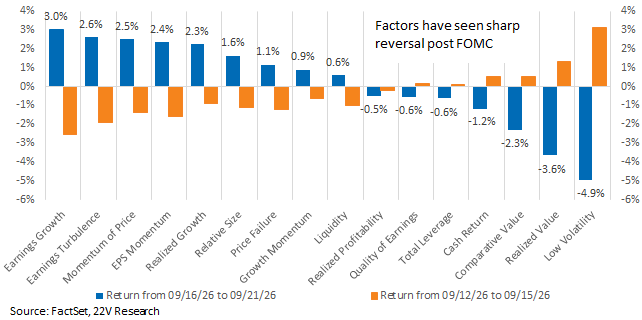
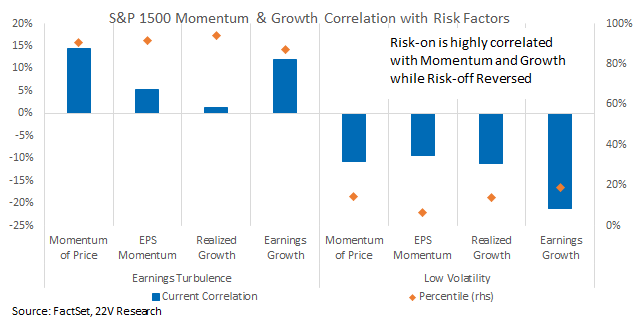
One important divergence is that Earnings Turbulence outperformed Low Volatility despite tighter financial conditions, contrary to historical relationships. This likely reflects changing factor correlations driven in part by AI names. Momentum and Growth overlap strongly with Earnings Turbulence/Risk-on factors, while their correlation with Low Volatility/Risk-off factors have collapsed. As a result, outperformance of Momentum and Growth favors Earnings Turbulence more than usual.
Looking ahead, declining implied volatility, easing geopolitical risks, and a previously extreme Risk-off tilt could support a shift toward Growth Continuation regime, continuing to favor Momentum, Growth, and Risk-on exposures.
Risk-on Factor Reversal Following the FOMC: The Fed hiked rates 25bps at the last FOMC meeting. Since then, inflation sentiment expressed by the Fed has improved marginally along with monetary sentiment. During the last hiking cycle, inflation sentiment bottomed 3 months after the hiking cycle. If the pattern holds, inflation sentiment is likely to improve from here along with lower inflation.
During the meeting, Chair Warsh explicitly noted that financial conditions were not restrictive. Following the hike there was a clear tightening of financial conditions, leaving them at their tightest level of the year. That tightening weighed on markets and our Market Internal Regime Classification rotated to a Broad Selloff regime over the past two weeks after staying Risk Averse for most weeks since July.
However, internally there has been a dramatic shift post the FOMC meeting. Momentum, Growth and Risk-on factors rebound sharply at the expense of Risk-off and Value factors. The market is embracing Early Cyclicals especially Tech at the expense of Deep Cyclicals, following historical pattern after the first rate hike (HERE).
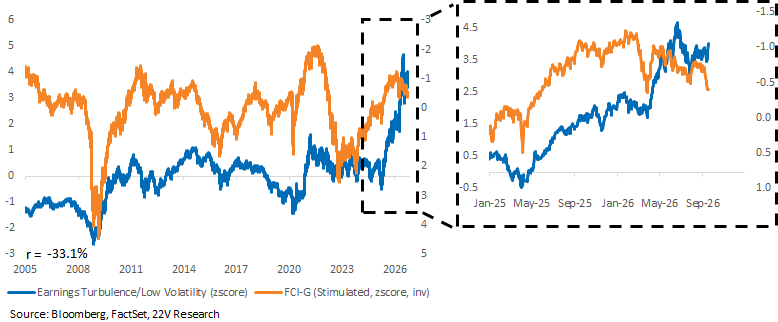
There has been a divergence with historical pattern that at factor level, Earnings Turbulence outperformed Low Volatility post the Fed meeting even as financial condition tightened meaningfully. Historically tightening financial conditions are a tailwind more to Low Volatility given risk factors relative performance is negatively correlated with the FCI-G Index. The risk-on outperformance is also diverged from factor return post historical first Fed rate hikes.
We see the divergence likely to be a result of factor correlation changes, partially a result of AI thematic trading. Momentum and Growth factors are extremely overlapped with Risk-on/Earnings Turbulence factor on its stock ranking, as the current correlations have climbed to around 90%th percentile, and their stock ranking correlations with Low Volatility have all moved below 20%th percentile. With market buying Early Cyclicals and selling Deep Cyclicals on a backdrop of expected slower growth, Momentum and Growth which are AI driven have outperformed. That favors Earnings Turbulence and brings headwind to Low Volatility, leaving risk factors relative performance diverged from financial conditions tightening.
Longer term, as the market has been extremely Risk-off tilted since July, implied volatility moving lower post the hiking risk and oil prices dropping on easing of the Middle-East conflict, the market internal regime is likely to move more risk-on. Expect more Growth Continuation periods, the highest frequency internal regime during Normal expansion backdrops. That will continue to favor Momentum, Growth and Risk-on factors.