Bottom Line: Near Term Backdrop
The near-term backdrop, defined as the next few months, will continue to support Cyclicals and fundamental factors (Earnings Momentum, Earnings Growth, Value, GARP). Retail, Regional Banks, Airlines, and Homebuilders are early Cyclical industry groups that should “catch up” over the coming months. It’s tough to have a high conviction LONGER TERM (next 6-12 months and beyond) view on Cyclicals and fundamental factors outperforming. Actual inflation data is so high, that we are forced to focus on a shorter time frame.
Relevant News: Iran Update
The emerging U.S.-Iran ceasefire deal would be a strategic win for Iran and a setback for both the U.S. and Israel, as it reopens the Strait of Hormuz, eases economic pressure on Tehran, and focuses narrowly on nuclear negotiations while leaving Iran’s missile, drone, and proxy capabilities untouched. The agreement reflects political and economic pressure on President Trump to end the conflict, weakens future U.S. military deterrence, and leaves Israel dissatisfied. For oil markets, however, the deal is broadly bearish, as reopening the Strait should normalize energy flows and reduce immediate supply risks, though Israel’s actions in Lebanon remain the key threat to the agreement’s durability.
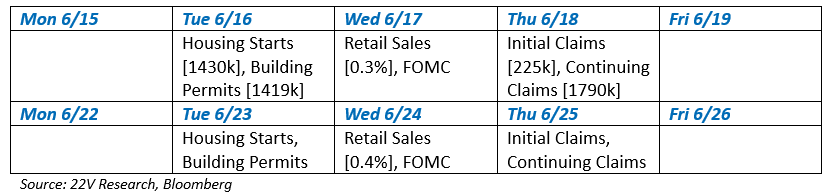
Things to Watch [Consensus, Results]:
Strategy:
SOH Reopening Means a Fed on Hold and Low Nearby Risk of Tighter Financial Conditions – (HERE)
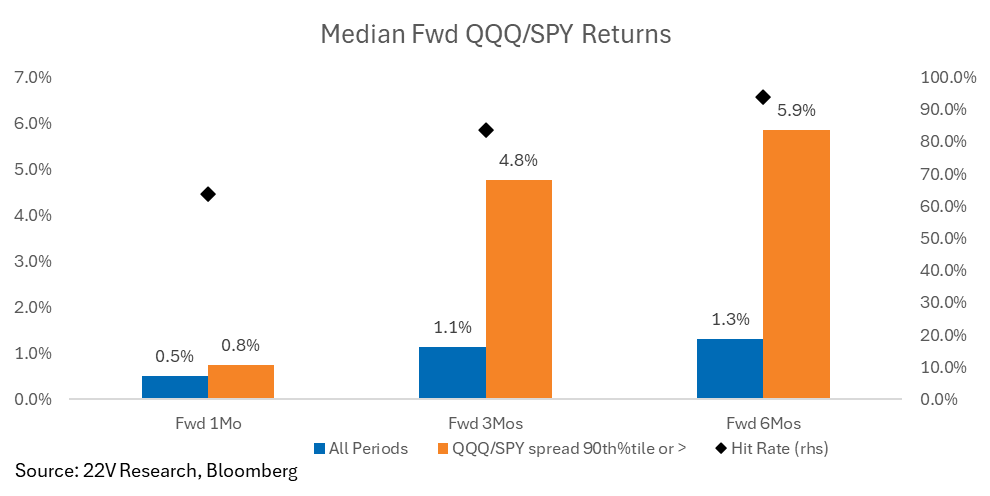
The change in the QQQ versus the SPY between 3/30 and 6/1 was in its 99.8th%tile. This was a 2.77 standard deviation return. When the spread between the two over ~2months is in its 75th %tile or 90th %tile, the forward returns on a 1,3, and, 6-mo basis are higher than typical for QQQ (+3.3% for 75th %tile or +5.9% for 90th %tile over 6 months). Our read of the implied 3 and 6-mo returns using current QQQ options pricing is above typical.
AI Macro Nexus
The AI Mid-Cycle Slowdown: From Building Intelligence to Applying It – (HERE)
The AI investment cycle appears to be shifting from its explosive early phase—driven by model breakthroughs, data center spending, and compute scarcity—into a mid-cycle stage where the key opportunity moves from building intelligence to applying it. While infrastructure demand remains strong, future returns are likely to become more selective as leadership rotates toward software, enterprise productivity, drug discovery, healthcare, and financial systems that enable autonomous AI agents to transact and operate in the real world. The core thesis is that AI’s long-term growth story remains intact, but the easiest gains in hardware have largely been captured, making the application layer the next major source of value creation.
Data Infrastructure / Commodities:
Mythos Restriction and the Second Derivative Question — A Quick Update on Themes – (HERE)
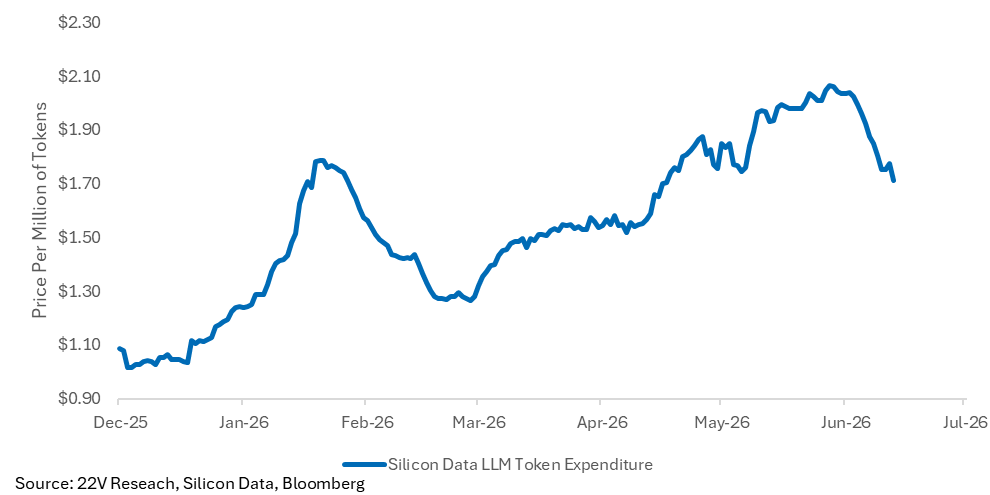
AI is facing a new challenge as regulation joins power and job displacement concerns. The restriction of Anthropic’s Mythos-class models raises questions about AGI development, global AI adoption, and enterprise confidence, while declining AI token prices, softer spending signals, and significant equity issuance create second-derivative growth concerns. Although these factors could drive a near-term pause in the AI trade, we continue to favor infrastructure themes such as cooling, thermal management, and space, while closely watching AI token and compute price discovery as the next phase of the cycle unfolds.