

DAILY STRATEGY: The 22V view is that the Strait of Hormuz is unlikely to be closed again (HERE). Assuming Jacob’s view on the SOH is correct, the MACRO focus moves to core inflation trends ex the supply shock and tariffs. As Peter Williams noted in his Fed preview (HERE), many officials want to look through the next few months of inflation given war + tariffs. put differently, the Fed will be on hold and financial conditions tightening risk is LOW near term.
The near-term backdrop, defined as the next few months, will continue to support Cyclicals and fundamental factors (Earnings Momentum, Earnings Growth, Value, GARP). Retail, Regional Banks, Airlines, and Homebuilders are early Cyclical industry groups that should “catch up” over the coming months.
It’s tough to have a high conviction LONGER TERM (next 6-12 months and beyond) view on Cyclicals and fundamental factors outperforming. Actual inflation data is so high, that we are forced to focus on a shorter time frame.
The reason – If inflation data remains too high (tracking 0.25-0.3% MoM in June, July, and August), or cleaner reads in the fall force forecasts higher, the Fed not responding with hikes becomes increasingly unrealistic. A sequence of 2-4x hikes starting in late 2026 or early 2027 is increasingly plausible. A VAR shock/broad derisking would likely be associated with a sequence of hikes being signaled by the Fed. That is because financial conditions are still historically easy relative to core inflation (93rd percentile). Financial conditions would need to adjust sharply higher to slow demand growth. Recession probabilities would increase.
The broad derisking related to Fed hikes IS NOT our base case. We expect economic growth to slow in the back half of 2026, reducing the need to tighten. But the risk of a hiking cycle is in the 30-40% range. At least for now.
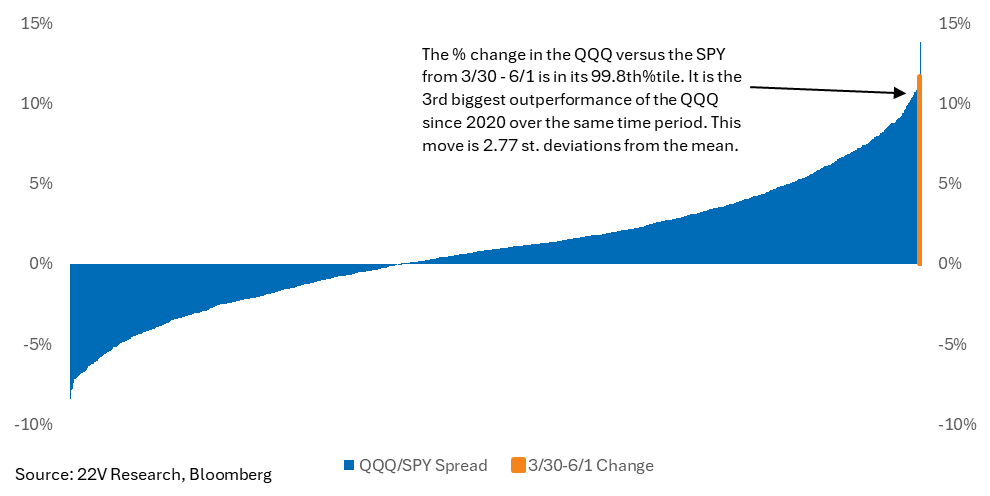
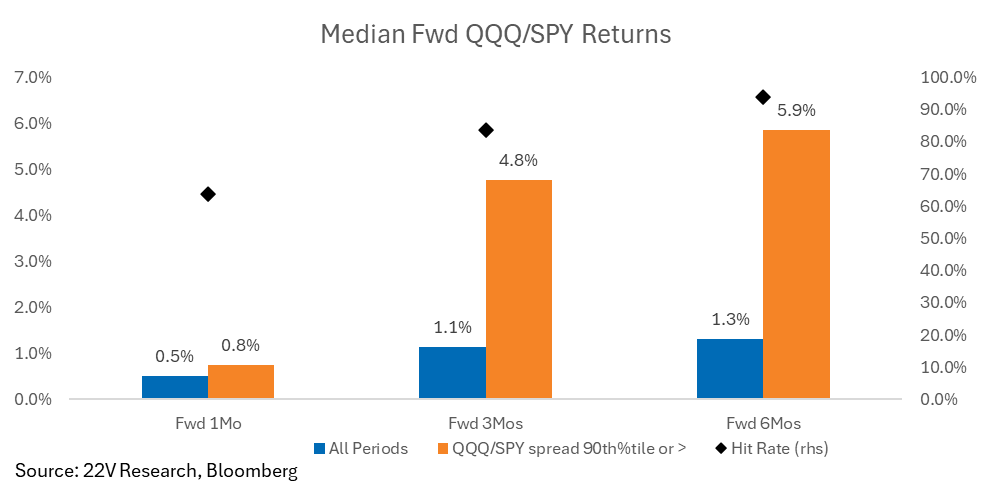
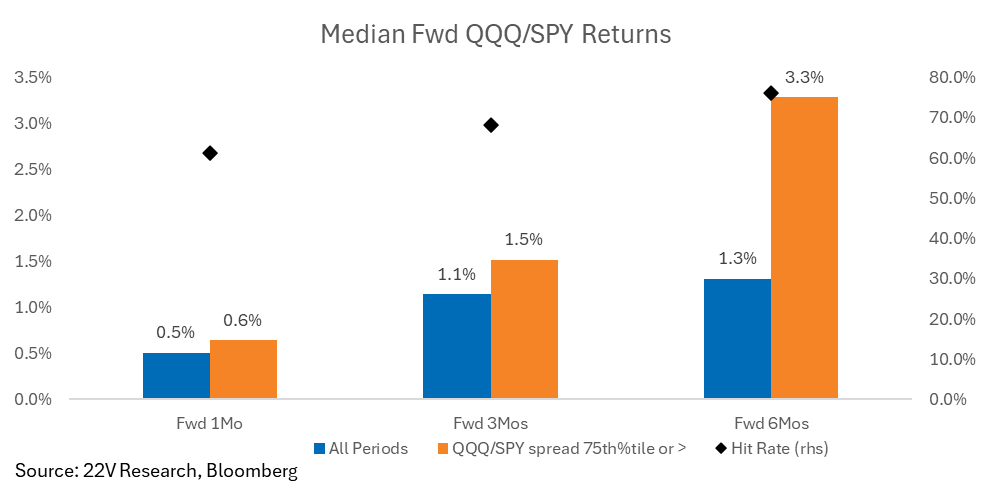
Fade QQQ vs. S&P or IWM – The change in the QQQ versus the SPY between 3/30 and 6/1 was in its 99.8th%tile. This was a 2.77 standard deviation return. When the spread between the two over ~2months is in its 75th %tile or 90th %tile, the forward returns on a 1,3, and, 6-mo basis are higher than typical for QQQ (+3.3% for 75th %tile or +5.9% for 90th %tile over 6 months). That is the good news.
The bad news is our read of the implied 3 and 6-mo returns using current QQQ options pricing is +12.5% and +18.2% respectively. That is WELL ABOVE typical. One way to play for some broadening out (other indices “catch up” to QQQ), is to sell upside QQQ calls and “replace” that long notional exposure with either the “cheaper” SPY or IWM calls on a similar delta. Jeff Jacobson, 22V Options Strategist (HERE), prefers the IWM calls. More details below.
When the spread between the two over ~2months is in its 90th %tile or above, the forward returns on a 1,3, and 6-mo basis are higher than in a other periods, but much less than what is currently priced. Our read of the implied 3 month and 6 month returns using current QQQ options pricing is +12.5% and +18.2% respectively.
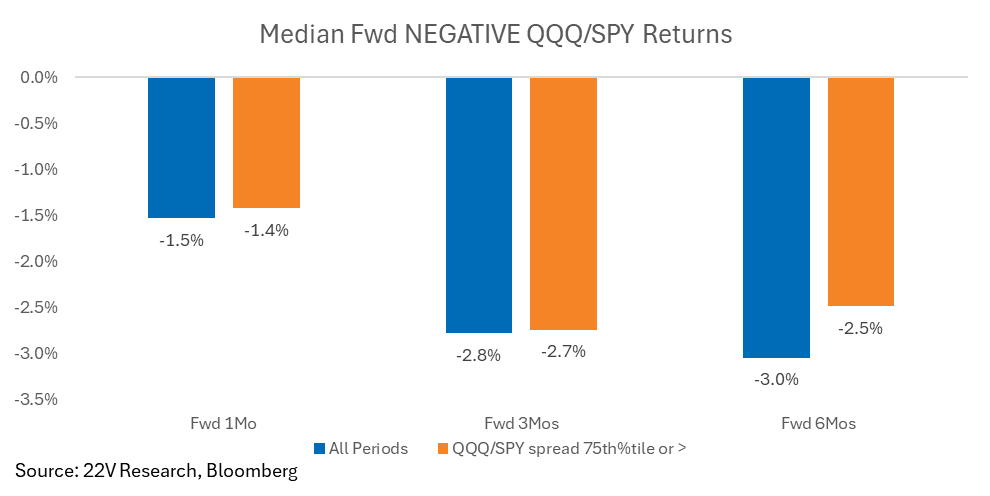
75th %tile outperformance is also positive, but less different than all periods forward returns.
In his note last night (HERE), 22V’s Jeff Jacobson highlighted that QQQ upside call options have become unusually expensive relative to both SPY and IWM, with call skew at multi-year highs despite QQQ 98th%tile outperformance relative to the S&P since March. Options markets are pricing in an unusually high QQQ returns over the next 3 to 6 months. One way to play for some broadening out (other indices “catch up to QQQ), is to sell upside QQQ calls and “replace” that long notional exposure with either the “cheaper” SPY or IWM calls on a similar delta. Jeff prefers the IWM calls.
The trade would look something like this (please contact Jeff for exact trade):
Sell QQQ Aug 755 calls 1x (37d, 24.35 vol)
Buy IWM Aug 305 calls 2.6x (37d, 22.4 vol)

