DAILY STRATEGY: Main Point – Thinking About Downside Risk to AI Demand Beneficiaries: Recent productivity gains could have nothing to do with AI. While the costs of AI are increasing rapidly and organizations are still struggling to convert AI into ENOUGH value to offset increased token costs. This is something we are being asked about. The best way we can think of tracking this concern, for now, is margin sentiment relative to cost sentiment. I.e. what companies are actually saying about costs and margins, and how that relates to margin changes going forward. For now, the bias is still increasing margins. All things equal, that should support AI capex beneficiaries and the Price Momentum factor.
If S&P 1500 margins sentiment declines, tracking the recent deterioration of S&P 1500 cost sentiment, and actual margins stop increasing (or move lower), the price Momentum basket and AI buildout beneficiaries will face a headwind.
Background – 1Q Earnings season made it clear that AI demand is outstripping supply. At the same time, S&P 1500 margins increased by 1pp relative to expectations. If margins are increasing, particularly for companies using AI the most (HERE), that SUGGESTS company level AI productivity gains can continue and AI demand will continue accelerating. As we have highlighted a few times, rapid margin expansion has been a primary driver of the unusually strong corporate earnings performance in 2026.
Bottom line – Consensus seems to agree that strong productivity gains have allowed firms to sustain profitability and meet demand despite high input costs and labor supply constraints.
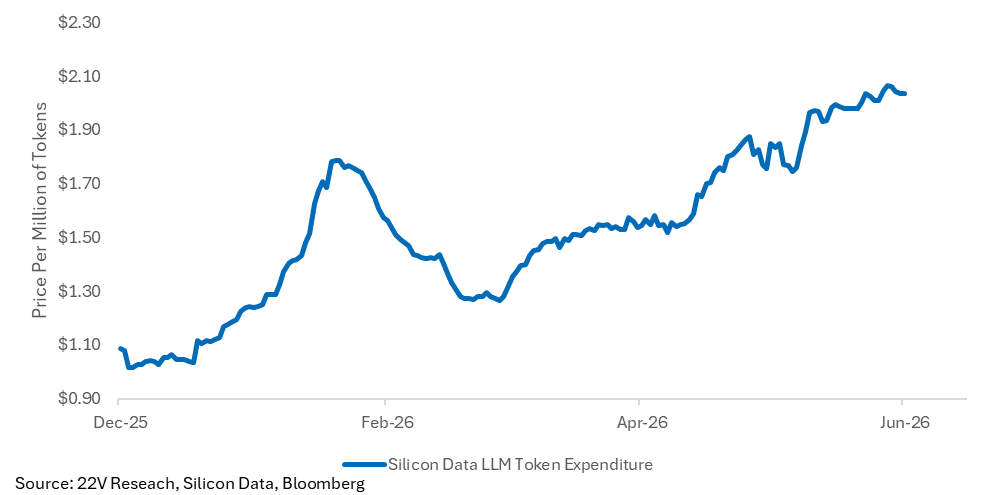
Investors Are Asking Us How To Think About AI Demand Being “inflated”- As Bloomberg highlighted this morning, Uber set usage caps on some AI-powered tools used by its staff. The move is meant to manage costs after the company blew through its AI budge (see token costs chart below). At the same time, a recent Boston Consulting Group study found that 42% of regular AI users report saving the equivalent of a full workday. That is good. BUT, most organizations haven’t figured out how to convert the time into value. Bottom line – if the costs are going up, but the value is not yet clearly improving, there is risk to AI demand trends.
There is also the issue of individuals testing or “tokenmaxxing”. As Noah Smith put it yesterday…”trying to use coding agents as much as humanly possible with AI tools and not realizing how the cost is surging.“ This could be inflating demand temporarily.
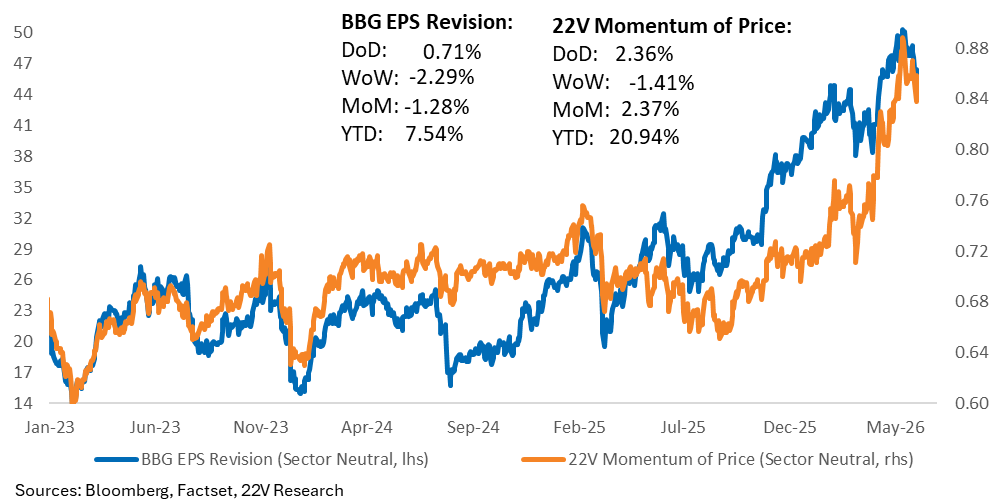
But Doesn’t Margin Expansion Disprove the Worries Discussed Above? – That would be a fair point. If margins and productivity are improving, AI demand trends should remain firm. Worries about AI demand slowing should be faded. Price Momentum and the 3 mos EPS revisions factor from Bloomberg (considered a proxy of hedge fund positioning) should continue to outperform.
Here is the interesting counter point to the recent margin expansion/productivity gains. It is possible that recent margin expansion/productivity gains have VERY little to do with AI. As Peter Williams pointed out in a report last week, when you account for the fact that businesses are simply working their existing workers and machines harder — which naturally happens after an economic slowdown, the recent productivity gains appear to be driven by a surge in the utilization of capital and labor. Not AI. Theoretically, this is a temporary lift.
Also, the immigration slowdown could be temporarily boosting productivity now. The theory being, fewer low-wage immigrant workers means total work hours are dropping faster than economic output, which makes productivity look better for a time, but should fade (HERE).
Tracking the AI Demand Slowing Worry – One way of tracking margin relative to costs sentiment discussion is focusing on what companies are saying about costs and margins. Recently, S&P 1500 cost sentiment has deteriorated (higher costs) for S&P 1500 companies, but S&P 1500 margin sentiment remains at unusually high levels. It is probably fair to assume that investors will accept some increase in costs if margin sentiment remains at unusually high levels. The current level of margin sentiment suggests an INCREASE in margins in 2Q26. Unless margin sentiment declines or actual margins decline, it will be difficult to be short Price Momentum.
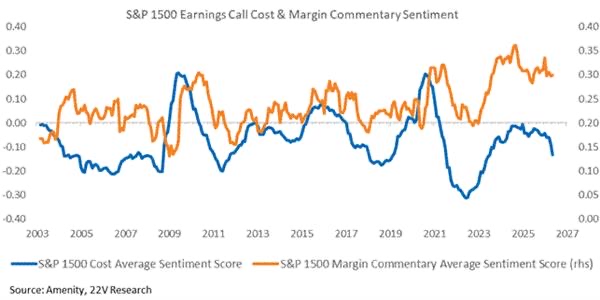
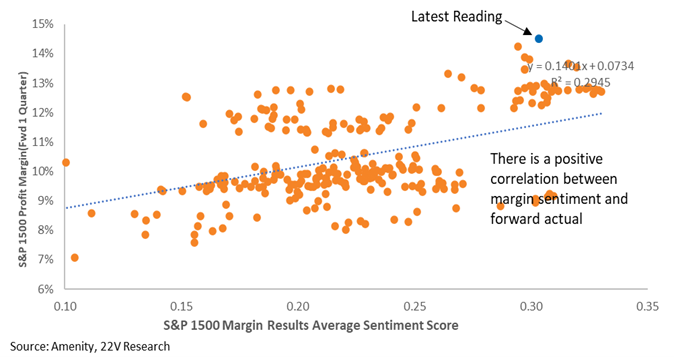
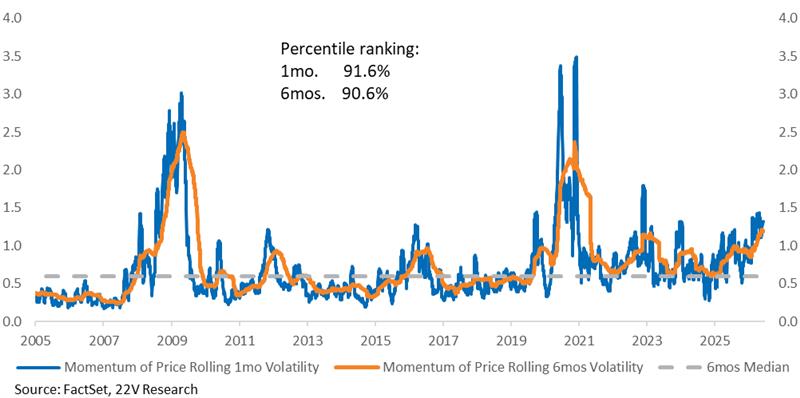
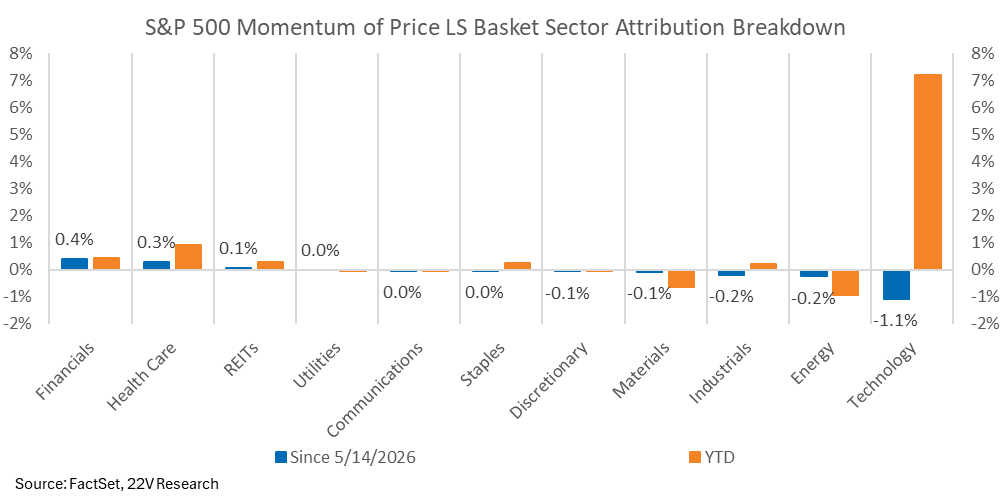
Momentum factors are driven by technology currently (HERE). And the Vol of momentum is unusually high. A slight change in the AI demand narrative could have a large impact on price momentum short term.
The LLM Token Expenditure Index (BBG: SDLLMTK) is a daily financial benchmark that tracks the effective aggregate spend on large language model (LLM) APIs rather than just nominal price per token. It measures how much enterprises are spending on AI inference.