

SUMMARY
- Top-down and sectoral views of analyst sentiment suggest that the overall outlook for consumption is neutral to slightly negative; this makes sense given China’s subdued macroeconomic backdrop, particularly a soft labor market.
- The trends toward choosing value brands over premium brands, and domestic over foreign goods, have eased since the peak of thrifty behavior in mid-2024; however, recent dynamics still reflect a cautious new normal.
- Foreign luxury brands in China face a less hostile environment than was the case in 2024, but it will likely still be an uneven and often challenging environment.
- Aggressive fiscal stimulus would be the most effective way to reduce the cyclical headwinds for consumption and the property market but is unlikely anytime soon.
Several clients have asked us over the last week about the health of the Chinese consumer, with a particular eye on the appetite in China for foreign luxury brands.
While we are not sector experts, here we offer some views at the macro level. We add perspective by using 22V’s proprietary China Economic Sentiment Series (CHESS) tool. CHESS uses LLMs to assess the sentiment of economists writing about the broad economic and financial outlook, and – with a new capability that we launched in February – the sentiment of industry analysts discussing the outlook in their specific coverage sectors (see our CHESS relaunch paper HERE). This allows us to look at consumption patterns – including the appetite for premium vs. value products, and foreign vs. domestic brands – in more detail.
The key takeaway is that consumption appetites are broadly stable, but within a “new normal” of households dealing with an ongoing property downturn and weak labor market. There are few reasons to think household spending will break out of this relatively cautious pattern anytime soon.
The Overall Consumption Outlook Is Neutral, Leaning Negative
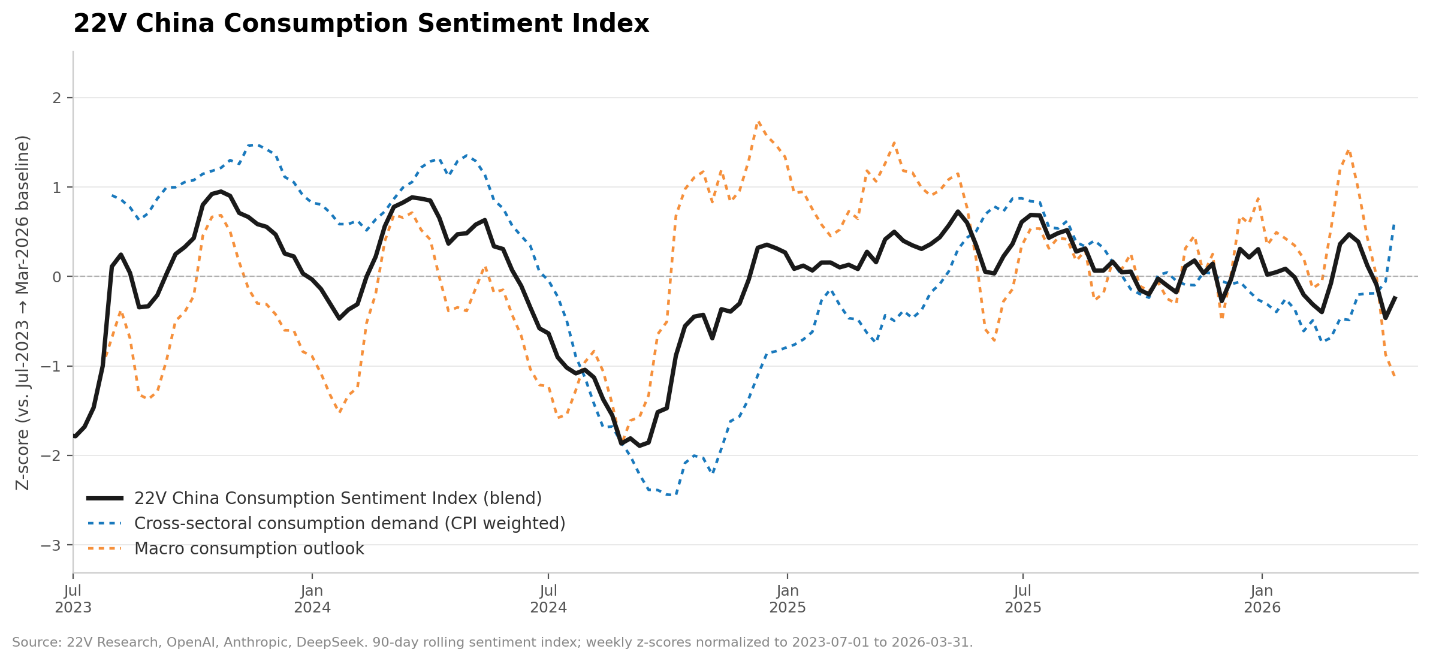
For a macro view, the chart below shows the headline CHESS consumption sentiment index (black solid line). This is a blend of two series:
- The top-down view of the consumption outlook from Chinese economists (orange line)
- A bottom-up view of how analysts in consumption-oriented industries view the demand outlook in their coverage areas (blue line). We aggregate these industry views and weigh them according to their share of China’s CPI basket.
- Both series are normalized, so the chart shows not the absolute level of sentiment but instead z-scores, which measure how current sentiment compares to the mean since July 2023 (the start of the series). This helps correct for an inherently bullish bias.
Consumption sentiment hit a bottom in the summer of 2024, as deflationary pressures, wage cuts, and youth unemployment intensified. China’s “policy pivot” and a cyclical improvement led to a modest recovery by early 2025. Sentiment in the last year has been broadly stable but has drifted down since mid-2025 and is now slightly negative (again, relative to the mean since 2023).
These dynamics are consistent with our take on the broader macro backdrop, particularly the soft labor market. Employment demand (especially formal employment) is weak, suppressing wage growth. In Q1, household disposable income grew by only 4% y/y, below the post-pandemic average of 5.4%, and the household savings rate ticked up in a sign that consumers remain cautious (see our coverage of the Q1 economic data HERE).
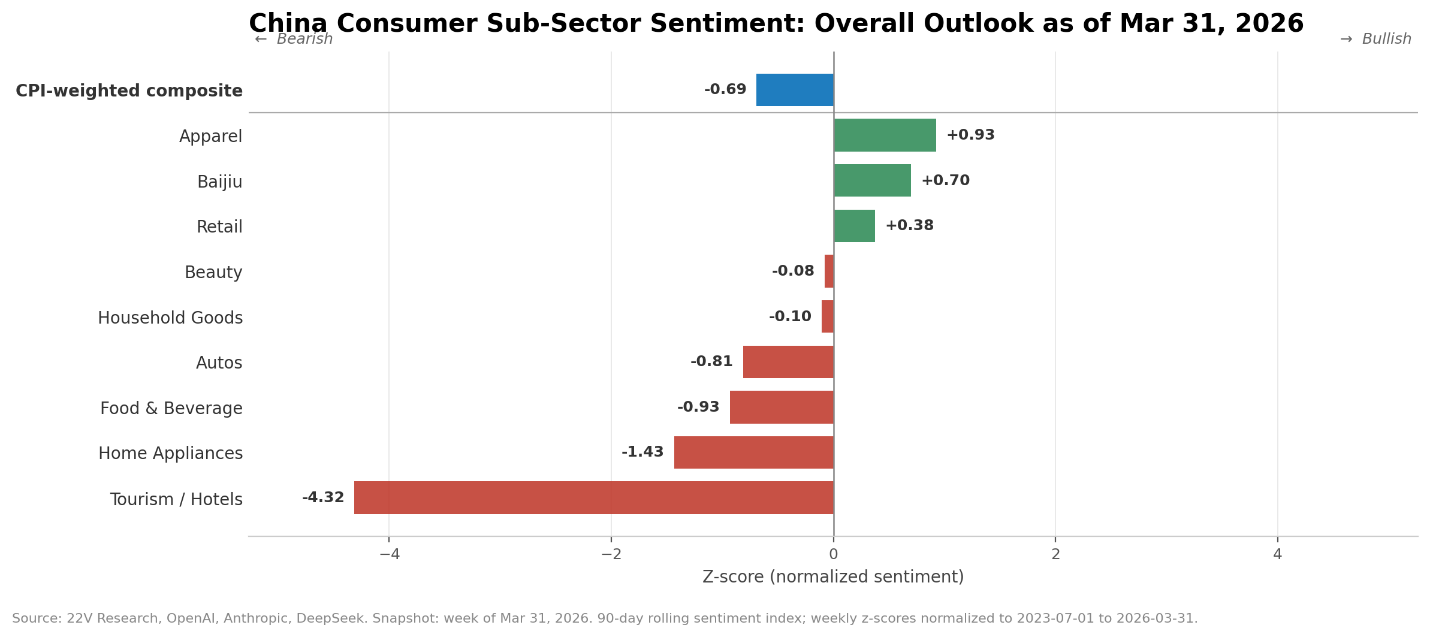
In terms of key sub-sectors (chart below), analyst sentiment is positive in apparel, traditional Chinese liquor (baijiu), and retail. Sentiment is weakest for tourism/hotels (impacted by the Middle East conflict and rising energy costs), while autos and home appliances are seeing “payback” from last year’s consumer rebate program, which pulled forward demand from this year.
Trading Down Behavior Has Eased
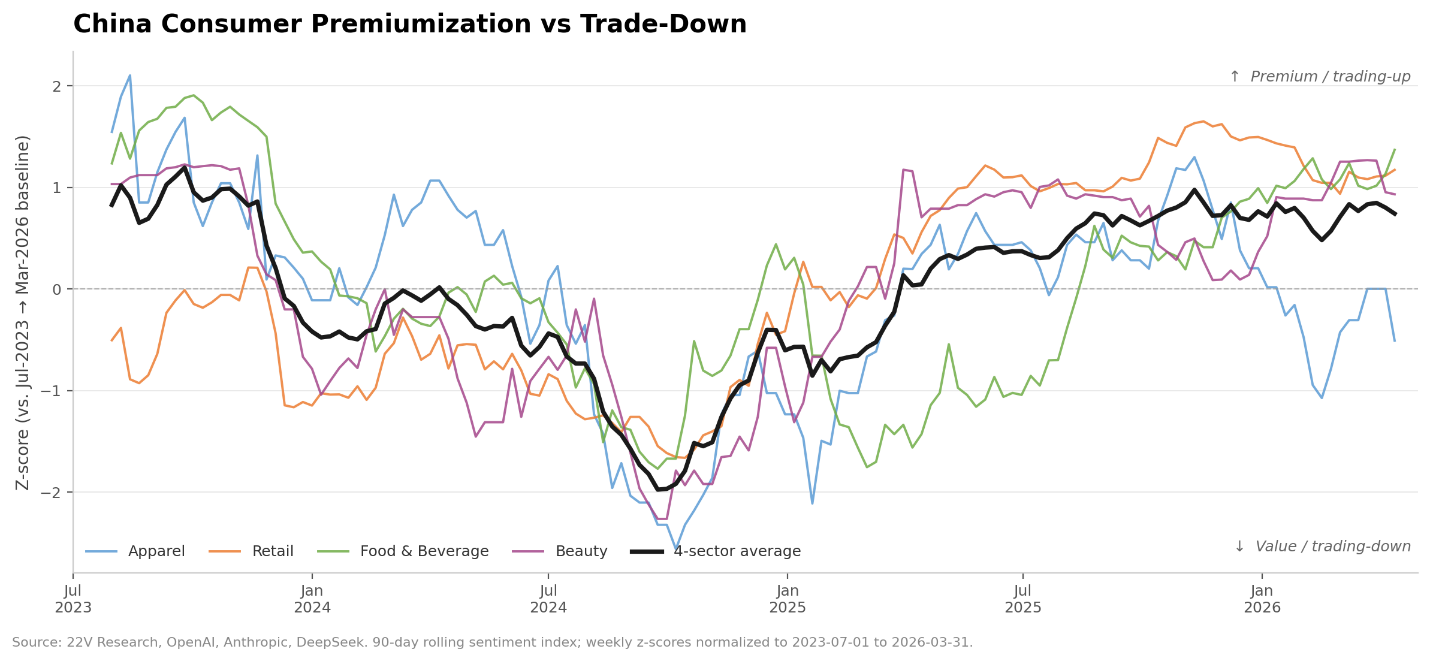
The chart below looks at four key sub-sectors – apparel, food and beverage, beauty, and retail – through the lens of “premiumization.” That is, whether analysts see consumers in these sectors as reaching for premium/luxury brands (positive) or trading down for value products (negative).
The trading down wave hit in late 2023, when China’s post-Covid economic recovery fizzled, and then intensified in mid-2024, when economic pessimism was at its worst. Since the September 2024 “policy pivot,” consumers (according to analysts) have been gradually more willing to buy premium products. Sentiment towards “premiumization” is now back at the same level as mid-2023. While this is a significant improvement from the bottom, it still suggests that consumer appetites are within the relatively cautious “new normal” that has prevailed since 2021/2022 (real estate collapse and Covid lockdowns).
Foreign vs. Domestic Brands
The last chart looks at how analysts in the same four sub-sectors assess the relative outlook for domestic brands (positive) compared to foreign brands (negative). Analyst commentary is less frequent in this category, so the data is noisy and probably useful as a broad gauge.
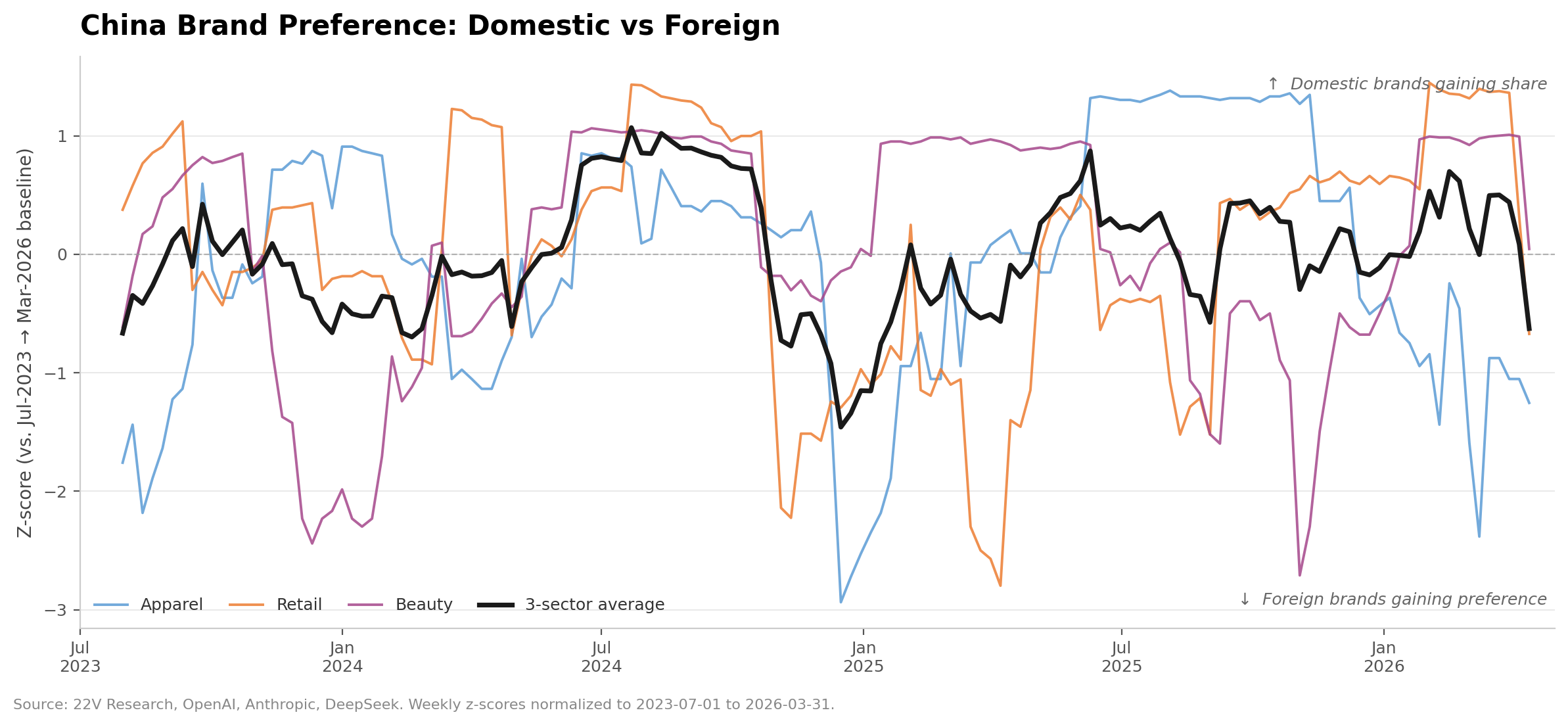
The key takeaway is that consumers flocked to domestic brands in mid-2024 as part of the broader trend towards value-minded consumption. There was a swing back toward foreign brands after the September 2024 policy pivot, likely driven in part by a short-lived improvement in property prices. For the last year, however, the domestic vs. foreign dynamic has been broadly stable at close to the mean level. In short, industry analysts are not picking up on convincing signs that households are returning to a pre-2021/2022 embrace of foreign brands.
Bottom Line: Few Reasons to Expect a Consumer Breakout
Foreign luxury brands in China face a less hostile environment than was the case in 2024, but it will likely still be an uneven and often challenging environment.
From a cyclical perspective, the key headwinds for consumption are the weak labor market and ongoing property downturn, which reinforce each other (falling property prices hurt household sentiment, which in turn hurts spending and overall demand). In our view, the most effective way to short circuit this dynamic would be through aggressive fiscal stimulus that boosts overall demand and hiring activity. We do not expect Beijing to ramp up stimulus anytime soon, particularly after Q1 headline GDP numbers that came in at the top end of the target range (4.5-5%), even if the underlying dynamics were unimpressive (link again to our analysis HERE).
The trends towards trading down and preference for domestic brands also seem part of a longer-term shift in household mindsets, perhaps best explained by Robert Shiller’s framework of “narrative economics.” In recent years, a cluster of popular narratives has spread in China centered around “lying flat,” “involution,” and similar themes. The common thread is a view that China’s boomtimes are over, and that consumers – especially the young – are best off modifying their lifestyles, expectations, and sources of satisfaction. These attitudes help explain the embrace of domestic brands (the sign of a savvy/patriotic consumer), value for money (over ostentatious luxury), and experiences (including outdoor leisure activities) over goods accumulation.
As Shiller describes, citing the Great Depression in the US, narratives of thriftiness can impact the economy and thus be self-fulfilling. While some narratives in China are shifting – especially growing confidence in domestic innovation capabilities – we have not yet picked up strong signs that the narrative cluster around consumption behavior is fading. The potential impact of AI on employment, particularly for recent college graduates, adds a new source of anxiety about the future.

