

SUMMARY
- CHESS 2.0: We are leveraging advancements in LLMs to broaden the scope of 22V’s proprietary China Economic Sentiment Series (CHESS) tool, analyzing sector-level trends as well as key macro drivers.
- Growth: Analyst sentiment towards the macroeconomic outlook has continued to improve due to strong exports, but the outlook for domestic demand is weaker.
- Policy: Stimulus expectations have declined in recent months, a warning sign given the need for continued support for domestic demand.
- Equities and Corporates: Beijing’s “anti-involution” campaign has helped support equity market sentiment but may be reaching diminishing returns.
- Consumption Focus: Analysts see consumers shedding only some of the frugal behavior that has prevailed in recent years; tourism and beauty are relative bright spots.
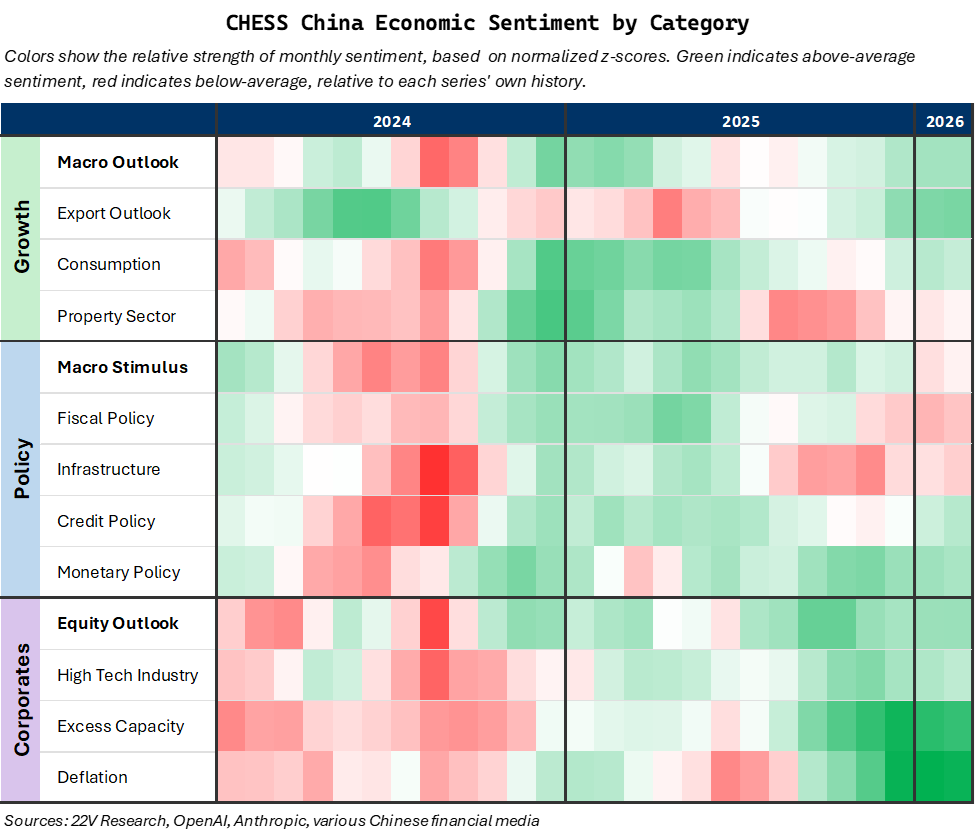
CHESS 2.0: A TOOL FOR MONITORING CHINA’S SHIFTING OUTLOOK
In April 2024, 22V debuted the China Economic Sentiment Series (CHESS) project (see the original CHESS white paper HERE). CHESS uses Large Language Models (primarily ChatGPT to date) to assess the sentiment of leading economists commenting in China’s domestic financial media. The LLM scores each relevant commentary/report on a scale of -2 (very negative) to +2 (very positive) across 13 dimensions, from the growth outlook to the property market to equities. We then compile these into time series, which provide a visual and quantitative way of assessing daily shifts in the economic and financial outlook. This can be especially useful for looking at areas that are traditionally hard to measure, such as stimulus expectations.
The continued advancement of LLMs is now allowing us to expand CHESS’ coverage and flexibility. The key changes in “CHESS 2.0” are:
- Expanded sources: The input for CHESS thus far has been the commentary section of one of China’s leading financial news websites. We are now adding Chinese-language sell-side analyst reports, collected by a different online clearing house. With hundreds of reports per day, this has only become practical as the cost of LLMs has come down and the context windows have increased. For macro topics, the higher frequency of reports means that we can more quickly monitor daily shifts in sentiment. In CHESS 2.0, we equally weight the two channels of analyst reports and media commentary, as this increases the number of daily reports while retaining meaningful weight on the views of key opinion leaders.
- Sectoral coverage: CHESS 2.0 will now analyze not only macro commentary but also industry reports across all leading sectors in China’s equity market, from consumer retail to semiconductors to industrial metals. The goal is to understand drivers within, and especially across, key industries. As an initial example, later in this report we look at the health of Chinese household spending by assessing analyst sentiment across five consumption-related sectors.
- Refined methodology: We have also used the experience from two years of CHESS to refine the methodology, especially in designing prompts. In our latest back-testing, these tweaks have significantly improved CHESS’ performance in confirming or predicting shifts in economic and financial data (please reach out with interest in the back-testing results or to run your own tests).
By representing the informed consensus within Chinese financial circles, CHESS has several uses for investors:
- Identifying inflection points. Like other applications of sentiment analysis, CHESS is less useful for making point forecasts of economic data than for identifying directional turning points – whether arising from economic fundamentals, policy (such as stimulus moves), or international developments (easing of trade tensions).
- Understanding key drivers of sentiment. CHESS can help explain key factors behind sentiment shifts, such as the extent to which exports rather than stimulus expectations are supporting the growth outlook (see next section).
- Challenging the consensus. We think monitoring the informed consensus is useful, but our CHESS reports point out where our in-house view differs – which itself may be an opportunity for counter-consensus moves.
CURRENT MACRO SIGNALS FROM CHESS
In the section below, we highlight key macro signals from CHESS, based on analyst reports as of February 14, just before the start of China’s Lunar New Year holiday.
Exports are Driving Positive Macro Sentiment
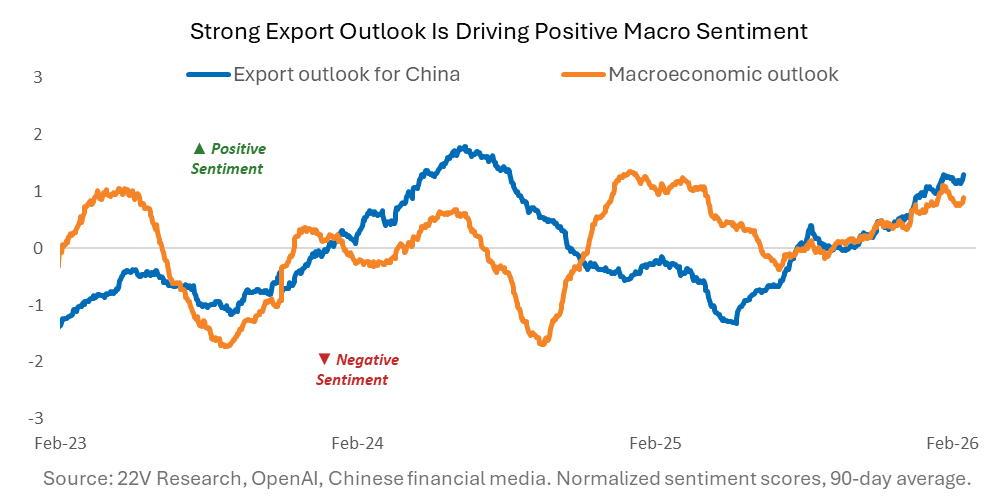
Sentiment towards the macroeconomic outlook (orange line below) is below the peak reached after China’s September 2024 “policy pivot,” but remains positive and has steadily improved since Q2 2025 – even as economic data show momentum sliding. The key driver for this is the resilience of exports, where sentiment (blue line below) has climbed since the stabilization of US-China trade tensions.
Our Take: We expect China’s growth to stabilize in coming months but at low levels, especially for nominal growth. While exports may get a modest boost from the US Supreme Court’s ruling against IEEPA tariffs, this is not enough to fully offset the weakness and deflationary pressures stemming from property and consumption (next section).
Limited Optimism for Property and Consumption
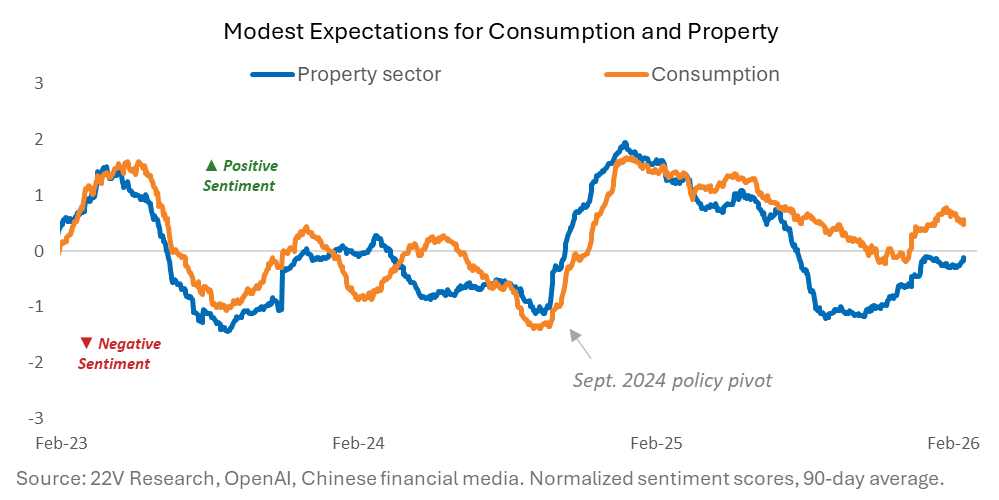
Sentiment towards the property sector (blue line below) has picked up modestly in the last two months, but is neutral and well below the peak of optimism after China’s 2024 policy pivot. Sentiment towards consumption (orange line) is a bit better but only modestly positive.
Our Take: We have been consistently negative on the prospects for property to reach a bottom anytime soon and continue to expect a double-digit decline in property construction in 2026. We also expect consumption to remain subdued given a soft labor market, falling housing values, and lack of aggressive demand-side stimulus.
Analysts Expect Stimulus to Stay Restrained
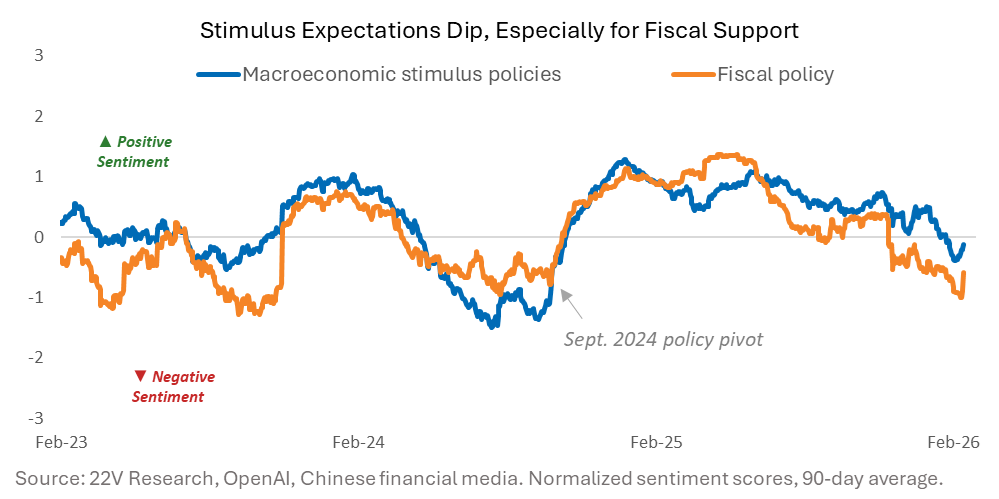
Overall expectations for macroeconomic stimulus (blue line below) have declined since December, with Beijing signaling only limited urgency to support demand this year. Sentiment towards fiscal policy (orange line), the most important stimulus tool right now, has been especially weak.
Our Take: A key driver for our subdued economic outlook has been Beijing’s complacency towards growth since the stabilization of US-China tensions. That said, we are a bit more optimistic about the near-term support coming from fiscal policy, as we expect the authorities to use fiscal saving from last year to boost spending in coming months. The upcoming National People’s Congress (starts March 5) will be a key watchpoint for fiscal and other macro policies for the year.
Anti-Involution Campaign is Supporting Equity Sentiment
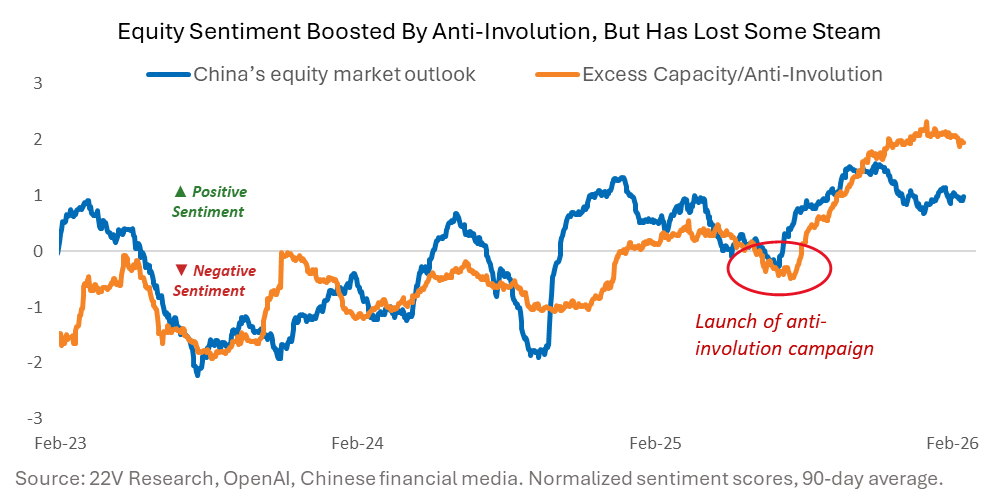
Beijing’s intensifying “anti-involution” campaign against price wars and excess capacity, which launched in July 2025, has led to surging sentiment in this area (orange line) as well as towards deflation (not pictured). That has been a source of support for equity market sentiment (blue line), but it is showing diminishing returns. Equity market sentiment is still modestly positive but has declined in the last two months despite a strong market rally to start the year.
Our Take: We remain skeptical about the effectiveness of the anti-involution campaign in sustainably boosting prices and margins at the macro level, which would require stronger support for domestic demand. Equity markets may need additional macro catalysts to lift sentiment higher.
SECTORAL FOCUS: HEALTH CHECK FOR CONSUMPTION SECTORS
In our concluding section, we use CHESS’ new sector-level capabilities to shed light on a key point of interest from clients: how strong is the Chinese consumer? We do this by assessing sentiment in industry reports across five consumption sectors: apparel, beauty, food and beverage, retail, and travel and tourism. There are three main takeaways from analysts.
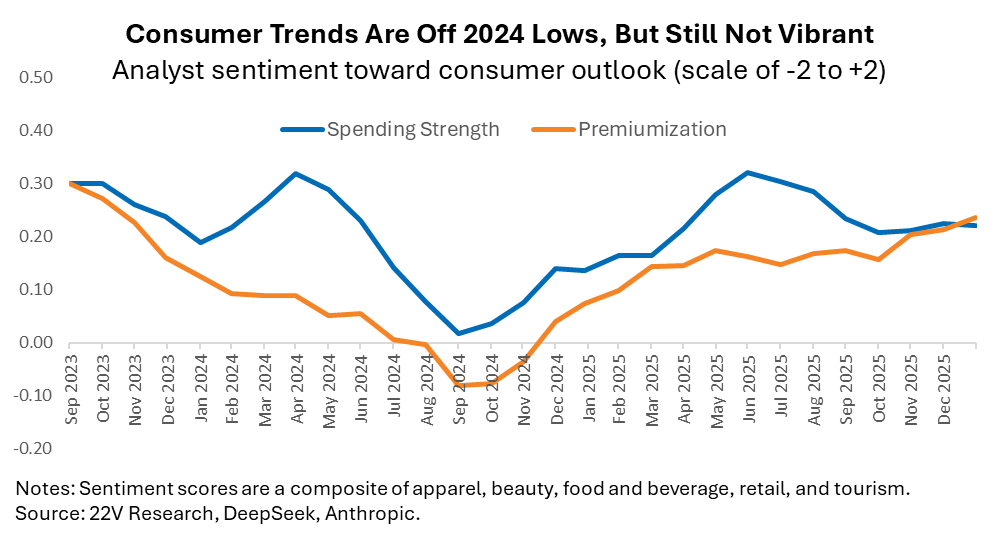
Consumers have only partially shed their frugal mindset. The chart below shows analyst sentiment towards overall consumer spending and towards “premiumization” – luxury vs. bargain spending – aggregated across all five sectors, from September 2023 through January 2026. According to analysts, spending and premiumization trends have both recovered from the worst of thriftiness reached in Q3 2024, before China’s policy pivot. That said, both spending and premiumization are at or still slightly below their high points in Q3 2023, which was a decent but hardly robust period for consumption activity. The food and beverage sector has shown the sharpest decline in premiumization, with sentiment meaningfully lower than in Q3 2023. In sum, industry analysts see the consumer as only gradually shedding the frugality that has prevailed in recent years. This is consistent with macro data showing that the savings rate remains above the pre-pandemic norm.
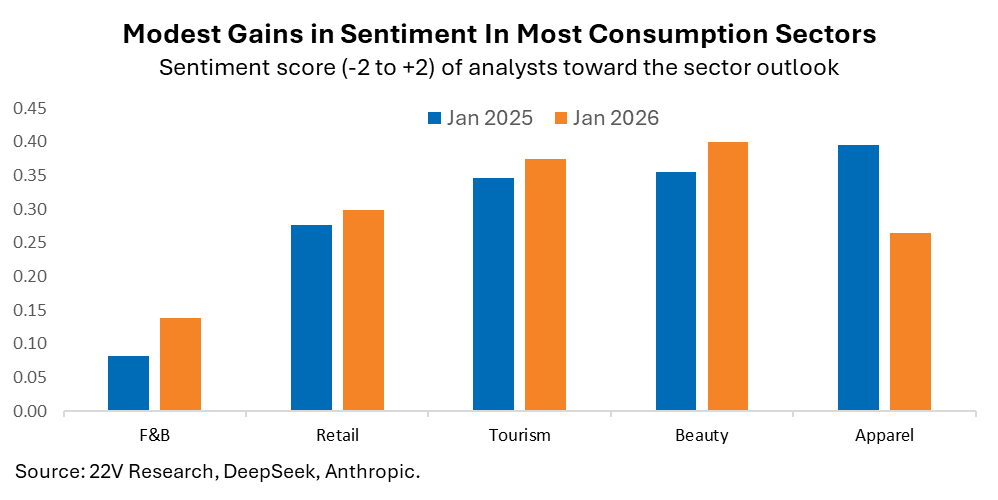
Travel/tourism and beauty are spending bright spots. In the next chart, we compare analyst sentiment towards the overall outlook within each sector, in January 2025 and January 2026. The bright spots remain travel/tourism and beauty, whereas food and beverage looks the weakest. The outlook for most sectors has improved modestly in the last year. The exception is apparel, but the underlying data shows this is primarily due to exports (in the face of US tariffs) rather than domestic spending.
NEXT STEPS
CHESS will continue to evolve to meet client interests and shifting dynamics in China. We will update CHESS on a biweekly basis, featuring not only macro signals but also a rotating look at key sectors and themes (consumption, metals/commodities, and AI/tech in particular). LLMs with agentic capabilities allow us to add new sources and look at new questions as needs evolve. We thus especially welcome feedback on which topics and approaches are of most interest, as well as questions regarding methodology and access to the underlying data.
CHESS is a collaborative project, leveraging the expertise of 22V’s Quantitative Research team (Sophia Wang, Frodo Gu), and China-based economic consultant Dr. Fei Han. The authors thank them for their continued contributions and insights.

