Consumption Speeds Along, Faster than the Vibes
- Nominal consumer spending continues to motor along, despite the tremendous volatility buffeting consumer sentiment and monthly spending, with topline trends that remain remarkably steady.
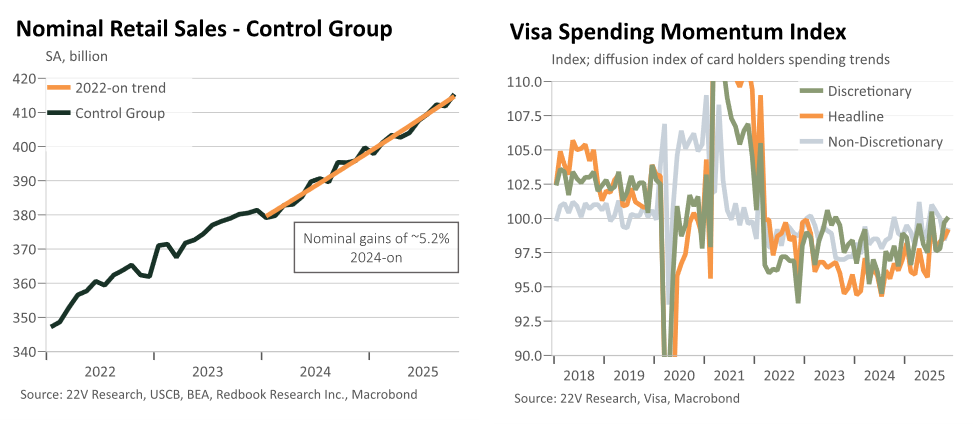
- October retail sales data was quite strong on an underlying basis, following a softer September that saw payback from July-Aug heat. Nominal control group retail sales are running at roughly 5.2% pace since the start of 2024 and current spending continues to bounce right around that trend level.
- Inflation is weighing on real volumes some, but this will be largely transitory. Eventually falling core goods inflation will allow for better composition of spend and increasing volumes with nominal fairly steady. My analytical framework has shifted to focusing on a nominal – inflation = real as an approach, rather than an bottoms up real + inflation = nominal one. This is because nominal trends have been quite steady and inflation very volatile this cycle, leading to too much cyclical noise when reasoning from short-term real spending trends.
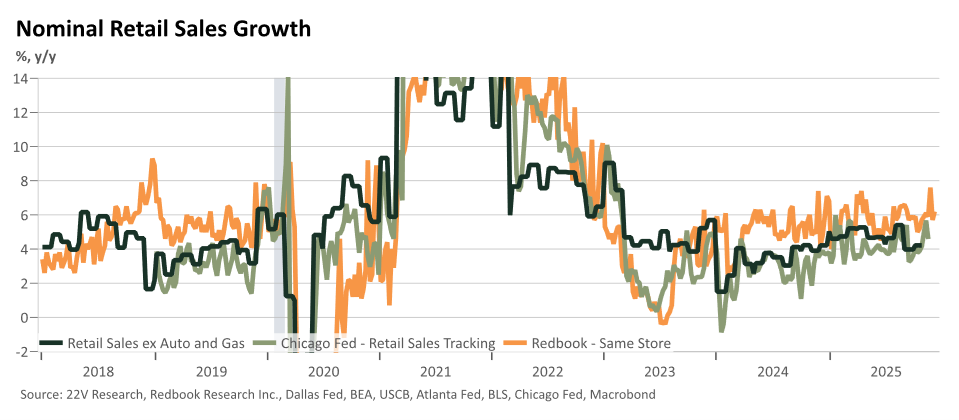
- While holiday timing shifts, the shutdown, and tariff newsflow have led to some volatility. Rebook same store sales continue to bounce around their ~6% pace with the occasional dip. This matches the broad trends from the banking and card spending data, discussed below.
Recent Corporate Comments are Consistent with this Story
- The sequential acceleration in spend flagged by the banks from Q2-Q3 lines up with the hit then stabilization of private sector hiring in the NFP data and our read of the underlying signal from ADP as well.
- During Costco’s earning call they summed the environment up quite well: “there’s a lot of consistency actually… When you look at month by month, there’s definitely been some lumpiness in the individual monthly sales results that we’ve posted. A lot of that has been to do with whether it was uncertainty around tariffs one month to another or port strikes that we had to cycle… If you look at every individual month, there was only two months in that last seven months that were outside of the range of 6% to 7%.”
- Bank conference season largely supported this view as well (see ‘A Macroeconomist Goes to Earnings Season’). K-shaped discussions remain a theme though although the popular rhetoric on this seems to overstate underlying reality.
- V (“holiday season, which, again, is stable and strong”) and MA (“there’s sort of a divergence, I think, between the soft and the hard data… But what we see in the hard data continues to be very supportive of consistent spend”) both highlighted continued aggregate spending stability, echoing broader theme.
- BAC saw spending decelerate a small amount in recent months, but said “I wouldn’t overly read into a 0.5% movement… So consumers are in good shape.” They see some evidence for the k-shaped economy but “not as much as people think.” MA see’s “healthy spending metrics across both mass and affluent segments in our portfolio.” Visa’s measure of consumer spending breadth has bounced this year.
- The strength of spending reported by AXP (around Thanksgiving it was +9% overall and +13% for platinum card customers) and JPM (“spend in the 4th quarter improved a little year on year and relative to the first three quarters of the year… [was +9% in Q3] Yes, there is a divergence in spend growth between higher-income customers and lower-income customers. But that relative level of spend growth is a sort of relatively normal trend”) highlighted the top-end strength rather than bottom-end weakness.
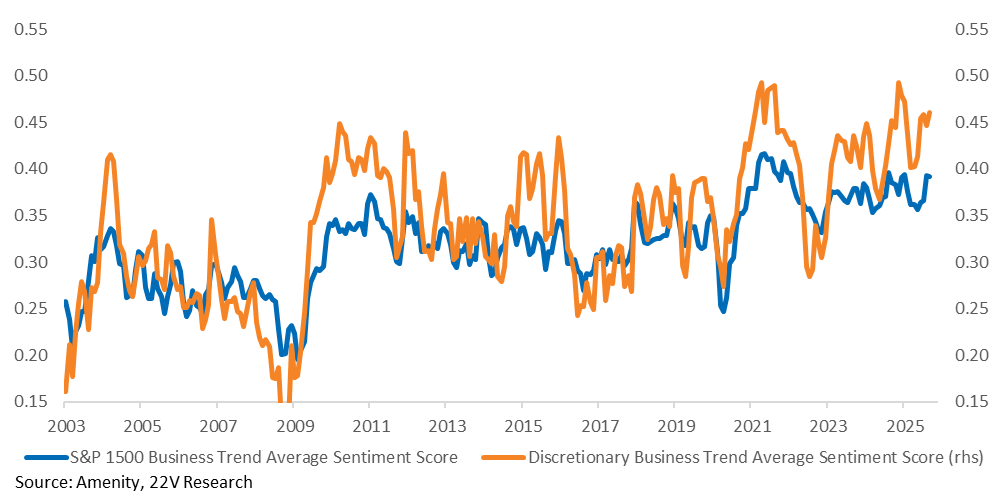
- On the more mass-market side, DLTR flagged its first positive y/y comp for discretionary spending since 2022Q1. They also noted growth twice as fast for lower income cohorts than high. Beats and raise were common themes throughout earnings seasonal for retailers with some posting their first positive SSS comps in years. Our measure of sentiment for the discretionary consumer sector has almost never been better.
- BAC noted that “small businesses are fine.” JPM echoed the sentiment noting that small businesses are “keeping themselves in pretty good shape so far,” despite tariffs.
- Tariffs are fading as a drag on activity. BAC’s Moynihan noted that business leaders and economic forecasts have done a roundtrip thanks to tariffs, “I think the certainty, the path forward from six months ago to now is higher because trade and tariff has largely worked through the system in terms of people’s understanding of what will happen.” We think the uncertainty and cashflow drags from the myriad tariff shocks this year remain and underappreciated part of how 2025 has gone and this fading risk is a key tailwind for next year.