SUMMARY
- China’s Third Plenum meeting is unlikely to serve as a major market catalyst; breakthrough reform announcements are not coming, and the end-July Politburo meeting will be more important when it comes to the near-term economic situation
- Still, it would be a mistake for investors to ignore the plenum, which will set the direction of policies key to China’s medium-term growth and market outlook; expectations for the meeting are so low that there is room for modest surprises to the upside
- There will likely be forward movement in urbanization and fiscal reforms, both of which are important for China’s domestic demand in coming years; when it comes to support for the private sector, reform of state-owned enterprises, and the role of capital markets, Xi’s political priority on tight Party control will stymie major liberalization
On July 15-18, China’s leadership will convene a much-discussed Third Plenum meeting to outline the next stage of Xi Jinping’s economic agenda. The meeting is unlikely to serve as a major catalyst for markets. First, expectations for breakthrough announcements are appropriately low heading into the meeting. Second, the plenum will focus on institutional and structural reforms rather than macroeconomic policies. For investors confronting a weak economic recovery and assessing potential policy support, the end-July Politburo meeting on the economy will be more important. We do not expect the Politburo to announce major stimulus, but outlined potential incremental support measures HERE.
Still, it would be a mistake for investors to ignore the Third Plenum. The direction of policies announced at the conclusion of the meeting will be important for assessing China’s medium-term trajectory, including the strength of domestic demand, the regulatory stance towards domestic firms, the outlook for capital markets, and China’s complicated trade and investment dynamics with the rest of the world. Given exceptionally low expectations for the plenum, there is scope for the meeting to surprise modestly on the upside in several reform areas, such as urbanization and fiscal reform.
Key themes
“Plenums” are meetings of the central committee of the Chinese Communist Party (CCP), comprised of the party’s senior 205 officials, and are typically held at least annually. By tradition, the third plenum held after each Party Congress (once every five years) is devoted to economic reforms. The Third Plenum meeting in Xi’s first term, which took place in November 2013, generated initial excitement about the prospect of market-oriented reforms, but the results disappointed amid Xi’s insistence on Party control over the commanding heights of the economy and his cautious pace of liberalization. The Third Plenum in Xi’s second term (2018) skipped over economic issues entirely as Xi instead pushed through measures to consolidate his political authority and the Party’s dominance in policymaking.
The economic stakes for the Third Plenum in Xi’s third term, which began in October 2022 with the 20th Party Congress, are high even if expectations are low:
- China’s post-Covid recovery is still weak, held back by the collapse of real estate as a key demand driver, subdued confidence by households and firms, and restrained stimulus (see our recent update on China economic sentiment HERE).
- Anemic domestic demand is translating to ongoing deflationary pressures, which drag on corporate revenue and earnings growth and thus the outlook for Chinese equities. China’s CPI rose just 0.2% y/y in June; producer prices have been in deflation for 21 months, though the decline narrowed in June (-0.8% y/y, from -1.4% in May).
- While the manufacturing sector remains a juggernaut, supported in part by massive expansion in electric vehicles and clean tech, rising pushback against China’s exports and concerns over excess capacity weigh on the extent to which the production side of the economy can carry growth while domestic demand is weak (see our special report on the supply-demand imbalance HERE).
- The economy’s long-term growth prospects are clouded by worsening demographics, high debt burdens, and modest productivity growth.
The plenum will not quiet these concerns but will provide important signals as the effectiveness of the policy response in coming years. China’s leadership acknowledges the challenges above but views them through its own political and economic lens, and relative to Xi’s extended timeline for China to become a “moderately prosperous society” by 2035. The most authoritative signaling in advance of the plenum – from Xi and his leadership team – point to several key themes:
- Xi Jinping’s overarching priority remains Party control over China’s system. There is limited appetite for reforms that dilute the Party’s authority. Indeed, recent propaganda has emphasized overall continuity of policy under the umbrella of “Chinese-style modernization,” which emphasizes China’s unique development path. Implications: Do not expect politically charged breakthroughs such as increasing the autonomy of the private sector and capital markets.
- Xi and the leadership are consumed by making progress in technological self-reliance, innovation, and advanced manufacturing. Xi’s push for innovation-led growth, now under the mantra of “new quality productive forces,” will receive top billing at the plenum. Beijing views the innovation drive, centered on advanced manufacturing, as critical for the rivalry with the United States and for preventing China from falling into the “middle income trap.” Implications: Supply-side industrial and technology policies will be a central focus at the Third Plenum, as Xi looks to accelerate breakthroughs and reduce reliance on the US and its partners. An important watchpoint, especially for trade frictions, is whether the plenum addresses the risks of excessive investment and over-capacity in hot sectors such as clean tech and semiconductors.
- When it comes to domestic politics, Xi has signaled in advance of the plenum that a key focus will be “people-oriented reforms.” This a recognition that as economic growth slows, the Party’s legitimacy rests on addressing grievances such as high income inequality. Implications: Watch for more forceful policies in areas such as urbanization and the social safety net, which would have important knock-on effects for consumption and (in the case of urbanization) property demand.
What to expect
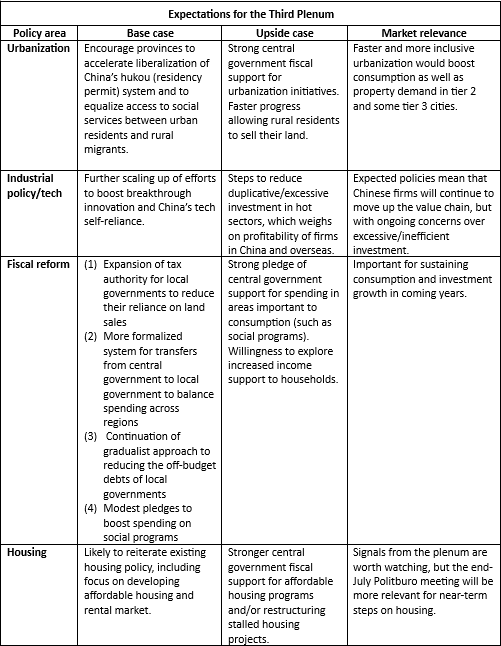
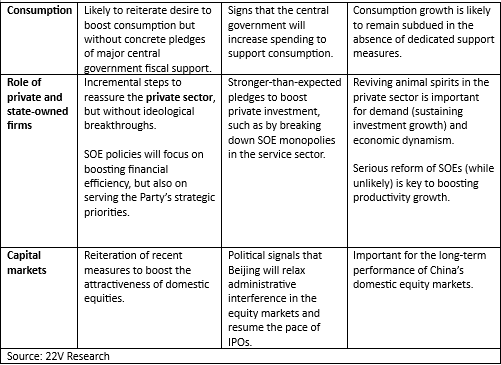
The table further below summarizes our basecase and upside case expectations in specific areas of policy. Here we cover the most important points.
Urbanization and fiscal reform are two areas worth watching, as they are key for boosting domestic demand and are likely to see a greater degree of policy attention.
- Urbanization: While China has substantially liberalized its system of residency permits (hukou), rural migrants to cities continue to face barriers buying property and accessing social services. The obstacles to hukou reform have been the leadership’s desire to control the pace of migration and the fiscal costs that local governments face absorbing new residents. A number of factors are coming together to spur greater urgency to remove hukous and equalize access to services, including the collapse of real estate demand, China’s shrinking population, Beijing’s desire to boost consumption growth, and rising income-inequality coming out of the pandemic. Our basecase is that Beijing will push local governments for a stepped pace of urbanization, backed by modest increases in central government fiscal support. The upside case would be strong determination by the center to lead this process and to help pay for it. The market implications of accelerated urbanization would be to improve the longer-term outlook for consumption as well as property demand in tier-2 and tier-3 cities (provincial cities and smaller economic hubs).
- Fiscal reform: The collapse of real estate investment and associated land sales to developers has intensified the fiscal constraints of local governments, many of whom are already burdened by high debt levels after years of off-budget borrowing. The Plenum will outline some steps to address these weaknesses, including through: (1) expanding the use of the consumption tax, income tax, and potentially property taxes; (2) a more robust and institutionalized system of transfers from the central government to local governments; and (3) steps to gradually reduce the off-budget debts of local governments. The forcefulness of these efforts will be important for domestic demand in coming years, both for investment spending (e.g., infrastructure projects) and consumption (government outlays on social services and other current expenditures).

Other areas to watch include the following:
- The role of the private and state sectors. As noted above, we do not expect ideological breakthroughs that transform the political standing of China’s private sector, such as providing them equal treatment as state-owned firms (a measure that some policy advisors had floated in recent months). Measures at the Plenum will be more incremental and focus on improving private firms’ legal rights and access to finance. These steps will have only a modest impact in boosting the long-term confidence of the entrepreneurial class. When it comes to state-owned enterprise reform, China’s leadership is increasingly focused on improving financial discipline, such as by having financial metrics serve as evaluation criteria for SOE bosses. However, Xi will continue to insist that SOEs support Party objectives such as employment and investment in strategic initiatives, which act in tension with the push for greater financial discipline.
- Capital markets. A similar tension exists in capital markets reforms. In recent months, China’s regulators – influenced in part by Japan’s corporate governance reforms – have announced steps to increase the attractiveness of China’s equity markets such as by encouraging dividend payouts and stock buybacks, tightening criteria for IPOs, and delisting struggling firms. These are important moves but will butt up against other objectives, including Beijing’s desire to use capital markets to fund industrial policy initiatives. The balance of emphasis between these various goals is worth watching.
- Housing. The Politburo meeting will be more important for near-term housing policy, such as whether PBOC increases the size of lending programs to absorb excess housing inventory and aide developers. The plenum will discuss housing in broad terms. An upside surprise would be hints that the central government is coming around to providing fiscal support to housing, such as the affordable housing push as well as restructuring the debt of developers. Policy support measures to date have mainly put the onus on cash-strapped local governments.
- Assessment of the domestic and international environment. The manner in which Beijing characterizes China’s economic situation and the global political/economic environment (particularly China’s relationship with the West) are important high-level clues for how the leadership views the risks and opportunities for China and the appropriate grand strategy. This vision will inform the direction of industrial, trade, and investment policies, among others.
- Monetary policy. China’s monetary policy toolkit is in flux, with PBOC increasingly abandoning credit growth as a key target. While the plenum won’t signal major near-term changes, it could provide indications of how monetary and credit policy will evolve. The description of currency policy, including RMB internationalization, is also worth watching.
What comes next
If the last major Third Plenum (2013) is an accurate guide, investors should expect the following deliverables:
- The meeting will conclude on July 18 with a communique that outlines the major decisions in broad strokes. This should provide a preliminary read on the reform agenda.
- Several days after the meeting, Beijing will release a lengthy Decisions document. In 2013, the Decisions document was released three days after the meeting concluded. This is the key reference document, and one that will likely guide overall economic policy for at least the next five years.
As always, it will be important not to take the announcements in these documents at face value but to assess the political and practical feasibility of Beijing’s policy pledges. We will be watching closely.