Focusing in on the Claims Data
With the employer survey (NFP employment growth), household survey (unemployment, participation, and its own measure of employment levels), and JOLTS data telling somewhat-to-quite different stories about the state of the labor market, I have been and remain most focused on the weekly jobless claims data. This came up numerous times in my pre-Fed meeting calls and I think is a point worth highlighting after a fairly optimistic outlook and sanguine framing from the Fed yesterday.
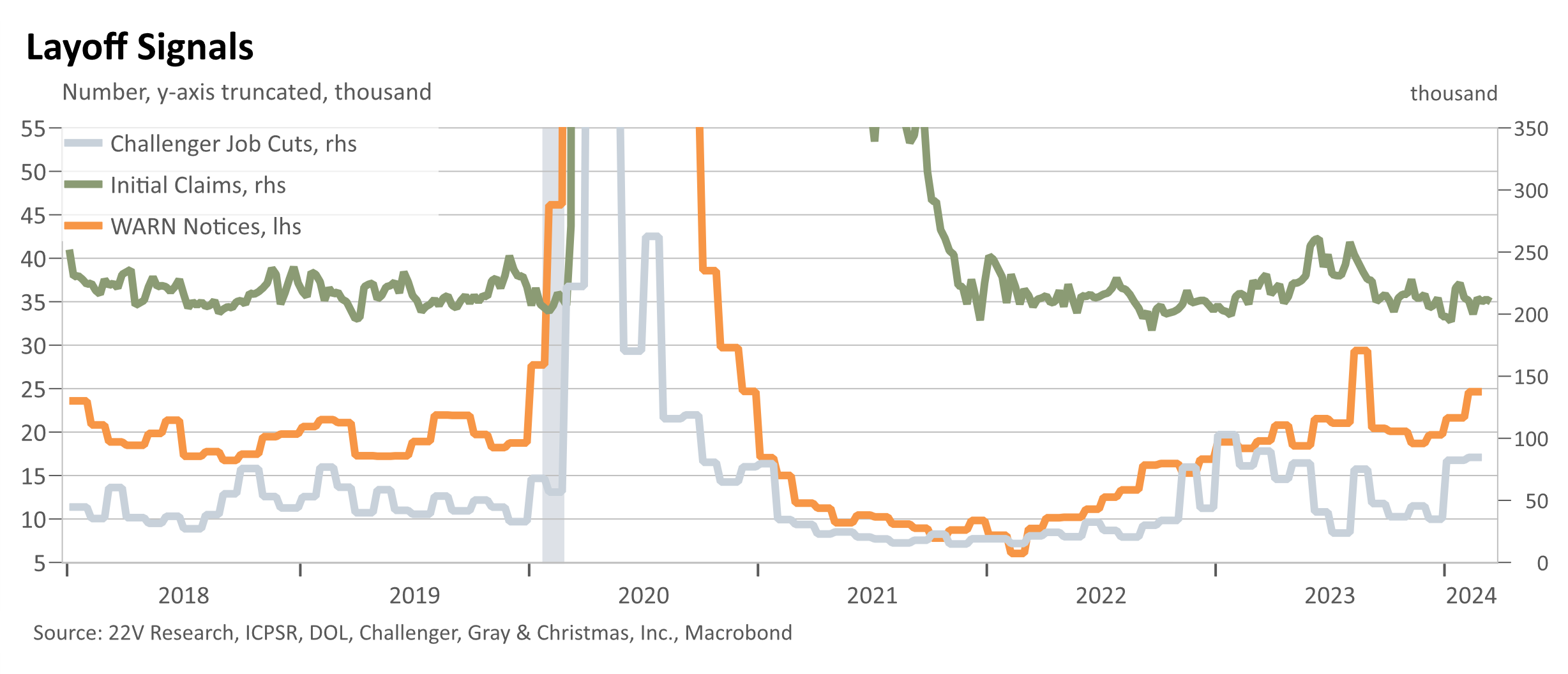
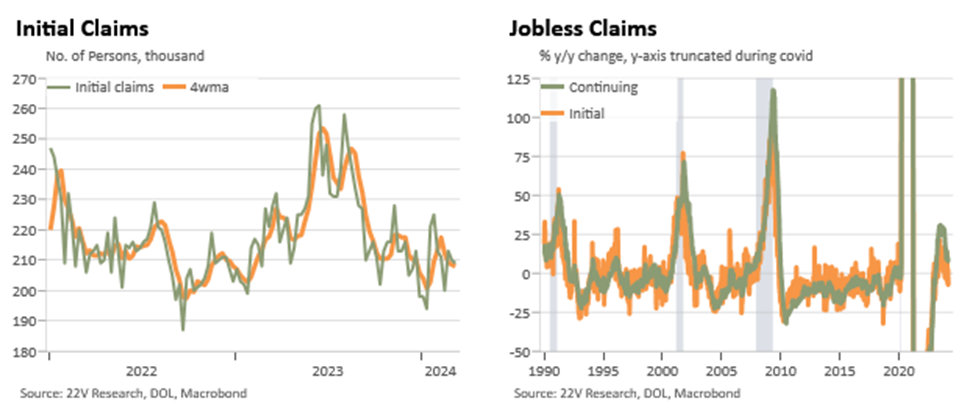
In 2023 initial jobless claims had a notable bounce in the spring and early summer, lagging the large round of layoff announcements that occurred around the turn of the year, but have since come down to their late-2022 levels (the benchmark revisions we saw to the NFP data, with more weakness in the winter and strength in the summer, are also consistent with this pattern of weakness in the initial claims data).
In the most likely scenario there will be some modest uptick in initial claims this spring, reflecting a similar but smaller announced layoff round this winter, while year-on-year growth rates initial claims should continue to be somewhat negative. I would note though that by this time last year we had already started to see some bounce in the level of initial claims so it seems possible that the announced layoffs, perhaps accruing partially through natural attrition, don’t amount to too much in once spread out and implemented.
Continuing claims essentially reflect the lagged accumulation of this initial claims jump and then decline. Using the old pre-seasonal adjustment revision data from the BLS this was harder to tell as there were a number of phantom ups and downs in the data. As a result I had been seasonally adjusting the data, and will continue to do so, which shows a much clearer mid-summer peak and then gradual decline since then. The new (as of last week) seasonal adjustments from the BLS got rid of most of the hard to explain wiggles and show a general plateau since early fall. Both my SA and the BLS’ are consistent with a labor market where reabsorption has slowed a fair bit, as weaker gross hires rates and durations of unemployment corroborate, but layoffs remain quite rare overall.
Continuing claims should, assuming that my views on initial claims’ trajectory are roughly correct, continue to move roughly sideways, with perhaps a bit of a bounce, in levels terms for much of the spring before the declining some over the latter part of the year. In y/y growth rate terms this will be a gradual descent towards 0% from the current high-single digits pace.
Why Weight Claims #1?
My underlying view is that the US economy is slowing some from the pace of last year on the back of decelerating consumer spending, but at the same time the housing and IP cycles, as well as the easing financial conditions impulse and fading impacts from the bank credit tightening shock, seem like they are bouncily becoming tailwinds to growth. Given this cyclical outlook, what I am primarily concerned about is not a gradual return towards more normal labor market conditions, with an elevated degree of dispersion, but rather an acute weakening in the labor market which threatens to become a recession.
There is of course a medium-term risk of a recession but I see that as more of an unavoidable overhead hazard, due to the mid-to-late cycle environment we’re in, rather than something that is shifting particularly dynamically.
With that in mind, I am mostly focused on the jobless claims, and to a lesser extent the NFP data (which isn’t perfect and is subject to benchmark revision but I think it runs the least risk of being distorted by post-covid renormalizations and monthly sampling issues), when it comes to assessing the contemporaneous risk of a recession starting. The benefits of the claims data are of course its timeliness, direct link to firm actions, and obvious cyclicality.
A few other forces currently make me lean in favor of claims (and to a lesser extent the NFP data):
- There is a possible bullwhip in churn-driven data in the labor market (quits dropping below their expected levels because of so much ‘excess’ quitting in 2021-22, which then pulls down gross hiring needs and reduces the effective number of jobs openings, perhaps somewhat distinct from the stated number; see more here), taking the JOLTS data at exactly face value leads to excessively dovish conclusions at the moment. We have heard the occasional note of dovish concern from Fed officials when looking at this data over the past few months but it has been rarer than I would have expected.
- In yesterday’s press conference Chair Powell continued to cite job openings’ dependent metrics of labor market tightness as illustrating the health and residual heat in the labor market. Given the secular uptrend in the job openings rate, depending on these metrics without adjusting for this is naturally hawkish in its implication, or at least it is not dovish.
- The household has departed notably from the employer survey in the past few months and is the most concerning part of the labor market. However, as Chair Powell also noted, the prime-age labor data is holding up notably better than the overall survey, which in the first case suggests to me that this gap is largely noise in an underlying macroeconomic sense. Historically it has opened up at times and there is not usually much of an immediate cyclical link, besides a general observation that the employer survey tends to be better during very good times while the household has trended higher during weaker labor markets (the late 1990s and the post-GFC years being the only two real examples of this extremely small-N observation).