Back Economic Research

Yet Another Bullwhip Effect? Could Falling Labor Market Churn Be a Source of Increased Fed Disagreement (or Dovishness) and Outlook Uncertainty

Published on November 7, 2023

∙ Download the PDF Report

By

Peter Williams

One idea I’ve been pondering, and which seems worth flagging to clients after the last few weeks of data and earnings calls, is the possibility that after 3 years of disruptions and elevated turnover in labor market labor market churn measures (quits, gross hires, and openings) might go through a period of post-boom bullwhip where they temporarily drop below their 2019 levels even if other measures of the labor market remain relatively healthy.[1]

This is admittedly something that’s a bit more speculative than fully grounded and I am not entirely sure how to handicap the odds as its a fairly novel concept if applied to labor markets (but better to flag tentatively and watch than wait for 100% confirmation), even if much better understood in goods and investment cycles. If it is likely to happen, we should start seeing broader signs soon and this will have notable impacts on the Fed and broader macro debates.

In the event some version of this does occur, sectors such as leisure and hospitality, retail trade, and warehousing seem more likely to be impacted than others, with some recent earnings call commentary leaning in that direction but the macro data not as suggestive.

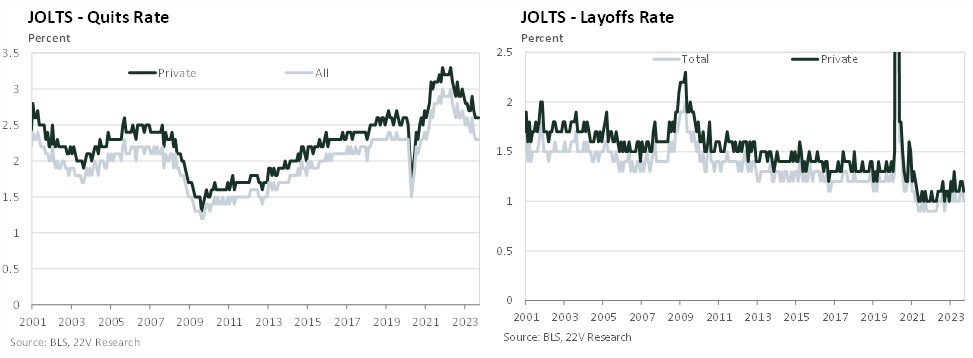
If this happens, even among higher levels of job growth and a low-enough unemployment rate, it will likely lead to increased Fed and economic commentator disagreement, with the more dovishly inclined able to point to less-robust churn measures as a potential warning sign of recession or at least signal that the Fed has done enough and should start to pivot soon. Given the quits rate’s historical outperformance as an indicator of labor market slack there is a robust basis for this view.

As with inflationary bullwhips after large sectoral surges (the ECB’s Schnabel gave a speech last week on this that is worth reading or skimming, even for US- focused audiences), how long the payback downturn in churn lasts, even how intensely, may not be that meaningful for actual underlying inflationary pressures, especially if one views the world through a hawkish lens. Admittedly in the labor market context that metaphor may be a bit stretched but it is worth bearing in mind that some payback-driven softening could tell us little about underlying trends.

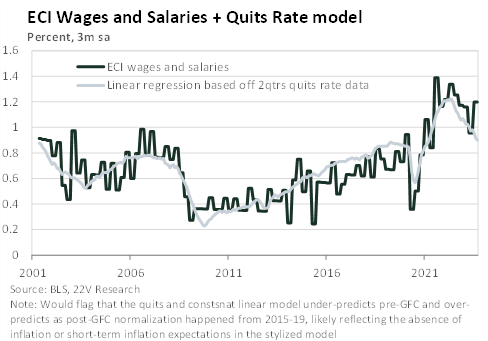
The large or massive cumulative gap (depending on if you looking at the Atlanta Fed wage growth tracker or ADP’s wage data) between job switcher and job stayer wage growth since mid-2021 could lead to more modest declines in wage growth than a linear mapping from quits to the ECI, for example, would suggest as whole-economy wages reconverge after the switching surge.[2] Cumulatively the ECI has been a bit stronger than quits would tell you to expect since 2021H2, perhaps reflecting lagged wage catchup or the impact of still-elevated inflation and/or inflation expectations on the wage setting process.

It’s worth noting amidst the other data that so far the layoffs rate has barely budged off its post-covid lows; this could be a sign of cyclical robustness amidst odd labor market internals or that after so much labor market churn firms remain extremely hesitant to fire workers even if demand was to slow from here. [3]

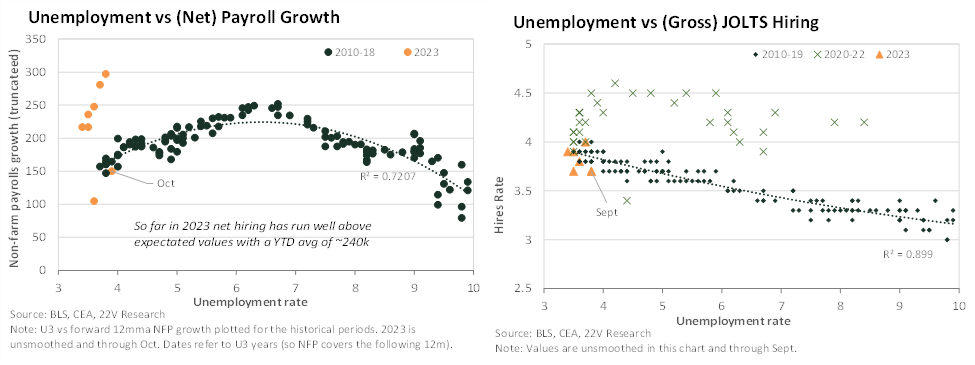
Mechanically a transitory dip in quits this would also lead to less hiring in gross terms, as mildly seen in the JOLTS data but not the NFP data, as there would be fewer open positions needing to be filled.

Gross hiring rates (which are what JOLTS measures) have dipped slightly below their usual linear relationship to the unemployment rate in latter 2023, after running well above for the prior few years given post-pandemic rehiring, but net hiring remains strong and above that predicted by the usual relationship with the unemployment rate on a 3mma basis (where NFP growth was fastest mid-cycle once the acute recessionary impact faded but before hiring runs into late-cycle concerns or labor supply constraints).
  1. Guy Berger’s, formerly of LinkedIn, blog post on the JOLTS data christened this “the great stay” following “the great resignation”, a quippy title I wish I’d thought up. ↑

  2. Gerard has made the this point before and I think it reasonably conforms to the catch-up and relative price adjustment dynamics story told about the lagging growth and deceleration in core services ex housing inflation. ↑

  3. One of the broader issues at the moment is that the path to a slow landing and hard one are likely to look at least fairly similar for now. ↑


DISCLOSURES AND DISCLAIMERS

Analyst Certification

The analyst, 22V Research Group, primarily responsible for the preparation of this research report attests to the following: (1) that the views and opinions rendered in this research report reflect his or her personal views about the subject companies or issuers; and (2) that no part of the research analyst’s compensation was, is, or will be directly related to the specific recommendations or views in this research report.

Analyst Certifications and Independence of Research.

Each of the 22V Research analysts whose names appear on the front page of this report hereby certify that all the views expressed in this Report accurately reflect our personal views about any and all of the subject securities or issuers and that no part of our compensation was, is, or will be, directly or indirectly, related to the specific recommendations or views of in this Report.

22V Research (the “Company”) is an independent research provider. The Company is not a member of the FINRA or the SIPC and is not a registered broker dealer or investment adviser. 22V Research has no other regulated or unregulated business activities which conflict with its provision of independent research.

22V Research, LLC is a professional services and independent publication organization. 22V Research, LLC is not a securities broker-dealer, not a member of the Financial Industry Regulatory Authority (FINRA), not a registered investment advisor (RIA) and not a member of SIPC.

Securities transactions, when offered, are offered by 22V Securities, LLC through LPS Capital, LLC. Certain employees of 22V Securities, LLC are dually registered as securities representatives of LPS Capital, LLC or Analyst Hub Securities, LLC. 22V Securities, LPS Capital and Analyst Hub Securities are members FINRA, SIPC.

https://brokercheck.finra.org/

Current Ratings Definition.

SECTOR OUTPERFORM: An “outperform” rating anticipates the company will outperform the S&P Regional Banking Index (peer group).

SECTOR PERFORM: A “market perform” rating anticipates the company will perform in line with the S&P Regional Banking Index (peer group).

SECTOR UNDERPERFORM: An “underperform” rating anticipates the company will underperform the S&P Regional Banking Index (peer group).

Limitation Of Research And Information.

This Report has been prepared for distribution to only qualified institutional or professional clients of 22V Research Group. The contents of this Report represent the views, opinions, and analyses of its authors. The information contained herein does not constitute financial, legal, tax or any other advice. All third-party data presented herein were obtained from publicly available sources which are believed to be reliable; however, the Company makes no warranty, express or implied, concerning the accuracy or completeness of such information. In no event shall the Company be responsible or liable for the correctness of, or update to, any such material or for any damage or lost opportunities resulting from use of this data. Nothing contained in this Report or any distribution by the Company should be construed as any offer to sell, or any solicitation of an offer to buy, any security or investment. Any research or other material received should not be construed as individualized investment advice. Investment decisions should be made as part of an overall portfolio strategy and you should consult with a professional financial advisor, legal and tax advisor prior to making any investment decision. 22V Research Group shall not be liable for any direct or indirect, incidental or consequential loss or damage (including loss of profits, revenue or goodwill) arising from any investment decisions based on information or research obtained from 22V Research Group.

Reproduction And Distribution Strictly Prohibited.

No user of this Report may reproduce, modify, copy, distribute, sell, resell, transmit, transfer, license, assign or publish the Report itself or any information contained therein. Notwithstanding the foregoing, clients with access to working models are permitted to alter or modify the information contained therein, provided that it is solely for such client’s own use. This Report is not intended to be available or distributed for any purpose that would be deemed unlawful or otherwise prohibited by any local, state, national or international laws or regulations or would otherwise subject the Company to registration or regulation of any kind within such jurisdiction.

Copyrights, Trademarks, Intellectual Property.

22V Research Group, and any logos or marks included in this Report are proprietary materials. The use of such terms and logos and marks without the express written consent of 22V Research Group is strictly prohibited. The copyright in the pages or in the screens of the Report, and in the information and material therein, is proprietary material owned by 22V Research Group unless otherwise indicated. The unauthorized use of any material on this Report may violate numerous statutes, regulations and laws, including, but not limited to, copyright, trademark, trade secret or patent laws.