

A Few (Too Early) Thoughts on the March SEP and Fed Forecast Risks More Broadly
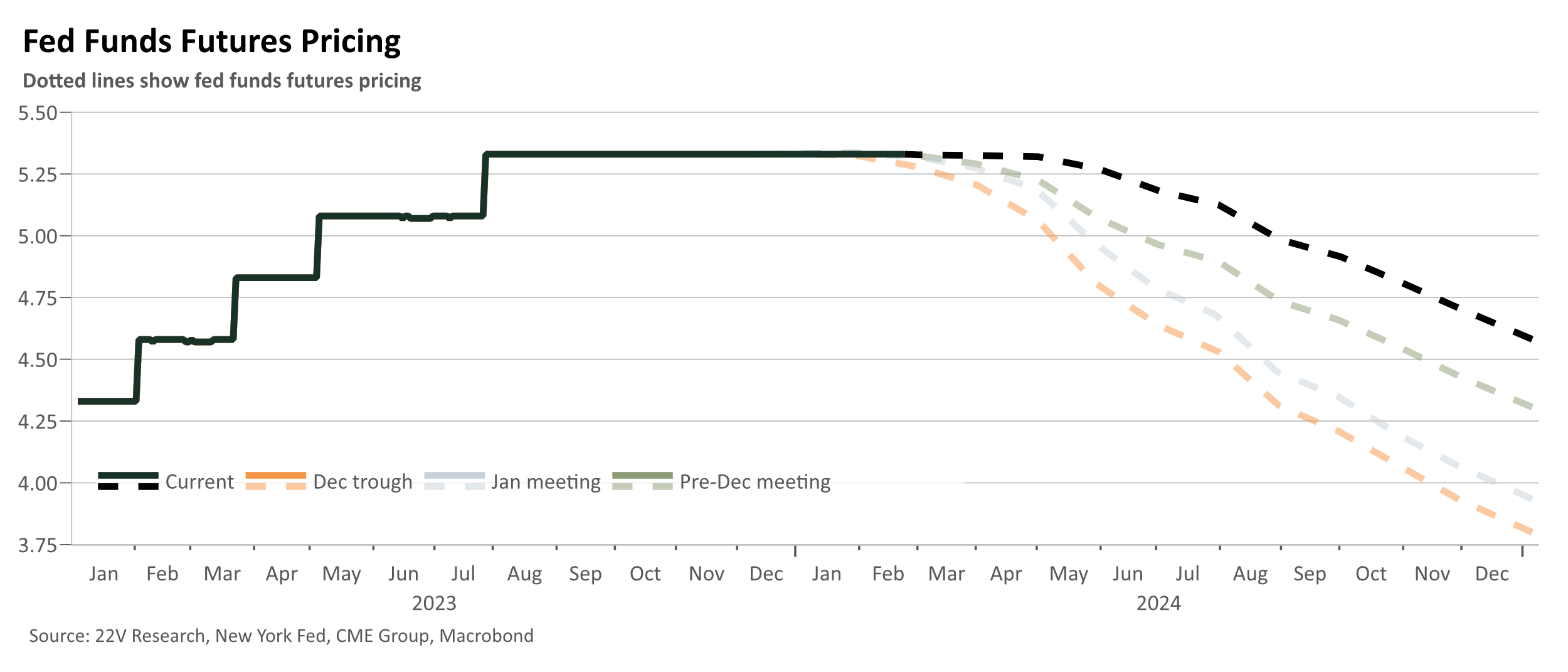
With recent hotter inflation and labor market data the Fed has found itself placing less emphasis on recessionary risks and real rate/Taylor rule-type frameworks for cuts, even with the fed funds rate at such a high level, leaving inflation concerns the marginal driver of policy. These are important shifts from the tone seen in much of Q4 as the inflation data was coming in softer and growth risks still seemed skewed to the downside.[1]
The March Fed meeting (3/20) remains a ways off and it is still too early to pencil in more formal guesses for the Summary of Economic Projections (SEP) and Dot Plot given that we get Jan PCE (2/29), updated Q4 GDP (2/28), and February CPI (3/12), PPI (3/14), and employment data (3/8) before the meeting.
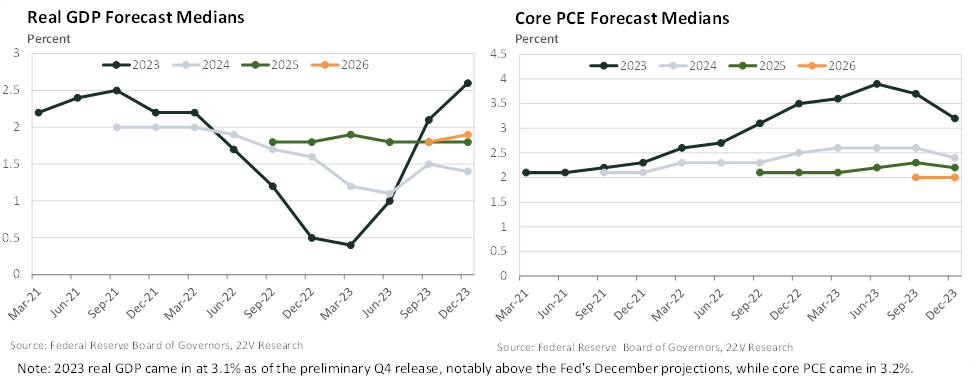
Directionally, the March SEP is likely to see 2024 GDP growth revised up slightly from 1.4% and the core PCE forecast (2.4%) runs the risk of being pulled up as well, but I think this depends on any January carryover into the February inflation data. My guess, quite tentative so far out from the meeting, is that the median of 3 cuts will be unchanged but it seems fairly likely that some of the downside distribution in the 2024 dots will be pulled up toward the median.
If, and it’s a big if at this point, the Fed ends up cutting less in 2024 than it currently expects that is unlikely to be telegraphed this early in the year. The June (or perhaps May) meeting and lead up it seems a more likely time for pushing out cuts given the Fed would have a much better sense of economic momentum in H1 and perhaps be more willing to assess its views on how restrictive policy has been if inflation has bounced some in the short-term and growth has decelerated less than forecast.[2]
The December SEP Suggests a Few Natural Shifts
Twp features of the December SEP bear pointing out given the recent data flow and are likely to be relevant for the March meeting.
- As I have noted before, the Fed’s 2024 growth forecast was too low as a base case and is likely to be revised up some, although how much is a matter of both Fed forecast praxis (the continued weight on restrictive real rates, long and variable lags, and the now seemingly departed banking and credit squeeze dragging growth below potential, see more here and here) and how Q1 tracking estimates look at the time of the meeting. We have heard Fed speakers partially shifting towards a more optimistic near-term forecast in recent weeks but there remains a forecast bias here which I think is unlikely to resolve fully in the near-term.[3] The data has meant that the Fed now has much less of an active risk management concern to the downside growth tail than even a few months ago. What the precise level of the 2024 growth forecast where it starts making the Fed outright hawkish, rather than less dovish, is harder to guess but my suspicion is that it’s roughly 2.75% (+100bps above their current views of long-run potential but allowing for some continued possible near-term supply side improvements that have elevated the non-inflationary growth path).
- The Fed’s current 2024 core PCE forecasts seem to have much more symmetric risks than their near-term inflation forecasts have had for much of the previous few years. I noted at the time of the December meeting that the 2023 core PCE forecast downgrade reflected a more full incorporation of the recent data flow after the September SEP CPCE forecast, which was immediately too high but starting to show fewer sign of inflation forecast risk aversion. The practical impact of this is that if there is some carryover from the hot Jan inflation data into Feb, the March SEP runs the risk of pushing up the 2024 core PCE forecast. It’s too early to make a definitive call on this possible upgrade but the risk, and potentially hawkish implications, should be top of mind as we move closer to the meeting.
In the interest of fairness, at the turn of the year I was a medium-term bull but thought there was a risk we would get some downside Q1 volatility in the labor market and/or activity data that would lead to an ephemeral rally in rates before medium-term economic tailwinds took over ↑
Weather and residual seasonality, as well as the Fed’s annual rather than quarterly forecasting projections, lean against any large shifts in March barring particularly large shocks combined with an obvious direction of travel. Also other central banks, the Bank of England for example, suffers from a bit less forecast inertia if they focus on constant horizon rather than date-based forecasts. ↑
Obviously, risk management concerns have a roll to play but the issue is that the Fed had seemed to be partially imparting risk management via the modal base case macroeconomic forecasts themselves rather than just through the dot plot. ↑

