

Credit Tightening is Normalizing, Removing a Downside Tail for the Fed to Risk Manage
- The Fed’s senior loan officer opinion survey (SLOOS) for 2024Q1, which the Fed would have had at the January meeting, shows a notable lessening in the share of banks continuing to tighten credit standards. The removal of the post-meeting statement’s language on the health of the banking system (a slightly Owellian tweak in a way) and minimal discussion of banking or credit stress from Powell suggested this was likely to be good news.
- In many respects, the SLOOS cycle resembles the ISM / goods and housing ones, all of which look like they are troughing or bouncing out of a mid-cycle slump.
- The SLOOS will likely switch to showing mild-to-modest net easing during the coming few quarters, assuming the economy holds up.
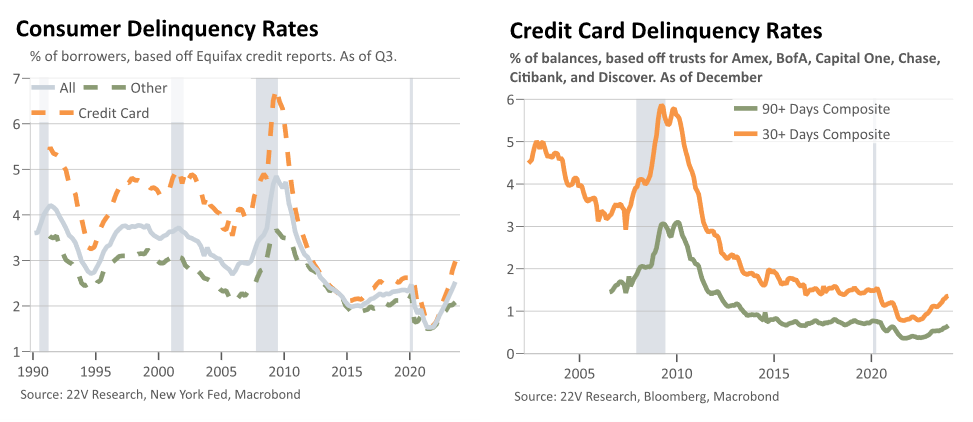
- Other sources also suggest that the credit cycle, especially for consumer, may be in the latter innings of a normalization. Comments from bank and financial company earnings season suggest that the deterioration in consumer credit health seems to be starting to fade, with delinquency behavior largely normalizing to 2017-19 levels. Recent Fed staff research suggests that credit score and lending drift after covid may go part of the way in explaining the recent uptick in delinquency rates, which attenuates some of the potentially worrying signal there.
- For the FOMC, these increasing signs of credit cycle stabilization, whether in consumer credit trends as reported by the banks or the SLOOS, help truncate some of the reasons for being dovish. Up until the January meeting their policy actions, forward guidance, and forecasts had been incorporating some of these forward-looking concerns which are now more obviously fading.
- With these risks becoming progressively more attenuated it may, ceteris paribus, start to push some of the medium-term policy rate risks in the other direction as the recession-less credit tightening cycle’s normalization starts to help boost the cycle, even after it dampened it (I’d suggest on net in a helpful way) over the past few years.
This highlights two dueling market forces will play key roles in shaping the Fed outlook in 2024:
- Banks are likely to end up doing some modest loosening for the Fed over the course of the year.
- Longer-term interest rates (whether Treasuries, corporate credit, mortgages, or other consumer installment loans), are going to act as negative feedback loops on cyclical heat, moving up when growth or inflation accelerate and back down when they slow. This will do some of the Fed’s work for it endogenously but makes for more challenging rate policy and forward guidance dynamics.
The SLOOS Suggest That Credit Tightening is Fading
Since the SME bank stress that peaked in March 2023 the Fed’s policy making framework has incorporated banking stress sector stress and credit tightening into their policy framework. This probably helped lean against an additional +25bps hike or two in 2023.
Much of the credit standards tightening shock was downstream from the increases in rates and rates volatility, which had myriad impacts on banks’ net worth and liability management needs, but some of it also reflected a preemptive belt tightening that came after the post-covid reopening boomlet. This is contrary to the usual behavior of these series which tend to be highly procyclical but contemporaneous rather than outright leading of growth weakness (shocks, meaning moves not explained by other macro developments, to the SLOOS do predict future activity weakness but usually as a source of drag rather than forward looking recessionary predictor).
The 2024Q1 data almost universally show less tightening taking place across banking loan relationships, although there is no outright easing happening yet either.
Given the nature of SLOOS diffusion index and its rapid swings from modest-to-no easing towards broad-based tightening and back again, the move towards easing seems likely to happen over the course of this year. Some of these measures (cost of credit lines and CRE notably) seem likely to normalize at a somewhat slower pace than the commercial and industrial and consumer facing measures given the relative sources of stress remaining in the system (high spot rates, rates vol, and CRE uncertainty jump to mind).
It is also worth noting that in almost all these measures the average tends towards a slightly positive share of banks which are tightening, so 0 in the usual sense is more like 5-10 (not unlike how the ISM survey usually reference values in the low-to-mid 40s as outright recessionary rather than 50)
The overall story from the SLOOS release is one of continued caution from banks, but with a trend that now looks favorable for the latter part of the year.
At First Glance, Consumer Delinquencies Appears Concerning
Consumer credit, and lending tightness more broadly, has been an increasing area of worry for many over the past 12m. This was accentuated by the liabilities stress that the demise of SVB brought to many small to medium sized banks.
The fairly rapid increase in delinquency rates, especially for credit cards, has tied back in with discussions of a slowing labor market to suggest that the consumer, and thus the broader economy, is close to rolling over. Recent comments from bank and financials earnings calls as well as granular Fed research suggest that this fear may be overstated although the personal hit to many consumers is undeniable, and pinning down the underlying reasons, beyond simple normalization and perhaps a bit of catchup, is fairly challenging.
During and after covid, robust hiring markets and exceptional levels of fiscal spending targeted at households lead to substantial credit score migration. This has had two important effects on how delinquency data appears in public. First, it meant that a much smaller and less credit worth section of the population was left as subprime, making that category much more susceptible to a normalization in delinquency behavior as stimulus checks were spent and extremely rapid wages gains faded. Second, the near prime and prime categories experienced substantial increases as well which made them less credit-worthy when compared to 2019 standards.
Two recent pieces of Fed research dived into these themes with somewhat differing tones of concern and are worth sharing:
- Staffers at the Fed Board used Equifax microdata to estimate counter-factual auto and credit card delinquency ratees assuming there had not been post-covid credit score drift (here). The results show “subprime delinquency rates that are both considerably lower and exhibited more muted increases over the past few years. Because so much of the increase in subprime delinquency rates owes to this migration, the large increases in these rates should not be used as a sole indicator of deteriorating credit quality.”
- At the New York Fed, the tone was somewhat more pessimistic in their assessment of the data. They noted that, “while the growth in auto loan delinquency has appeared to moderate over recent quarters, credit card delinquency rates have risen at a sharper pace. Even though the increase in delinquency appears to be broad based across income groups and regions, it is disproportionately driven by Millennials, those with auto or student loans, and those with relatively higher credit card balances.” They note difficulties in finding an underlying cause given that the move up has happened without underlying labor market weakness; one comparison that immediately jumps out is the 1995-96 move up in delinquency rates which occurred after the 1994 tightening cycle and during that mid-cycle correction without leading to any broader cyclical issues.
But Bank Earnings Lean Suggest the Consumer is Generally Healthy and this is a Normalization Story
Bank earnings season this January sounded notably more optimistic than it had in recent quarters. The theme in their consumer-facing books largely boiled down to either a gradual normalization in default and delinquency behavior or a stabilization, after a bounce, since roughly Q3 (when the FRBNY/Equifax data used in both the Fed pieces above stops).
In most cases, firms highlighted that delinquency rates were near their 2017-19 comps, suggesting that while some increases have occurred this is driven by normalization, not outright weakness, and that their expectations into 2024 are for these normalization or stabilization trends to continue.
Some quotes from the most recent round of earnings calls that stood out to me below.
Bank of America
- “We see a normalization of that credit. So they’re working, they’re getting paid, they have balances in their accounts, they have access to credit, they’ve locked in good rates on their mortgages, and they’re employed. We feel it’s good. So we think the soft landing is a core thesis and our internal data supports what our research team sees and they see it also through our institute.”
- “They’re beginning to normalize. This is a period of transition for the economy, and it’s a period of transition for our clients, too. A lot of them are dealing with higher interest rates and they’re just beginning to moderate and change their spending behaviors. So, we’ve seen a trend over the course of the past few quarters… but that’s going to bounce around over the course of the next couple quarters now that we’re back towards 2018, 2019 levels. It’s going to settle in, we think, in the first half of this year.”
- “Be careful on the Consumer side because basically the pay as you go side of the Consumer side is still building up to a nominal amount of charge-offs consistent where it was in 2018-2019. So if you look at card in 2018-2019, the charge-off rate across the eight quarters ranged from a low of 2.90% and a high of 3.26%. We’re at 3.07% today.”
Wells Fargo
- “Consumer spending remains strong. Credit card spend was up 15% for the year and was remarkably stable throughout the year with growth rates strong across all categories except fuel, which was impacted by lower gas prices.”
- “Consumer net loan charge-offs continued to increase and were up $118 million from the third quarter to 79 basis points of average loans. The increase was driven by the credit card portfolio which performed as expected, with increased losses driven by recent vintages maturing.”
JP Morgan
- “The way we see it, the consumer is fine. All of the relevant metrics are now effectively normalized… But I do think it’s important to take a step back and remind ourselves that consistent with that soft landing view, just in the central case modeling – obviously, we always worry about the tail scenarios – is a very strong labor market. And a very strong labor market means, all else equal, strong consumer credit.”
Capital One:
- “The 30-plus delinquency rate has been stable on a seasonally adjusted basis for a number of months now. Since August, our monthly delinquency rate has been moving in line with normal seasonality, and at stable ratios relative to the same month in 2018 and 2019. And at this point, we have a pretty good window into January as delinquency entries in December indicate continuing delinquency rate stability in January.”
- “Monthly auto credit began to stabilize even earlier than domestic card credit results. On a monthly basis, auto delinquency rate and charge-off rate have been tracking normal seasonal patterns since the first half of 2023 and continued to do so through December.”
Discovery Financial Services
- “So, my sense is that given real wage growth, our consumers will end up in, frankly, a better spot in 2024 and 2025 than they were in 2022 and 2023. And our charge-off forecast and reserves reflect a view that the consumers will manage through this and delinquency formation will continue to slow.”
Citizens Financial Group
- “The second area is really just continued normalization on the consumer side, which has been extremely slow and gradual, but they’re still slightly better than where we were pre-COVID. And so, that will just gently push up as we go forward.”
Fifth Third Bancorp
- “I think the scenario that you’re laying out there with fewer Fed cuts, continued strength from an economic perspective, that’s not a remote scenario in our view. We feel like that is something that could very easily happen, especially in the first half of the year, as we continue to see potentially some strong resiliency from the consumers.”
Synchrony Financial
- “At year-end, our 30-plus days delinquency rate was 4.74%, compared to 3.65% in the prior year and 12 basis points above our average for the fourth quarters of 2017 to 2019. Our 90-plus days delinquency rate was 2.28% versus 1.69% last year, and 4 basis points above our average for the fourth quarters of 2017 to 2019.”
- “It’s important to note that when you look at both the 30-plus and the 90-plus days delinquency rate that is in the fourth quarter, there are only 12 basis points and 4 basis points, respectively, over the three-year average from 2017 to 2019. So – and then when I look at the mix of credit that sits in delinquency today, it’s substantially similar to that of the 2019 credit mix… When you look at it, the consistency of the growth month-on-month, year-over-year, and 30-plus, 90-plus days, has not shown deterioration.”
- “We’re generally cautiously optimistic on credit”

