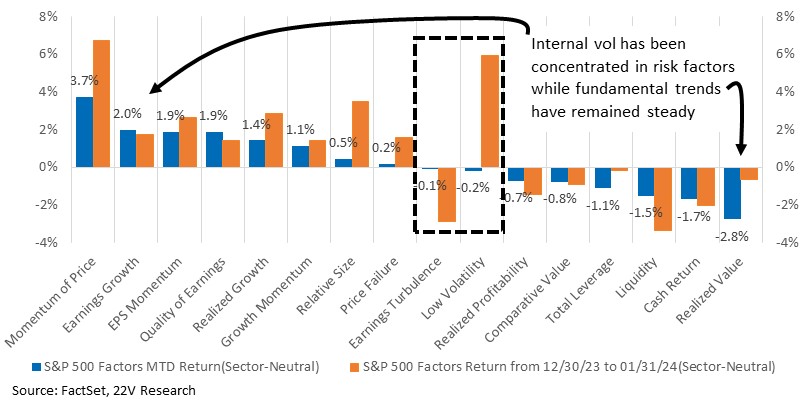
There are a few important takeaways from today’s report. First, increased policy uncertainty after the FOMC and payroll report caused a dramatic shift in risk factor performance BUT had little impact on fundamental factor trends. Momentum and Growth continue to lead internals, and Price Mo has shown no mean reverting tendency.
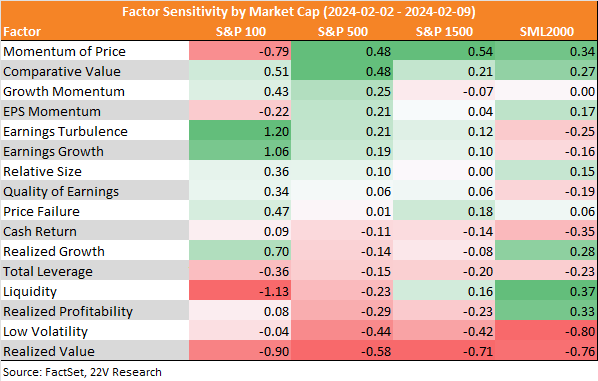
Second, Value factors continued to lag, deepening their YTD declines even as the growth backdrop has improved, the Treasury curve has steepened, etc., Value has NOT been universally weak though. Sensitivity analysis applied across cap breakdowns shows Comparative Value started to contribute to returns last week. Growth contributions to returns faded some as well. For most market size segments, fundamental factors sensitivities remain positive. Realized Value remains an outlier among fundamental factors, and macro supports for Value have firmed.

Historically, Value factor performance has been positively correlated with various leading indicators. PMIs bottomed out and moved higher over the past several months, which has helped lift fundamental factors in general. Near-term, the MUCH stronger than expected earnings reporting season has boosted Growth, and policy uncertainty has stood in the way of a strong Value rotation. Value factors become more attractive after reporting season winds down, assuming no new policy shocks. FYI, based on our survey work last week (HERE), Value and Growth are the favored factors in all economic scenarios.
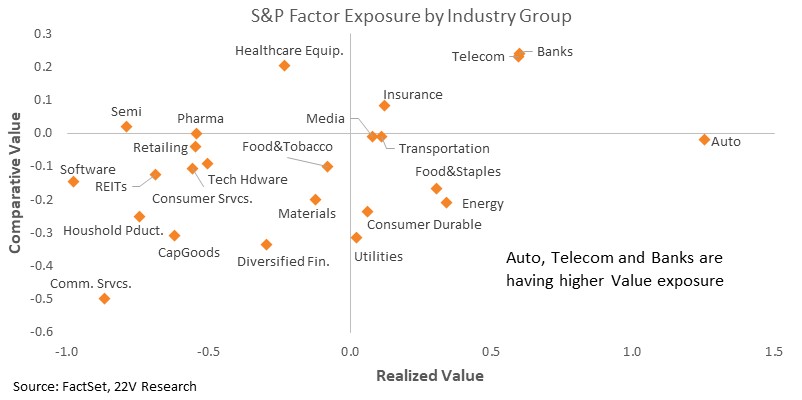
Industry group exposure to Realized Value and Comparative Value are positively correlated with just a few large divergences. Banks, Telecom, and Insurance are positively exposed to both Value measures. To be clear, there are Value names within all industry groups, but of potential group plays for a Value rebound, Banks, Telecom, and Insurance are best positioned. Within most other industries, looking for value requires being more selective.
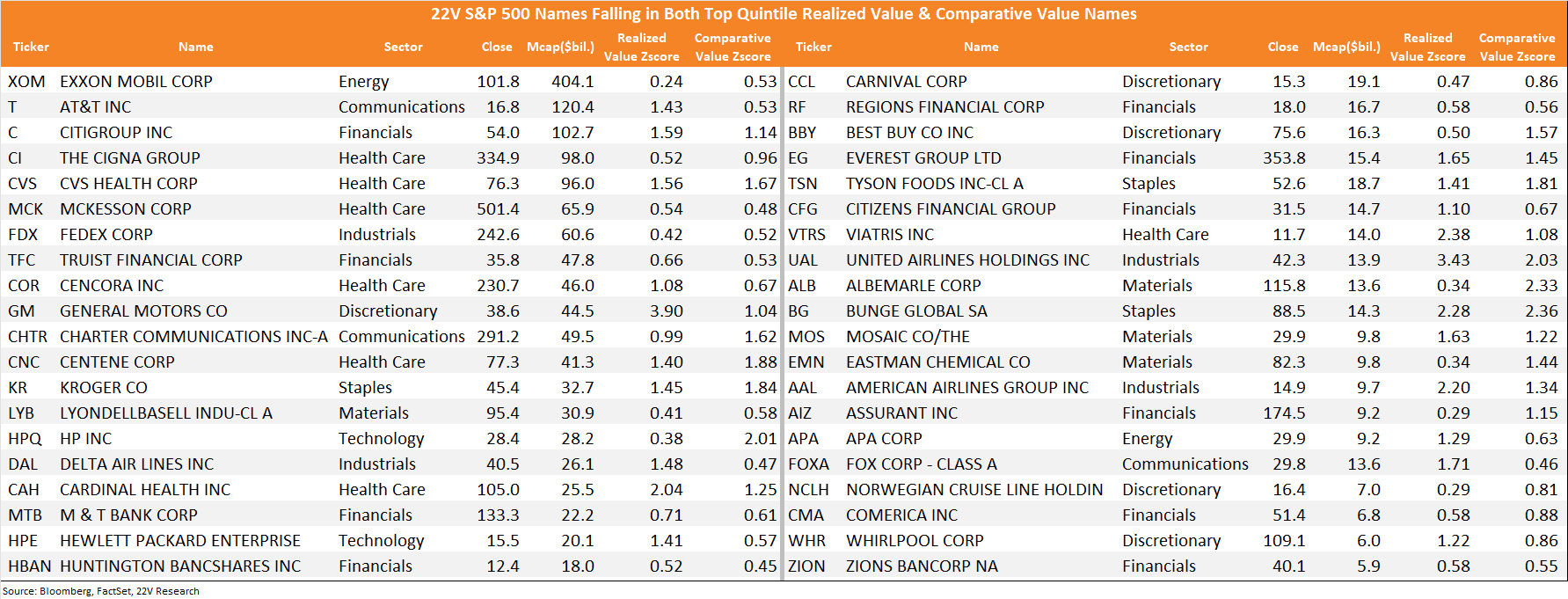
At the end of this report, we list names with high Realized and Comparative Value scores from within the S&P. A similar ranking approach can be applied across custom universes or portfolios. The bottom line is fundamental factor contributions to returns have already increased, and the influence of Value factors is likely to increase as reporting season winds down.
Value Divergence from Macro Trends: Increased policy uncertainty after the FOMC and payroll report caused a dramatic shift in risk factor performance but had little impact on fundamental factor trends. Momentum and Growth continue to lead internals, and Price Mo has shown no mean reverting tendency. Value factors continued to lag, deepening their YTD declines even as the growth backdrop has improved, the Treasury curve has steepened, etc.,
Value has NOT been universally weak though. Sensitivity analysis applied across cap breakdowns shows that Realized Value continued to lag last week, but Comparative Value (value measured relative to history and other names) has started to contribute to returns. Growth contributions to returns faded some last week as well. For most market size segments, fundamental factors sensitivities remain positive. Realized Value remains an outlier among fundamental factors and there are reasons to think that trend will reverse.
Historically, Value factor performance has been positively correlated with various leading indicators. PMIs and Value factor returns tend to be positively correlated for instance. PMIs bottomed out and moved higher over the past several months, contributing to the firming of the overall macro backdrop. Near-term, the MUCH stronger than expected earnings reporting season has boosted Growth, and policy uncertainty has stood in the way of a strong Value rotation. Value factors become more attractive after reporting season winds down, assuming no new policy shocks. FYI, based on our survey work last week (HERE), Value and Growth are the favored factors in all economic scenarios.
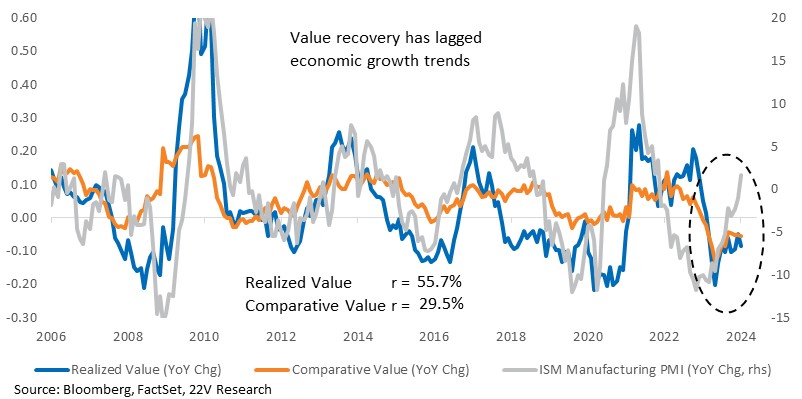
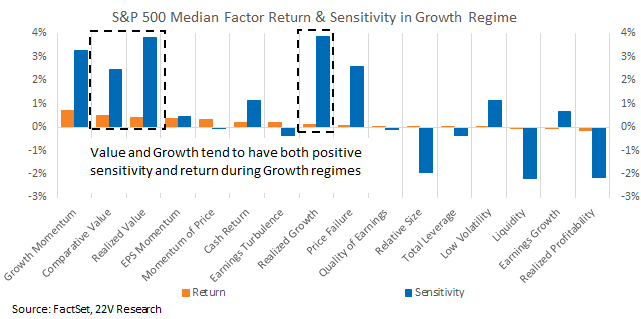
Historically, Growth regimes have been good for Value. S&P Value factor median returns and sensitives are positive during period of economic expansion. Put simply, focusing on Value characteristics tends to be a good way to enhance portfolio returns during economic expansion periods.
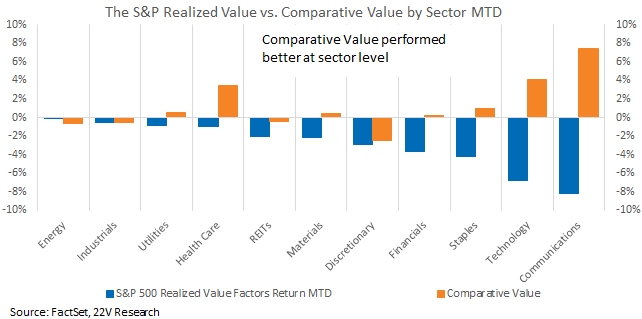
At the sector level, Value factors returns have diverged recently. Comparative Value gained, especially in Communications and Technology in February. Realized Value, on the other hand, has underperformed across all sectors. Realized Value measures current price relative to fundamentals, and Comparative Value evaluates Value relative to historical readings and across sub industries. Comparative Value outperformance suggests investors favor strong fundamentals that are relatively inexpensive rather than the lowest cost names. That is consistent with the outperformance of GARP during 3Q23 (HERE), a period with a similar macro backdrop (improving economic activity, policy uncertainty), and why Value and Growth are favored by investors.
Industry group exposure to Realized Value and Comparative Value are positively correlated with just a few large divergences. Banks, Telecom, and Insurance are positively exposed to both Value measures. Communication Services tend to be less exposed to both Value exposures. To be clear, there are Value names within all industry groups, but of potential group plays for a Value rebound, Banks, Telecom, and Insurance are best positioned. Within most other industries, looking for value requires being more selective.
Below, we list the S&P names most exposed to both Realized Value and Comparative Value. An expected rebound from Value factors should benefit the names below. A similar ranking approach can be applied across custom universes or portfolios.