The Great Wait – The Goods Economy Between Boom, Blah, and Slowly Back Again
For the goods sector of the economy, the past few years have been a challenging time with higher rates weighing on durables and housing-related consumption as pandemic-era demand surges and disruptions normalized. This left pricing stretched and firms unsure about where exactly they needed to steer prices towards to maintain, or least defend, margins as volumes were largely flat.
In 2024, after muddling through the slowdown of late 2022 into 2023, the broader goods economy will start to rebound. This process is likely to take some time and is more of a 24H2 view than a near-term one but already one can see some, still tentative, signs of stabilization emerging. The just released Fed Biege Book, conveys this idea nicely with firms reporting that, “overall, most Districts indicated that expectations of their firms for future growth were positive, had improved, or both.”
For now, firms are in what I will call (at the risk of letting a good title drive the contents of a piece) ‘the Great Wait,’ having experienced substantial headwinds over the past year and a half, but with prospects starting to look up as post-pandemic shocks and demand normalize. In the near-term, pricing is likely to remain under some pressure (anyone with an inbox even vaguely similar to mine probably noticed a sharp increase in the number of holiday-related sales this year compared to the past few years), through mid-year seems like a reasonable base case, but volumes seem to be tentatively picking up and my read of the data suggests that this is likely to continue.
While eventually corporate sentiment and survey measures are likely to bounce, I suspect that this may lag the hard data a bit more than history might suggest given the relative weakness of survey measures relative to the hard data over the past 18 months (more acute rest of world weakness has probably been a partial cause of this discrepancy in fairness).
Causally, much of this impulse to growth and eventually more normal pricing comes from: the housing sector’s return to modest growth, auto production bouncing and stabilizing, the slow normalization in inventories dynamics and real retail sales, and fading impacts of supply chain shocks. In other words, the pandemic era whipsaws are still reverberating through the economy, but the amplitudes are declining over time as we move farther from the originating shocks.
On top of all that, the broad consensus of a looming recession, which really entered into the zeitgeist in 2022H2, restrained firm sentiment and had injected a degree of caution into many parts of the business world. This seems to be slowly fading from forward-looking sentiment, at least anecdotally, having gone so long without a broad-based (i.e. an actual) recession ever materializing. This recessionary preparation may have actually been one of the things which enabled the economy to weather the slowdown in demand growth and rate hike cycle as firms had larger buffers to work with as volume growth slowed (high nominal growth may have also given firms and households extra flexibility to buffer through the shocks). Fed contacts in the Beige Book also highlighted that labor hoarding continues to be a strategy many firms are employing as they wait out the slower patch in the economy; this has dampened the overall cyclical response of the slowdown (perhaps a part of why so many over-extrapolated the bouts of weakness of the past few years).
Of course, in almost all sectors related to real estate, and for much of the industrial and goods economy, there was a sectoral ‘recession’ over the past year to year and a half. These highly cyclical parts of the economy, whose weakness normally precedes or coincides with broader economic weakness, did not ultimately end up rolling over further or experience widespread layoffs because while demand weakened it seemed to find a floor relatively easily, even if a rebound has been harder to come by, but it does seem to be coming.
A Quick Look Under the Hood
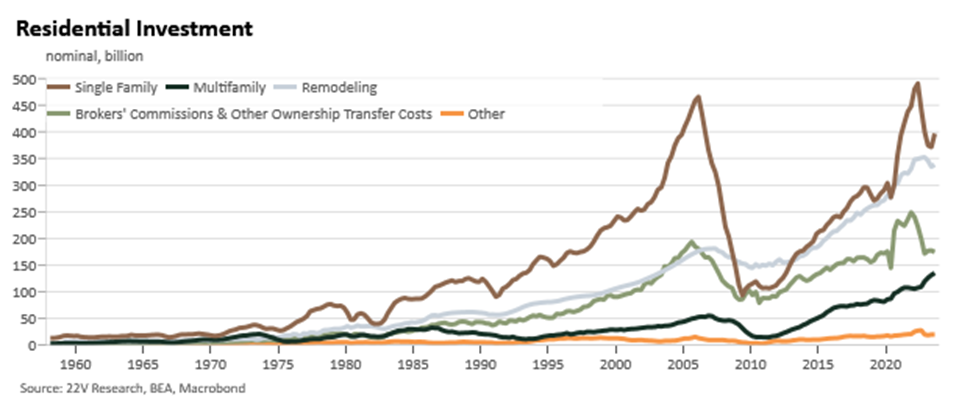
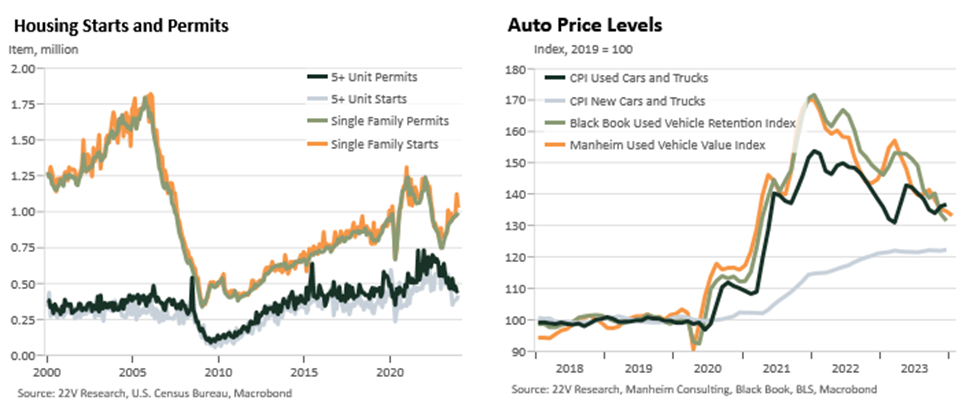
After being a drag on growth for much of the past 2 years, housing was a positive contributor to growth again in 23Q3 and looks set to be a modest one again over the coming quarters (q/q noise notwithstanding).
Working in the sector’s favor are rates coming off their recent highs and some gradual expected spread compression in mortgage rates, the millennial demographic bulge, healthy household balance sheets, and a labor market that is still hot, if not boiling. Rates are still elevated relative to history but this seems to be less of a strictly binding constraint than many models premised on just new mortgage payment to income ratios might have suggested (see a more in-depth discussion from my note in the fall).
Single family starts have bounced nicely, even before rates started to come down and are likely in the process of gradually catching up towards a higher trend rate of growth. Multifamily development is harder to read given the surge which took place immediately after the pandemic; there is some possible evidence that permits could be flatlining but this is extremely tentative so far. On net, multifamily activity is likely to be a very modest drag as the backlog of projects from the 2021-23 period gradually delivers even if new permits stay flat from here. It is important to remember though, that remodeling, existing home sales gradually ticking up (commissions), and single family are all substantially larger contributors to overall GDP growth than multifamily so even if multifamily activity reverts more towards a trend pace the rest of the sector is likely to more than offset this.
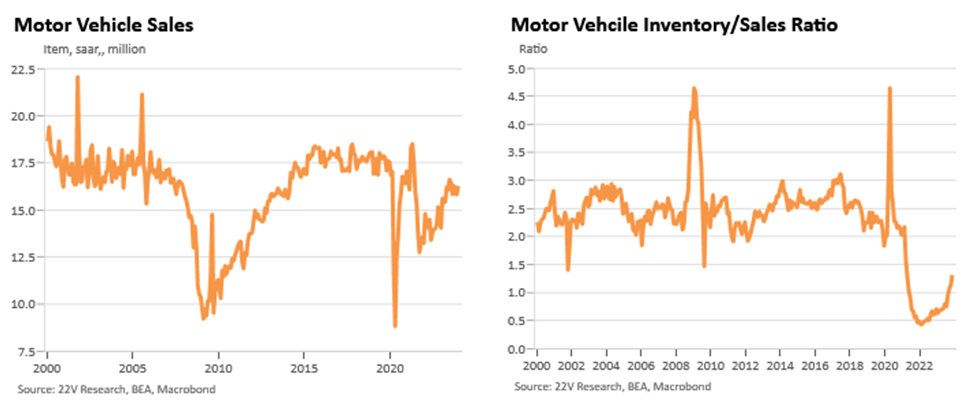
Autos have been another distorted sector of the economy, with supply shocks that led to an acute surge in pricing and an only gradual recovery in new supply. Inventories in the auto sector have only partially recovered and there remains further catchup production which likely needs to take place for inventories, let alone pricing, to fully normalize. More realistically, while some modest amount of catchup production may be possible, the shortfall over the past few years suggests that at least some of the price level supply shock is likely to be permanent, helping sustain the higher level of new car prices over the medium-term. On net, this means that autos are likely to be a positive contributor to GDP growth going forward but for new cars price levels are likely to be quite sticky high
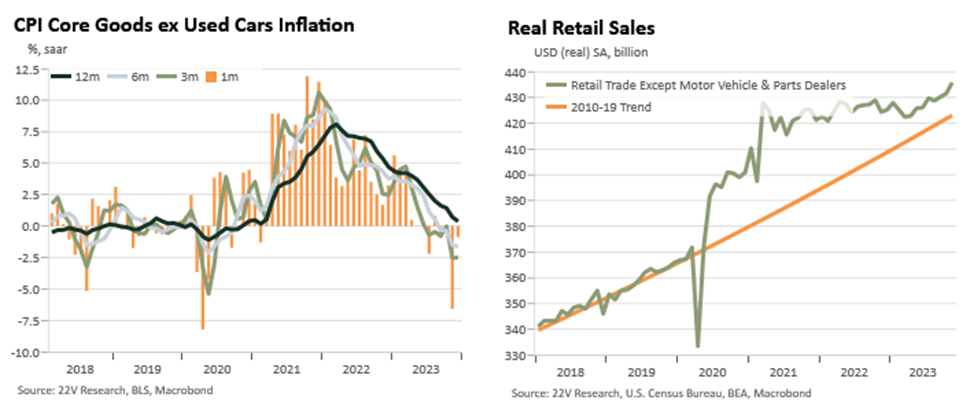
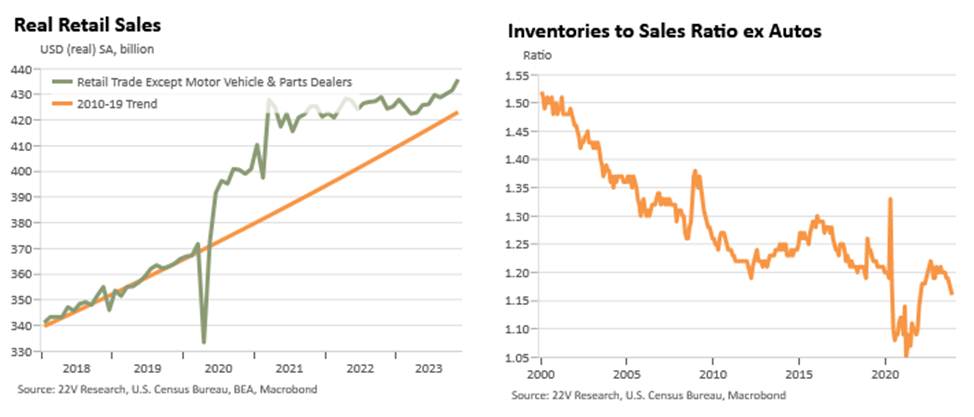
After moving sideways for roughly 2y in real (volume) terms, retail sales, tentatively, may be starting to return to growth more robust again. There may be some pricing relief, both directly for core goods and indirectly through food and energy price level declines, getting passed through into volumes by consumers in an environment of still robust wage growth. In addition, having substantially overshot trend and then been noisily flat some return to modest growth is perhaps not too surprising. Retail inventories have largely normalized, outside autos, after dipping some in late 2023, are likely to be more stable going forward, but should be expected to more of a mild non-headwind to growth than anything else.
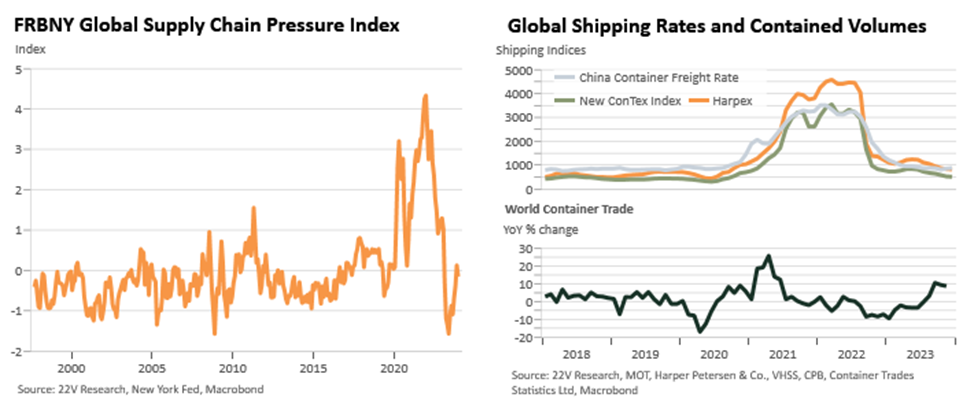
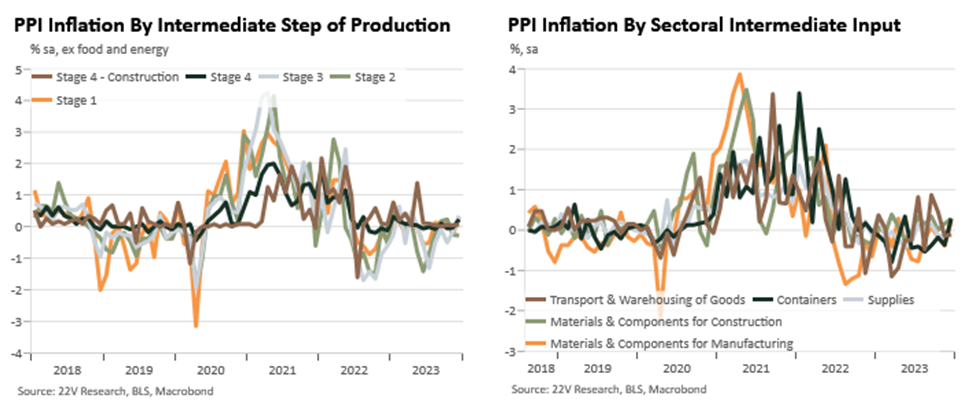
Lastly, it seems that while geopolitics conspires to keep worries about global supply chains at the top of mind the hard data suggests that the shock and normalization process there is largely over. Global trade volumes have bounced some with shipping price indices generally stable at levels somewhat above pre-covid levels (Red Sea related concerns notwithstanding). The FRBNY’s supply chain pressure gauge has also normalized in level terms although given that it is a more analogous to a diffusion index than anything else this means it is extremely unlikely to fully unwind all the disruptions that occurred (supply chains break quickly and heal slowly but there is also likely to be additional sand in the gears of global trade going forward), suggesting that there is only limited room for price level normalization in tradable goods so long as demand growth remains robust. The producer price indices also suggest that the disinflationary impulse may already be starting to fade somewhat in intermediate production, implying only a modest runway left for consumer prices.
This leans into my two-stage thesis for the broader goods economy. In 2024, some measure of price level normalization is likely to continue as a drag on the inflation data through 24H1 but this will taper off as some of the price level impact ends up being persistent. Second, autos and housing demand normalization this will help pull up the rest of the goods economy, which, in fairness, already seems to be tentatively recovering as behavior reverts more towards trend after the excess and then doldrums of the post-covid period.