Back Economic Research

Are Homebuilders (and Data) Telling Us the Rates Floor for Housing is Creeping Up?

Published on November 3, 2023

∙ Download the PDF Report

By

Peter Williams

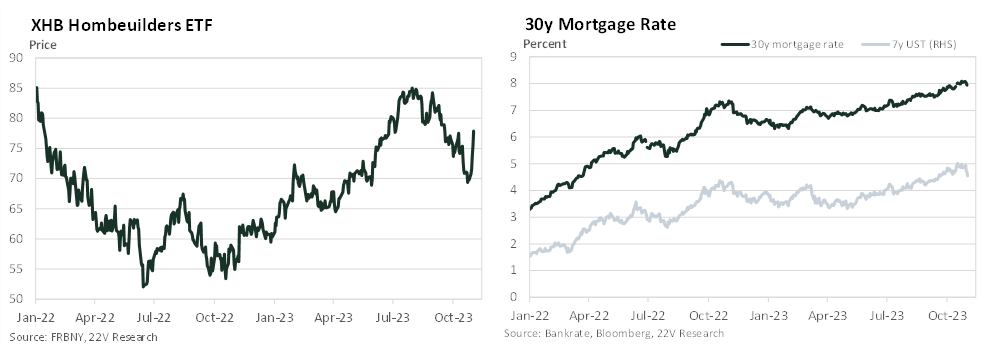
Homebuilding stocks (the XHB ETF) have staged a >12% rally since last Wednesday, with the move up beginning before rates staged their dramatic rally over the past 3 days but most of it coming along with rates. XHB is now down ~8% from its end-July value, a bit less than the equal-weight SP500 (-10%).

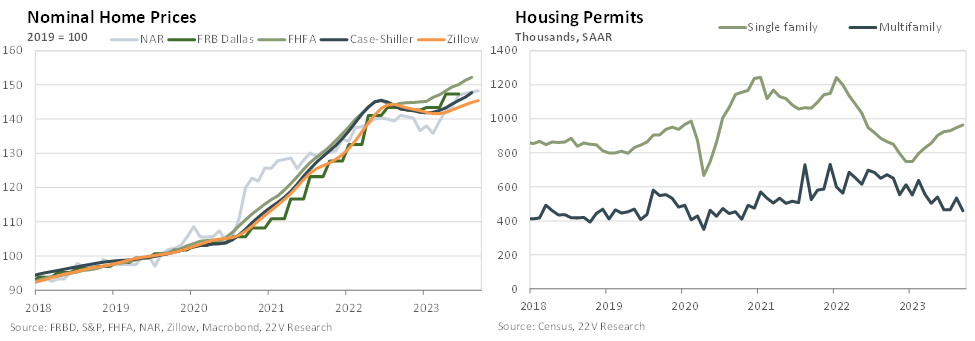
Their performance combined with the notable recent stability of housing starts, since their initial leg down after the hiking cycle began, suggests to us that the implied housing market reacceleration floor in rates (i.e. at what point the housing activity will accelerate not just near-term stabilize) has been creeping higher as builders find work arounds and consumers partially adapt to, or perhaps more accurately becoming begrudgingly tolerating of, higher rates and fairly sticky prices. This is of course a bit tentative of a concept and will need to be seen inferred based off the hard data to come in 23Q4-24Q1.

The performance of homebuilders contrasts with late-2018 when they were making relative lows amid fears of Fed overtightening at peak rates and Chair Powell’s “long-way from neutral” talk.[1]

If long-term US rates keep rallying, tight FCIs talk may not be able to last too much longer (of course there are some natural lags between UST rates to mortgage rates to housing activity, in addition to inertia in Fedspeak).
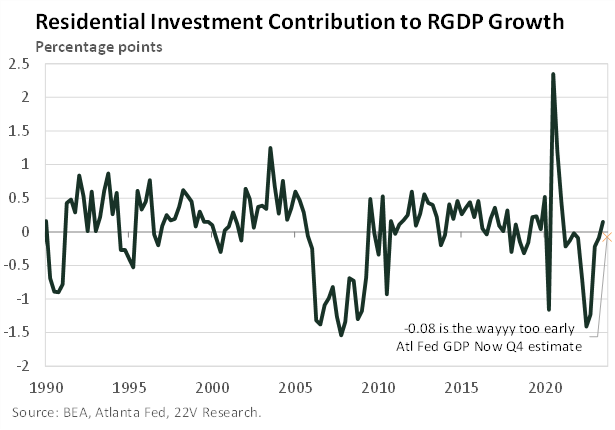
At a minimum, housing activity (in a GDP-and construction employment-related sense) has been much more robust than standard mortgage payment-to-income dynamics would suggest. This isn’t to say that there hasn’t been a hit with 22H2 q/q contributions to growth as bad as those seen during the GFC but the flattening out in activity has come more quickly, and house prices stayed higher, than broadly expected. That the broader economy survived this sharp recession in the most classically cyclical part of it[2] is one of my main reasons for medium-term optimism.

At least some of this is likely because existing home sales and listings were sharply negative for much of the past year, although they are now turning roughly flat y/y but have moved only mildly in NSA volume terms since late spring.[3] Given that starts, much more than housing prices,[4] are usually what bears the greatest part of rate-driven adjustments in the housing market, this strength relative to expectations suggests that either demographics (millennial aging into first-time home buying years and incomes in larger numbers), wealth gains, or changes in household consumption preferences are supporting the market. One could frame this strength-to-date as a flash in the plan that is likely to dissipate if existing sales start to increase in volume terms (sellers are forced to by life events) or the consumer just runs out of ability to keep paying.[5]

My own view is that the shifts outlined above, along with strong builder incentives to help consumers meet underlying housing demand needs through buydown and mix-shift in construction, will help keep a soggy floor under single family starts if or until the broader labor market starts to materially soften, even if rates just move sideways from here. Multifamily activity, by the nature of the building boom and the shorter-liability structure of most of the borrowers, seems notably more challenged and seems likely to bullwhip down below 2019 levels over the coming year.

For the more medium-term outlook this means that while residential investment is unlikely to be as positive a contributor to GDP growth as it was in Q3, and a reasonable forecast suggests it will be a mildly negative contribution in Q4, it may not weigh on activity to the extent many forecasts seem to have implicitly assumed, especially if rates stay near here for some time (helpful for both USTs but also the vol-driven spread component in mortgage origination rates).

The Fed’s strong shift towards using higher rates as a reason against hiking in Dec may create a complicated messaging problem if FCIs keep easing, while at the same time inflation’s progress towards 2% decelerates and growth, especially in the labor market, remains healthy. In the first order the Fed may talk up, correctly, the increasing odds of a soft-landing but too-much FCI easing could ultimately lead to a hawkish shift again down the line.
  1. Tip of the hat to the client who’s conversation and insights helped catalyze me into finalizing this piece. ↑

  2. See “Housing IS the Business Cycle” and “Housing Dynamics Over the Business Cycle” ↑

  3. See Redfin’s weekly data here. ↑

  4. See this excellent overview piece from the New York Fed in 2021 here; the conclusion states “our empirical estimates and prior studies suggest that the decline in mortgage rates can only explain low single-digit house price increases. Instead, we find that housing activity, both sales and construction, are very sensitive to interest rates.” ↑

  5. The Chicago Fed has a nice piece, which lays out a relatively less optimistic case on the medium-term housing market here. This is I think the plausible bear case for starts but misses some of the more base case dynamics we have seen so far with demand and supply keeps starts + permits elevated. Although it implicitly highlights the possible risks to house prices if we see a very large increase in existing sales at current mortgage rates (fairly unlikely in the near-term). ↑


DISCLOSURES AND DISCLAIMERS

Analyst Certification

The analyst, 22V Research Group, primarily responsible for the preparation of this research report attests to the following: (1) that the views and opinions rendered in this research report reflect his or her personal views about the subject companies or issuers; and (2) that no part of the research analyst’s compensation was, is, or will be directly related to the specific recommendations or views in this research report.

Analyst Certifications and Independence of Research.

Each of the 22V Research analysts whose names appear on the front page of this report hereby certify that all the views expressed in this Report accurately reflect our personal views about any and all of the subject securities or issuers and that no part of our compensation was, is, or will be, directly or indirectly, related to the specific recommendations or views of in this Report.

22V Research (the “Company”) is an independent research provider. The Company is not a member of the FINRA or the SIPC and is not a registered broker dealer or investment adviser. 22V Research has no other regulated or unregulated business activities which conflict with its provision of independent research.

22V Research, LLC is a professional services and independent publication organization. 22V Research, LLC is not a securities broker-dealer, not a member of the Financial Industry Regulatory Authority (FINRA), not a registered investment advisor (RIA) and not a member of SIPC.

Securities transactions, when offered, are offered by 22V Securities, LLC through LPS Capital, LLC. Certain employees of 22V Securities, LLC are dually registered as securities representatives of LPS Capital, LLC or Analyst Hub Securities, LLC. 22V Securities, LPS Capital and Analyst Hub Securities are members FINRA, SIPC.

https://brokercheck.finra.org/

Current Ratings Definition.

SECTOR OUTPERFORM: An “outperform” rating anticipates the company will outperform the S&P Regional Banking Index (peer group).

SECTOR PERFORM: A “market perform” rating anticipates the company will perform in line with the S&P Regional Banking Index (peer group).

SECTOR UNDERPERFORM: An “underperform” rating anticipates the company will underperform the S&P Regional Banking Index (peer group).

Limitation Of Research And Information.

This Report has been prepared for distribution to only qualified institutional or professional clients of 22V Research Group. The contents of this Report represent the views, opinions, and analyses of its authors. The information contained herein does not constitute financial, legal, tax or any other advice. All third-party data presented herein were obtained from publicly available sources which are believed to be reliable; however, the Company makes no warranty, express or implied, concerning the accuracy or completeness of such information. In no event shall the Company be responsible or liable for the correctness of, or update to, any such material or for any damage or lost opportunities resulting from use of this data. Nothing contained in this Report or any distribution by the Company should be construed as any offer to sell, or any solicitation of an offer to buy, any security or investment. Any research or other material received should not be construed as individualized investment advice. Investment decisions should be made as part of an overall portfolio strategy and you should consult with a professional financial advisor, legal and tax advisor prior to making any investment decision. 22V Research Group shall not be liable for any direct or indirect, incidental or consequential loss or damage (including loss of profits, revenue or goodwill) arising from any investment decisions based on information or research obtained from 22V Research Group.

Reproduction And Distribution Strictly Prohibited.

No user of this Report may reproduce, modify, copy, distribute, sell, resell, transmit, transfer, license, assign or publish the Report itself or any information contained therein. Notwithstanding the foregoing, clients with access to working models are permitted to alter or modify the information contained therein, provided that it is solely for such client’s own use. This Report is not intended to be available or distributed for any purpose that would be deemed unlawful or otherwise prohibited by any local, state, national or international laws or regulations or would otherwise subject the Company to registration or regulation of any kind within such jurisdiction.

Copyrights, Trademarks, Intellectual Property.

22V Research Group, and any logos or marks included in this Report are proprietary materials. The use of such terms and logos and marks without the express written consent of 22V Research Group is strictly prohibited. The copyright in the pages or in the screens of the Report, and in the information and material therein, is proprietary material owned by 22V Research Group unless otherwise indicated. The unauthorized use of any material on this Report may violate numerous statutes, regulations and laws, including, but not limited to, copyright, trademark, trade secret or patent laws.