SUMMARY
- China’s November activity data showed continued weakness in domestic demand, particularly retail sales and property activity; the production side of the economy looks better thanks in part to strong policy support
- China’s Central Economic Work Conference, which concluded earlier this week, suggests that pattern will continue next year; Beijing signaled a focus on supporting infrastructure and manufacturing investment but did not outline new measures to revive consumption
- That outlook implies continued appetite for investment-related commodities but an economic recovery that remains fairly narrow in scope and limited in strength
China’s activity data for November, released overnight, show a recovery that continues to suffer from a lack of domestic demand. Regular readers may notice that I am struggling for synonyms for “anemic,” “subdued,” and “weak” to describe the demand side of the economy. Suggestions are welcome, because I fear we will be stuck in this section of the thesaurus for a while given the lack of strong stimulus signals from the Central Economic Work Conference (CEWC) held earlier this week (see our write-up HERE).
First some thoughts on the data in the context of the CEWC, then a few details on the release:
While China’s leadership is less complacent about the need to support growth than it was heading into 2023, the question remains whether the planned policy mix is sufficient for the task ahead. From that standpoint the CEWC was quite underwhelming. The leadership acknowledged key challenges to consolidating the recovery (including soft demand, overcapacity in some industries, and weak societal expectations) but it outlined only incremental stimulus measures and a seeming lack of new ideas.
The CEWC statement implied that policy measures in 2024 will continue to focus on investment in infrastructure and manufacturing, along with a push to construct affordable housing. This production-centered approach will sustain China’s appetite for industrial commodities such as metals, but it will do little to revive consumption and broader private sector demand – where the weaknesses are starkly apparent in the November data.
Consider that nominal retail sales of goods in November were up only 2% from the level two years ago. This is a strikingly small improvement after a year that some observers had expected to unleash massive Chinese “revenge spending.” The consumer remains cautious due to dim expectations for employment income as well as the housing market.
There was little to cheer in the November data when it came to property, as sales remained in steep contraction (-21.3% y/y). While new home prices showed some signs of stability, prices in the secondary market had their steepest m/m decline since 2014. That is worrying because the secondary market is less subject to administrative price floors and thus is probably a more accurate picture of the state of the overall housing market.
China’s leadership will step up incremental support measures given these additional signs of slowing momentum. The authorities acted ahead of the data this week by further easing housing policies in Beijing and Shanghai. Infrastructure spending will get support from recent central and local government bond issuance. But the picture presented by the current state of the economy and the policy agenda signaled at the CEWC continues to be one in which the production side of the economy outpaces demand. That implies struggles with excess capacity, weak inflationary pressures, and a relatively narrow and anemic (sorry) recovery for the corporate sector.
Some observers have a more optimistic take on the CEWC, which is not delusional. There are signs of increased pragmatism, and Xi’s newish economic team is still settling in. But policymakers seem more focused on avoiding past mistakes (such as disruptive crackdowns) than on reaching for new tools. Markets and the domestic private sector will thus continue to put the burden of proof on Beijing that next year will look different from a disappointing 2023.
Notable points in the November data
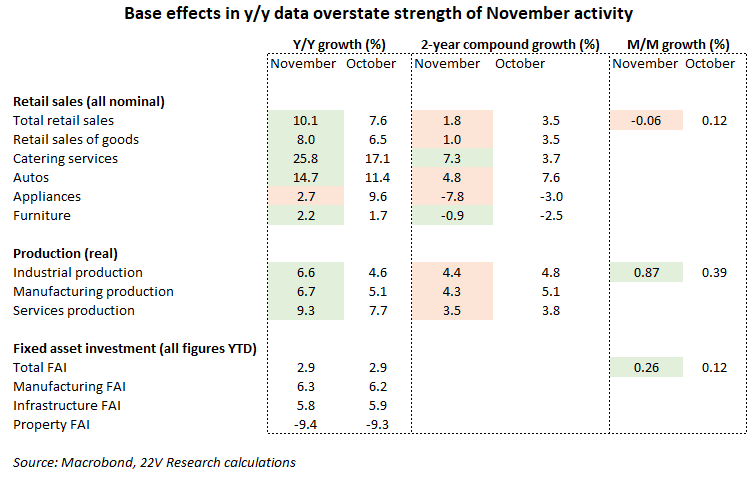
The headline year-over-year growth numbers in November data present a misleading view of improvement due to base effects: at this time last year China was in the midst of the highly disruptive pivot away from zero-Covid. It thus helps to look month-over-month sequential growth (when available) or a two-year compound growth rate (November 2023 over November 2021). See chart further below for a comparison.
Retail sales grew 10.1% y/y in nominal terms (vs. consensus of 12.5%) but fell month-over-month for only the second time this year (-0.06%). The two-year compound growth rate for retail sales of goods (not including catering services) slowed from 3.5% in October to only 1% in November.
Auto sales (up 14.7% y/y) remained a relative bright spot in household spending, though the two-year growth rate slowed from 7.6% in October to 4.8% in November. Broader household spending on durables such as furniture and appliances has yet to show a strong recovery.
While the surveyed urban unemployment rate stayed at a two-year low of 5%, our take based on broader data (including PMI employment figures) is that the labor market remains fairly soft, limiting improvements in household income growth and income confidence.
Industrial production was the main positive surprise in the report, growing 6.6% y/y compared to the forecast of 5.5%. Month-over-month, industrial production grew 0.87%, the fastest rate in many months. But strong demand for heating and related fuels may help account for those numbers, while other data (such the PMI) suggests more subdued growth in manufacturing. On a two-year basis, manufacturing production slowed from 5.3% in October to 4.3% in November. Auto production, again a strong point, was up 20.7% y/y and 12.5% on a two-year basis.
Fixed asset investment (FAI) stayed even at 2.9% y/y ytd (same as in October), as manufacturing investment and infrastructure investment offset some of the drag from contracting property investment. Manufacturing FAI improved slightly to 6.3% y/y ytd (from 6.2% in October) while infrastructure FAI slowed marginally at 5.8% y/y ytd (from 5.9% in October). Investment in property fell by -9.4% y/y ytd, from -9.3% in October.
There were few convincing signs of improvement in the property sector. Residential property sales by area fell -21.3% y/y, from -20.2% in October (estimates by Caixin). While housing completions remained strong (18.5% y/y), residential housing starts were down -22% y/y, only a slightly smaller contraction than the -24.1% decline in October. As noted, housing prices in the secondary market – which is less prone than new home sales to administrative price floors – fell- 0.79% in November, the steepest fall in nine years.