SUMMARY
- The readout of Tuesday’s Central Economic Work Conference (CEWC) met our already modest expectations and will likely do little to lift broad economic sentiment; Beijing did not outline major urgency to boost growth or plans to change key policies
- Fiscal and credit policies will focus on maintaining robust investment in infrastructure and advanced manufacturing, as well as supporting Beijing’s push on affordable housing; there will be little direct support for household consumption, particularly as local governments tighten purse strings
- Given continued economic headwinds, particularly from the property downturn, these signals imply a subdued outlook for China’s domestic demand and equity markets in 2024
China’s leadership concluded the Central Economic Work Conference (CEWC) on Tuesday, a few days sooner than we expected. The meeting was broadly consistent with the subdued expectations in our preview note (link HERE) and our coverage of Friday’s Politburo meeting (link HERE). Our key takeaways are discussed below.
STAYING THE COURSE
Similar to Friday’s Politburo meeting, the CEWC did not underscore great urgency when it comes to supporting growth next year. The meeting notes that the economy is already “rebounding and recovering,” though it faces challenges including “insufficient effective demand”, “overcapacity in some industries”, “weak societal expectations” and “hidden risks and dangers.” Implication: The overall characterization is of a recovery that is largely on track and requires incremental support, not the proverbial “bazooka”.
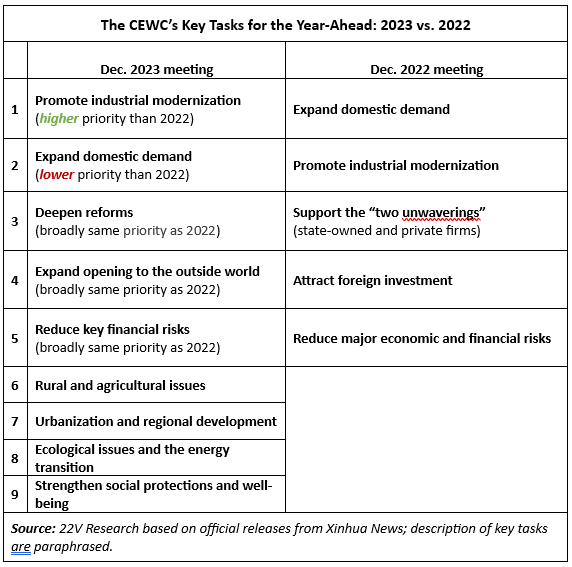
Policy is largely staying the course. While Xi Jinping is eager to boost confidence, he remains focused on a long-term agenda of “high quality development” that avoids major financial risks and stresses consistency with political/geopolitical goals such as technological self-sufficiency. Notably, the CEWC’s list of key tasks in 2024 puts industrial modernization first and “expanding domestic demand” second; these two were reversed at last year’s meeting (see table below).
Beijing is stressing increased policy coordination, not a new toolkit, to boost confidence. This year’s CEWC emphasizes the need to pursue more consistent policies and avoid measures that hurt confidence. This is captured in a prominent phase of “first establishing and then breaking,” which implies avoiding past mistakes of overly ambitious policy initiatives that disrupt the economy (such as with tech and real estate crackdowns). Relatedly, there is new language around “incorporating non-economic policies in the assessment of the macroeconomic framework,” which sounds like an effort to avoid unleashing security-minded regulatory crackdowns (such as in the tech sector) without being mindful of the economic and market consequences. These are all positive acknowledgements by Xi’s new economic team of past policy mistakes. There is also no mention of XI’s “common prosperity” initiative. Less positively, the CEWC also calls for strengthening economic propaganda and “promoting an optimistic economic discourse on China’s economy” – which suggests even less political tolerance for negative news, commentary or even economic data. Implication: economic policies will be less volatile but economic opacity may increase.
KEY POLICY SETTINGS
The discussion of macro policies largely followed the earlier Politburo meeting in stressing overall continuity, but with some important signals.
Fiscal policy will feature stepped up support for infrastructure finance but stay targeted. The language on fiscal policy implies that Beijing will look to leverage the broad government balance sheet to maintain a robust pace of infrastructure investment; key phrases here include “making good use of fiscal space”, “strengthening fiscal support for key national strategic tasks,” and “reasonably increases the use of local government special bonds in [project] capital.” All of this implies more on-budget support for infrastructure finance. However, there is also language stressing that even as local governments get support for infrastructure spending, they will be under tight purse strings, particularly when it comes to general expenditures. Implication: Fiscal policy will be supportive of infrastructure finance next year but frugal when it comes to broader government spending. This is better for industrial demand than it is for consumption.
Monetary policy will stay accommodative but avoid broad loosening measures. The statement notes that “prudent monetary policy must be appropriately flexible, and precise and effective” (slightly less dovish than last year’s phrase of “precise and powerful”). Rather than broad measures such as rate cuts, PBOC will continue to focus its support on “structural monetary policy tools” used to direct credit to prioritized sectors such as innovative firms, the green transition and inclusive finance. One interesting new signal is that the statement pledges to match growth in social financing and the money supply with “the expected targets of economic growth and price levels”; last year the comparison was to “nominal growth.” This change in nuance implies that PBOC is now more attuned to deflation risks and will look to guide inflation expectations to minimize such dangers. Implications: Monetary policy will focus more on supporting key industries and local government debt refinancing than broad rate cuts, though increased attention to deflation risks could signal a willingness to keep policy looser than in the past.
Property sector support will focus on cushioning downside pressures rather than seeking to reflate housing. As was the case last year, property is tellingly discussed in the section on “preventing financial risks” (rather than, say, boosting demand). There were no big surprises. The meeting omits last year’s phrase of “housing is for living not speculating” but also specific references to demand-side measures such as “meeting rigid demand for housing.” It repeats language from recent months on meeting the “reasonable financing needs” of both private and state developers but does not suggest any new, more robust backstop for troubled developers. It pledges support for Beijing’s “three major projects” of urban village renovation, affordable housing, and dual-use infrastructure, without new hints on financing sources or scale. Implications: Beijing will aim to narrow the depth of the property sector’s contraction in 2024, but it seeks to move to a new model for real estate – focused on affordable and rental housing – rather than reviving the current model.
Consumption will receive little direct policy support. The CEWC repeats previous pledges to boost consumption but with no indication of major new demand-side measures such as large-scale vouchers or cash transfers to households. Indeed, much of Beijing’s focus for consumption remains on supply-side measures, such as pledges to “actively foster new consumption growth points such as smart home appliances, cultural and sports tourism, sporting events, and trendy national products.” Implications: Without direct fiscal support and amid a weak jobs recovery, consumption patterns will stay subdued in 2024.
Industrial and sci-tech policies will remain strong, with increased attention to life sciences and space/aviation. The section on industrial policy – the number one task for 2024 – hits familiar themes of promoting advanced manufacturing, resilient supply chains, tech self-sufficiency and cutting edge innovation. Among “strategic and emerging industries” the meeting specifies “biomanufacturing”, commercial aerospace, and “the low-altitude economy” (i.e., drones) as areas of increased interest. While the CEWC’s description of the economic situation notes that that “some industries” suffer from overcapacity, it does not single them out and it is not clear if Beijing is concerned about signs of domestic overcapacity – and growing trade tensions – in key areas of clean tech (electric vehicles, batteries, and solar). Implications: China’s government will continue to direct public and private capital to fund its industrial policy initiatives, which will continue to produce some successes but with risks of excessive and misdirected investment.
The reform agenda remains incremental and unambitious. The meeting did not break new ground on its treatment of the private sector or outline new areas of structural reform. These themes could receive more attention at a “third plenum” meeting, which is typically held every five years and focuses on longer-term reforms. The third plenum was due to take place this fall based on tradition, but now likely will fall Q1 2024 and may not focus on economic reform issues at all – there isn’t much to suggest major new initiatives in the works. The meeting pledges to expand openness to foreign investment but largely retread familiar ground. Implication: While the CEWC does suggest more market-friendly policies, it won’t quickly revive “animal spirits” among the domestic business elite or foreign business community, who remain concerned about their ambiguous place in Xi’s governance agenda.
OUTLOOK FOR GROWTH AND MARKETS
The CEWC does not lay out the specifics of key policy targets in 2024, which will be formally announced at the annual National People’s Congress in March. The policy hints from the meeting are broadly consistent with the basecase views that we presented in preview note (link again HERE), including:
- GDP growth target: We continue to expect a GDP target of “4.5-5%” next year. An ambitious target of 5% growth is possible but the lack of forceful stimulus announced today continues to make us skeptical. A downside case targeting “around 4.5%” is also still possible based on the CEWC. More hints as to the growth target will come in advance of the March National People’s Congress.
- Fiscal targets: The language on fiscal policy today seems consistent with our basecase calling for an official deficit target of perhaps 3.5-3.8% of GDP, above the traditional 3% ceiling. But given warnings for local governments to expect tight constraints on general expenses, measures of the broad “augmented” deficit will likely be flat or perhaps even a bit smaller than 2023. The wording on local government debt issuance is a bit ambiguous; it seems to suggest a quota for special bond issuance that is similar to this year (RMB 3.8 trillion) but is used to leverage additional investment by allowing a greater portion of these bonds to count as project capital.
What does the CEWC mean for China’s economic outlook next year? At this point we expect real GDP growth of slightly above 4.5% next year. As described in our preview, 2024 will look similar to 2023 in its broad contours: fairly weak domestic demand due to the ongoing property downturn, cautious consumers, and subdued private sector confidence. The supply side of the economy will be stronger than the demand side, buttressed by investment in sectors favored by Beijing such as autos. Demand for hard commodities will get decent support from infrastructure stimulus, the affordable housing push, and manufacturing investment. The combination of strong production growth and less impressive demand growth means a disinflationary if not deflationary impulse from China to the rest of the world. Domestically, deflationary pressures will remain a concern and limit the fall in real borrowing rates, which will remain a constraint for reducing the debt burdens of firms, households and local governments. Anemic growth will also limit the improvement in corporate profits and broad business investment.
For China’s equity markets, the conditions above imply that broad earnings growth will be subdued. The bull case for Chinese equities will rely mainly on beaten-down valuations rather than a robust improvement in macro fundamentals. Beijing’s focus on avoiding surprises will lower perceived and probably actualized regulatory/political risks next year but not address deeper investor concerns with the longer term growth outlook, geopolitical tensions, and governance agenda.