

SUMMARY:
- China’s Central Economic Work Conference in December (exact dates TBD) will lay out the economic policy mix for 2024; the lack of urgency to support growth at last year’s meeting was a key reason for our cautious stance on growth heading into 2023
- While China’s leadership has become less complacent about the need to support growth, domestic demand will likely remain subdued in 2024 as stimulus will not be forceful enough to overcome the continued drag from the property downturn and other headwinds
- We expect policymakers to set a GDP growth target of 4.5-5% next year, supported mainly through infrastructure and manufacturing investment; consumption growth is likely to lag behind the pre-pandemic trend given muted job growth and the lack of direct stimulus to households
- An outlook of subdued domestic demand and weak pricing pressures means that the broad case for Chinese equities will rely mainly on cheap valuations rather than strong earnings growth
- China will likely continue to export disinflation (if not deflation) to the rest of the world; overcapacity in sectors such as electric vehicles, batteries and solar panels is a watchpoint for trade tensions
In early/mid-December, China’s leadership will convene the Central Economic Work Conference (CEWC), the annual meeting that previews the economic policy mix for the next year. The meeting lasts 2-3 days and in recent years has concluded in a window of Dec. 8-16. A monthly meeting of the Politburo is held several days to a week in advance of the CEWC and provides an initial sense of the key themes. This note lays out our expectations for the CEWC, the key watchpoints, and the implications for investors in 2024.
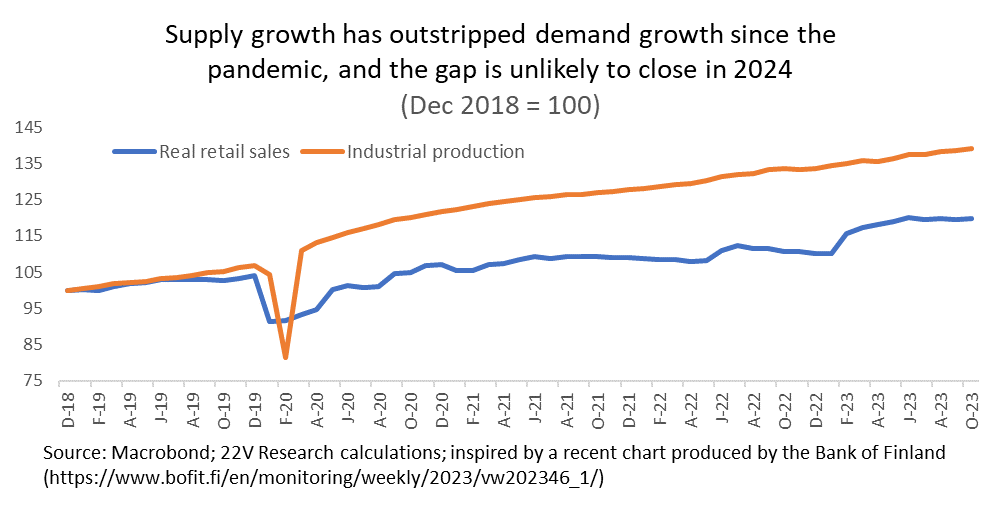
China’s recovery continues to struggle, but policymakers are no longer as complacent heading into 2024. China’s economic and market performance this year has disappointed investors expecting a more robust rebound from the Covid era. Private sector demand and confidence have been weak due mainly to the combination of economic scarring from the Covid era (e.g., a hit to household finances that was not cushioned by stimulus) and the ongoing crisis in the property sector. There have been bright spots, but mainly on the supply side such as investment in advanced manufacturing sectors (EVs, batteries, solar etc.). This investment push, along with sizeable infrastructure stimulus, has helped support demand for hard commodities despite property doldrums. But the overall weakness in domestic demand is inescapable, reflected in (among other indications) two straight quarters of deflation and in retail sales which, in contrast to production indictors, remain well below the pre-pandemic trend (see chart).

Policy missteps have been part of the problem. For the first half of this year, Beijing tried to muddle through without strong stimulus, calling for patience in a gradual recovery. But by the summer, as growth dipped, the property sector worsened, and financial pressures intensified, the problems became too great to ignore and the leadership signaled greater efforts to support growth. Beijing has continued to roll out new support measures, most notably with an unusual late-year increase in the fiscal deficit to support infrastructure (link HERE) and a flurry of property moves (link HERE). At the highest political level, General Secretary Xi Jinping has signaled an increased focus on reviving growth and confidence, including through steps to lower tensions with the US and allies (see our write-up on the Biden-Xi meeting HERE).
Will Beijing’s more supportive stance get the recovery moving in 2024? Less favorable base effects mean that in arithmetic terms, China’s GDP growth in 2024 will likely be slower than the roughly 5%+ growth expected in 2023. In some ways more important than GDP growth is whether private sector demand and confidence will improve – as would be reflected in a clear bottom for the property sector, less cautious spending by households, greater investment and hiring by private firms, and reduced risk of entrenched deflation. Such signs of economic repair would be especially important for equity investors, as they would likely translate to more robust earnings growth for Chinese firms and well as foreign companies selling into China’s market.
Heading into the CEWC, we expect the strength and quality of China’s recovery to improve only modestly in 2024:
- Property and structural factors will continue to exert strong downward pressure on demand. Beijing has strengthened its efforts to stabilize property, including a push to build affordable homes (likely to be funded in part by the central bank) and more pressure on banks to lend to private developers (unclear as to effectiveness). These measures will cushion but not reverse the ongoing decline in property sales and investment in 2024, which will continue to exert a drag on growth (though smaller than this year) through a variety of channels, from upstream materials demand to depressed local government land revenues and weak household confidence. Worsening demographics and high private and public sector debt burdens will also act as headwinds for growth.
- While policy is stepping up, it likely won’t be of the scale or nature to quickly reinvigorate private sector demand and confidence. On a recent visit to Beijing, we were struck that domestic sentiment towards the economy has improved only marginally since the summer. One reason, beyond the ongoing downdraft from property, is that stimulus measures have centered on state-directed investment in areas such as infrastructure that have only an indirect impact on households and private firms. This remains a weak jobs recovery, which is holding back a rebound in growth in income and consumption (see above chart). Beijing’s focus on spurring infrastructure and manufacturing investment, rather than labor-intensive services, means job creation will likely continue to lag. And overall policy settings, particularly in terms of real rates, are still restrained given the depth of weakness in the private sector.
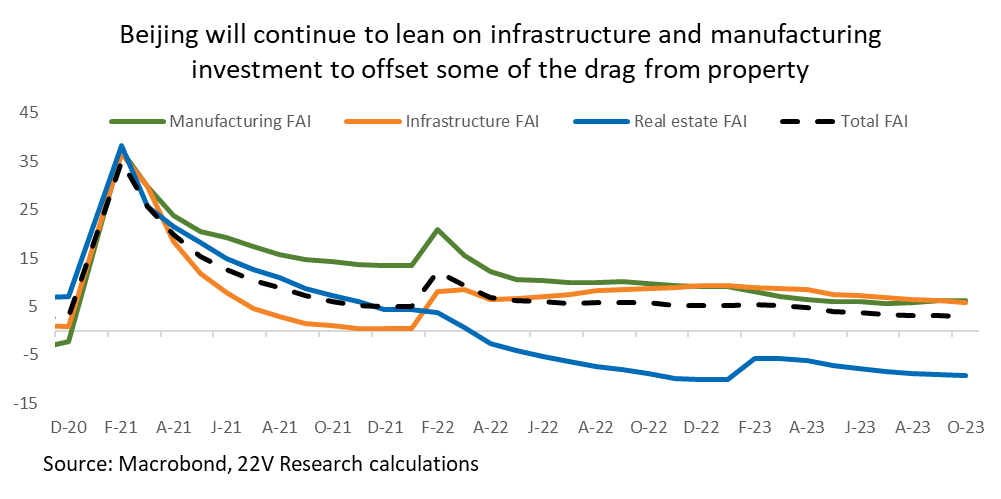
- These factors suggest that 2024 will look fairly similar to 2023 in the overall pattern of growth. Property investment will be negative but a smaller contraction than this year. Infrastructure investment will likely slow slightly from its 8% pace this year but, along with manufacturing investment, help support demand for hard commodities. Consumption will likely grow moderately faster than overall GDP but spending will remain below the pre-pandemic trend due to only modest growth in wages and household income. The economy is unlikely to see entrenched deflation but price pressures and nominal growth will remain weak. In short, we expect not a terrible year for growth but one in which the supply-side economy performs better than the demand side and with a relatively narrow set of sectors thriving.
The CEWC will provide key signals as to whether our modest expectations are on track, or if policy is headed for an upside surprise. The readout of the CEWC will not announce specifics such as the official GDP growth target and the size of the fiscal deficit – those will be officially announced at the National People’s Congress in March – but the tone and discussion of economic support should provide strong clues as to the policy mix. Indeed, the lack of urgency and stimulus measures at least year’s CEWC was a key reason why we went into the year warning of a subdued growth outlook in 2023 (see “Confidence Game”, 10 January 2023).
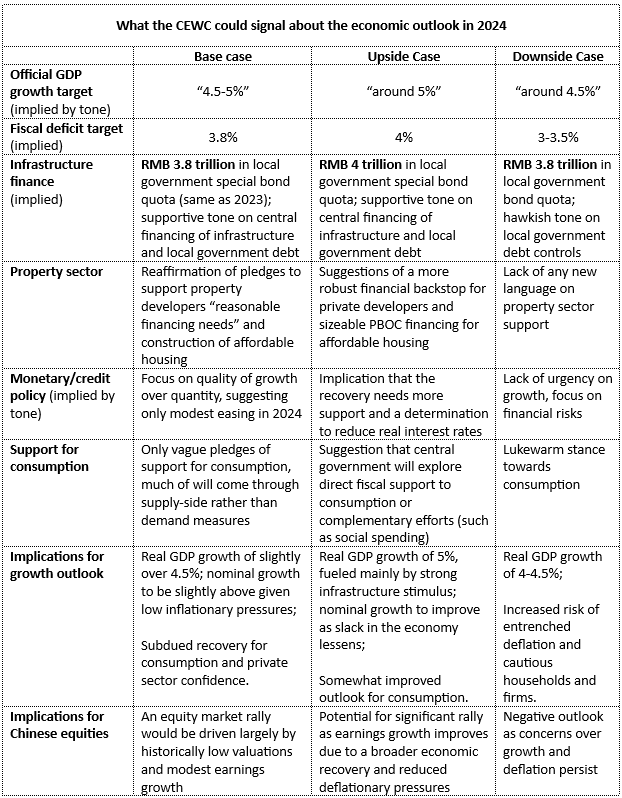
The key watchpoints for the CEWC are as follows, also summarized in the table at the end of this report:
- Growth goals: Our basecase scenario is that Beijing will aim for growth of around 4.5% or slightly above, probably framed as a target of “4.5-5%”; again, this won’t be announced at the CEWC but may be implied by the tone and supporting policies. The upside scenario would be language that stresses a push for higher growth and implies a target of 5%. The downside case would be a lack of urgency consistent with a target of 4.5%. Implications: The most direct implication of a growth target of 5% GDP growth target versus 4.5-5% would be the need for stronger infrastructure stimulus (e.g., generating 4.5% growth next year would likely entail infrastructure investment growth of roughly 6%, while a 5% target could require infrastructure investment to grow by 10%). More broadly, achieving 5% GDP growth would narrow China’s output gap and help to reduce slack in the economy (if rather inefficiently through infrastructure investment), likely reducing deflationary risks and boosting nominal growth.
- Scale of fiscal stimulus: Our basecase is that Beijing sets a budget deficit target for 2024 of 3.8% of GDP, consistent with the amended deficit this year, in order to help lower the burden on local governments to fund infrastructure and other spending. The local government special bond quota will likely be similar to this year (RMB 3.8 trillion) or perhaps higher at RMB 4 trillion. The upside scenario is a fiscal deficit target of 4% of GDP, and the downside scenario is a target of 3.5% of GDP or lower. It will also be very important to watch for clues as to how aggressive Beijing will be in limiting growth of local governments’ off-balance sheet spending, as this is also a key factor in spending, particularly on infrastructure. Implications: As with the growth target, the differences between scenarios here will matter mostly in terms of infrastructure spending and associated commodities.
- Support for consumption: Our basecase is a continued lack of sizeable direct stimulus for households, whether through vouchers, cash transfers, or similar programs. The upside case is language implying that Beijing is finally ready to make a push in this area and willing to provide financing for local governments to offer such programs. Implications: While quite unlikely, direct stimulus to households would be a boon for the consumption outlook and hopes for a recovery that broadens in terms of scope.
- Property sector: The nuances on property will be very important. One key watchpoint is how strong the language is on providing financing to developers. Our basecase is language reaffirming the call for banks to lend more to developers, such as through a “whitelist”; it isn’t clear whether this push will be effective, as banks will remain reticent to lend to weak developers without strong coordination by regulators. The upside case would be signals that Beijing is taking more drastic action to directly reduce/restructure property sector debt, such as a TARP-like program that would take bad assets off the balance sheets of developers. Another key watchpoint is Beijing’s push on affordable housing and “urban village” reconstruction. While a major initiative, its economic impact will depend on a host of factors including how it is financed (such as through the PBOC’s Pledged Supplementary Lending facility) and whether the supply of affordable housing will be obtained from vacant/stalled housing by developers or through new construction. Implications: Property remains the key factor for China’s broad outlook, and policy inputs from the CEWC will provide signals to the degree of upside/downside risk in 2024.
- Monetary and credit policy: The PBOC’s Q3 monetary policy report, released on Monday, took a relatively optimistic tone on the growth outlook and stressed the need to promote “high quality” growth. Those themes imply a basecase in which monetary and credit policy stay in the current accommodative stance, with only modest additional easing in terms of rate cuts. PBOC will focus on supporting fiscal policy (refinancing of local debt), property (including the affordable housing program), and Xi’s industrial policy goals (pushing credit to advanced manufacturing sectors such as clean tech). An upside case at the CEWC would be a more urgent tone on supporting growth and lowering real interest rates. Implications: Monetary and credit policy are likely to be similar to this year in terms of overall credit growth. The focus will be on supporting local government refinancing (reducing default risks), property, and industrial policy.
- Economic reforms: Our basecase is reaffirmation of recent pledges to improve the business environment for private sector and foreign firms but few new major initiatives announced. The upside case would be signals of a reinvigorated reform agenda, including fiscal reforms (such as tax reforms that reduce reliance on land revenues) and structural measures (e.g., reduced restrictions on labor mobility). However, such discussions are more likely to come in other venues (such as a “third plenum” meeting that could take place in coming months) than the CEWC. Implications: particularly for the CEWC, Xi and his new economic team are more focused on executing current policy than outlining a new agenda.
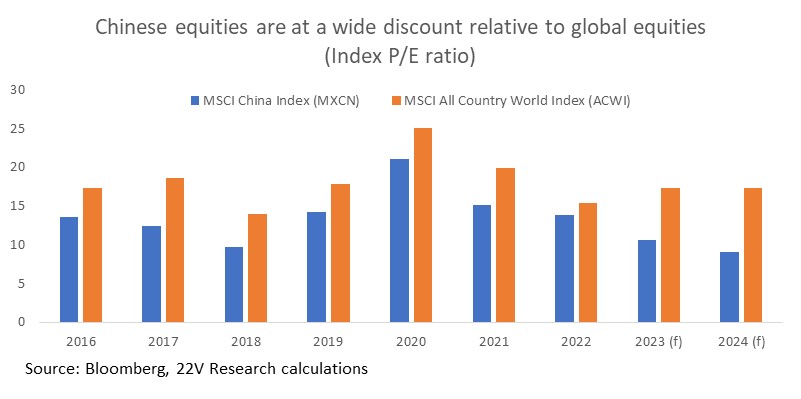
Implications for Chinese equities: Valuations for Chinese equity markets are low on a historical basis (see chart below). With Beijing’s policy stance becoming more supportive, the Fed pivoting away from further hikes, and US-China tensions modestly reduced, there is case to be made for better absolute and relative performance in 2024 than this year, though conversations with clients suggest that most remain cautious. Our basecase for next year would suggest only a modest improvement in the strength and breadth of China’s recovery, implying that the case for Chinese equities would rest primarily on relative value. Should the CEWC hit some of the upside scenarios we have laid out – a more ambitious growth target, direct stimulus to households (unlikely) – it would imply a considerably brighter outlook for earnings growth, particularly in nominal terms as an economy running hotter should see reduced deflationary risks.
Implications for global growth: If the basecase for 2023 holds, China will continue to have a largely disinflationary (if not deflationary) impact on the rest of the world given modest import demand, weak domestic inflation, and an exchange rate that is unlikely to see strong appreciation. As we have noted previously (link HERE), the combination of robust Chinese investment in advanced manufacturing and subdued domestic demand is leading to signs of overcapacity in sectors including EVs, batteries, and solar. This dynamic is a risk for the advanced economies that compete with China in these sectors (e.g., German auto exports) and is likely to increase trade tensions. It also poses dangers for Chinese industry and the financial system, though we expect strong policy support (directed lending to these sectors) to continue through 2024.
Source: 22V Research

