

With China’s messy Covid pivot set to conclude in Q1, Chinese leader Xi Jinping is banking heavily on a revival of confidence – among households and the business community – to power an economic recovery. This policy orientation brings benefits, including lowering the temperature of geopolitical tensions and reducing political pressure on beleaguered e-commerce firms. But it also has limitations: the rebound in real activity will be relatively subdued, given economic scarring from the pandemic, constraints on stimulus, and further manifestation of China’s long-term structural slowdown. Xi’s more pragmatic turn in policy is also likely to be limited in scope and in duration.
SUMMARY
- China’s leadership is banking on the post-Covid reopening to do much of the work in powering an economic recovery this year, with fiscal and monetary stimulus playing a supporting a role and the property downturn to drag on; the strength of the rebound could be more modest than many observers expect, particularly if households remain cautious in their spending.
- Beijing’s efforts to boost private sector confidence will reduce the risk this year of new regulatory moves against the tech sector; still, investors should be aware that platform and other private firms face a new normal of tighter regulation, and that Xi Jinping will continue to try to steer capital towards the “hard tech” firms key to his innovation ambitions.
- The US and China will maintain guard rails this year that lower the risk of crisis but do little to moderate technology tensions; the Taiwan issue will remain a flashpoint, particularly in the run-up to presidential elections in Taiwan and the US in 2024.
Xi seeks to turn the page on the pandemic
Since Beijing began to lift Covid restrictions in early November, it has become increasingly clear that the leadership is intent to execute a rapid pivot, no matter how chaotic. There are conflicting interpretations of what led Xi to finally abandon zero-Covid. Clearly, concern that the economy risked a potential crisis, and the onset of the broadest social protests in China since 1989, were key factors. But by late October, zero-Covid was failing to keep outbreaks at bay across most of China’s provinces; in other words, Xi held to zero-Covid until virtually the last minute possible. This is important to note, as one shouldn’t over-emphasize his panic at current political and economic conditions and the extent to which this shapes the urgency behind policies in 2023.
Having further consolidated power at the 20th Party Congress in October, Xi is eager to resume key long-term political and economic initiatives, including a focus on economic security and innovation amid intense competition with the US. But he must also repair the damage that three years of pandemic controls have inflicted on his agenda, and has signaled that near-term priorities are:
- Resuming growth and normal economic activity – in particular, repairing the hit to employment, the service sector, and household consumption. Youth unemployment stands near a record high of 20%.
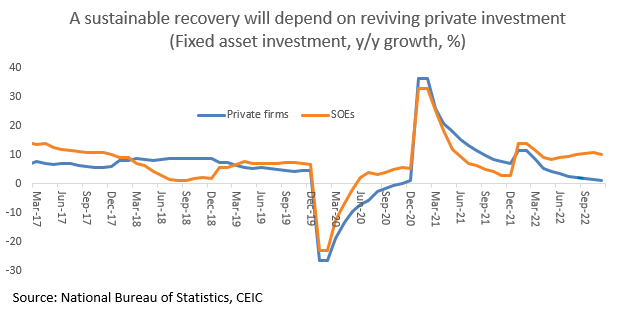
- Boosting longer-term confidence of the private sector. Private firms, hit hard by the pandemic but also suffering from longer-term economic and political impediments, account for 80% of urban employment and are key to a sustainable recovery. Xi has recently sent qualified messages in support of the private sector and toned down the intensity of political campaigns such as “common prosperity” that have weighed on business sentiment.
- Regaining diplomatic momentum. China’s soft power has taken a hit from three years of self-imposed isolation, aggressive “wolf warrior” diplomacy made worse by the pandemic, and an awkward straddle over the Russia-Ukraine conflict. Since November, Xi has embarked on something of a charm offensive, looking to lower tensions with the US, repair frayed ties with Europe, and expand influence among would-be partners such as the Gulf countries. The aim is to stabilize key relationships (including the US), expand Beijing’s influence, and avoid encirclement by the US as the Biden administration looks to build coalitions to counter China.
- Retaining foreign investment. China’s share of global foreign direct investment declined during the pandemic, and the foreign business community is assessing its reliance on Chinese supply chains given zero-Covid disruptions, concerns over geopolitical risks (especially Taiwan), and rising labor costs. Beijing is eager to court foreign firms, seeing FDI as key to China’s economic influence, goals of boosting productivity and innovation, and employment targets.
This policy orientation is positive, particularly in terms of reducing geopolitical tail risks and the intensity of political initiatives, such as the tech crackdown, that have been negative for markets and firms. But this is a shift in priorities rather than in Xi’s underlying strategy, and it is likely to be limited in scope as well as duration:
- Xi is intent to maintain the discipline of his long-term political agenda, including his concept of “high quality growth.” This means reducing financial risks and “national security” risks, including making China’s economy less vulnerable to export controls, sanctions and trade measures imposed by the US or its allies. Xi will not pursue growth-at-all-costs – such as trying to reflate China’s property sector for short term gains – or take a more laissez faire approach to managing the commanding heights of the economy.
- As growth and confidence improve, Xi may reassert other priorities, from common prosperity to harder-edged foreign policy initiatives.
Finally, it is not all about Xi. Many of the challenges that China faces are systemic in nature – including the US-China rivalry and China’s demographics-driven slowdown – and resistant to easy policy fixes even if Xi had the inclination.
It may be useful to think of China’s policy mix this year in absolute terms (the extent to which policies are growth- or investor-friendly) as well as how they have changed relative to 2022 (the policy “impulse”):
- Covid policy will deliver a large positive impulse to the economy this year, moving from sharply growth-negative in 2022 to growth-positive this year. The impact will be the largest in China’s services and consumption-related sectors, including oil demand as travel resumes.
- Economic stimulus will have a neutral impulse, staying accommodative in absolute terms but broadly equivalent to 2022. Property policies are clearly more stimulative than last year, but monetary policy will be largely constant and fiscal policy less stimulative (smaller augmented fiscal deficit). The implication is that industrial and investment activity and demand for these inputs (such as hard commodities) will not show a major acceleration over 2022.
- The “political impulse” will be moderately positive, swinging from market-negative in 2022 and especially 2021 (assertive foreign policy, aggressive domestic regulation) to neutral this year. That is, Xi is toning the temperature of both domestic politics and foreign policy but not making deep concessions in either area. The impact is to lower political and regulatory risks that impact investors in Chinese companies, though many of the longer-term concerns for investors regarding domestic policy and foreign policy remain in place.
Growth: More recovery than revenge?
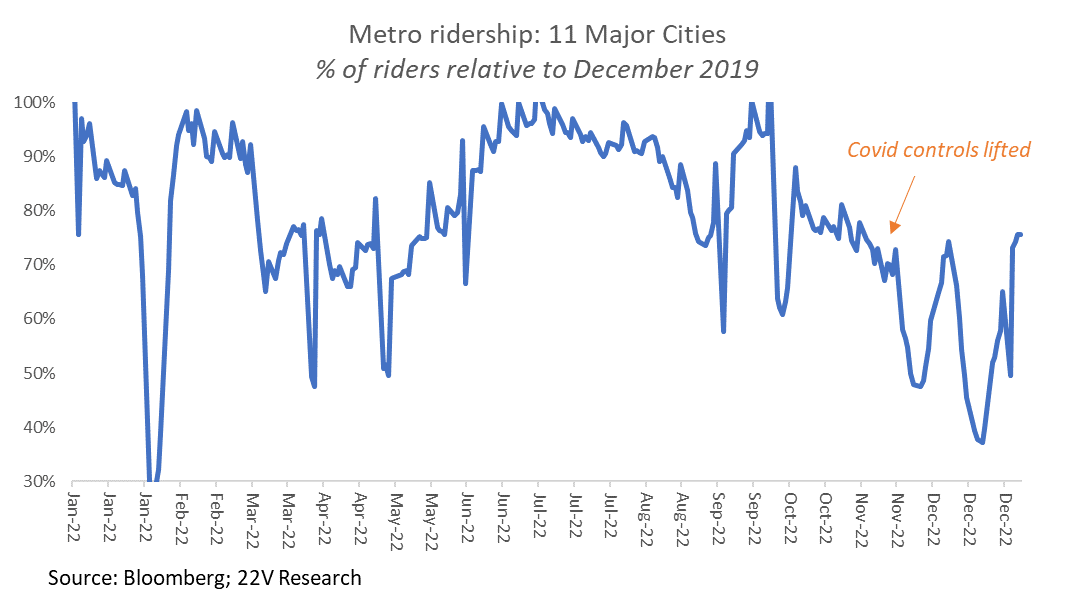
China’s economy is nearing the bottom of a Covid “J-curve” that policymakers describe as the path for this year. Economic activity has cratered with the removal of containment measures and explosion in cases across the country. Lack of reliable testing data makes it hard to track cases, but mobility data suggests that many large cities – particularly those with early outbreaks such as Beijing – have already hit their peaks. Travel for the Lunar New Year holiday (officially starts Jan. 22) will likely seed new outbreaks in the countryside. But China’s major wave will subside, and economic activity largely normalize, by the end of March.
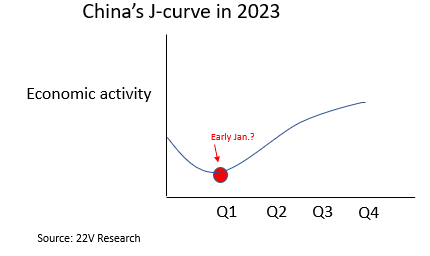
There are still potential risks on the public health side. China will likely experience smaller waves later this year. However, Beijing is clearly intent to prioritize a return to economic activity over efforts to flatten the curve, despite an overwhelmed hospital system. Short of a wild card such as the emergence of a dangerous new strain, the era of Covid containment is over.
What will the recovery look like? The more optimistic takes envision a sharp and broad-based rebound, fueled by “revenge spending” by Chinese consumers, and loose fiscal, monetary and property policies as Beijing looks to get the economy back on track. That outcome would imply considerable inflationary pressure from China to the rest of the world, though this is more likely to impact the ECB than the Fed; with the Fed focused primarily on domestic wage inflation, the bar for China’s reopening and resulting commodity price increases to derail the Fed’s path is high.
However, our outlook for China’s growth is a bit more subdued, based on policy signals and the state of the economy. We would be surprised if GDP growth is much above 6%, which is better than 2022 (estimated to come in below 3%) but not a rip-roaring performance given the low base effect. It would still leave China well below a return to the pre-pandemic trend.
In terms of composition, China’s growth will be led primarily by a rebound in consumption on the demand side (rather than investment or net exports), and services on the supply side (rather than manufacturing). The main inflationary risk to advanced economies is likely to come through oil demand, linked to the resumption of domestic and international travel. The incremental demand from China for industrial and investment inputs, such as hard commodities, will likely be more muted.
What’s behind the restrained outlook? Policymakers are thus far banking on Covid reopening, rather than aggressive stimulus, to power the recovery this year. While the Central Economic Work Conference emphasized boosting domestic demand, particularly consumption, as a key task for the year, it signaled little in the way of additional stimulus. Beijing’s implicit strategy is to get the pivot done as quickly as possible, with the lifting of containment measures leading to a rebound in services activity and employment demand (much of which comes from the service sector). Consumption would be lifted both by a rebound in income (as employment picks up) and higher marginal propensity to consume as confidence in the outlook improves. In this strategy, both fiscal and monetary policy remain accommodative but would play a supporting role; property policies are also scaling up very significantly but aim to ease the ongoing contraction in the sector rather than produce a sharp rebound this year (discussed further below). Should consumption and private investment disappoint, Beijing will increase stimulus, but this is likely to be limited in scale (given concerns over financial risks) and effectiveness.
The key signal for the outlook, of course, will come with the release of the government’s GDP target and other policy targets at the National People’s Congress in March. At this point, it seems likely that the GDP target will be set at around 5.5%. Some Chinese policy advisors are pushing for a more aggressive policy stance, with a growth target of 6% or above, and increased target for inflation (historically 3%) to let the economy run hot and boost employment. China’s leadership thus far appears more restrained, for two main reasons:
- Acknowledgment of global headwinds. Exports – which have propped up demand throughout the pandemic – will provide much less support this year as global growth slows. Weak exports will in turn drag on domestic manufacturing investment.
- Discipline on financial risks. The CEWC statement discussed the need to contain local government debt risks, which have become more acute as the pandemic and real estate downturn have strained local government finances. PBOC, while pledging to maintain accommodative monetary policy, is also keen to avoid staying too loose for too long given the risks of stoking speculative activity and bad loans. It is worth noting that after three years of pandemic stimulus, China’s policy buffers are considerably reduced, particularly compared to previous cycles: the IMF estimates that total government debt in 2022 (official and implicit) was 122% of GDP, almost double the level in 2016 (67% of GDP).
Given the relatively restrained policy stance, there is thus a huge amount riding on the behavior of the Chinese consumer – a major area of debate among economists. Some analysts cite a sharp increase in household saving deposits in 2022 as representing “dry powder” that will power revenge-spending once the Covid wave passes in Q1. But there several reasons to be cautious about the strength and durability of a post-Covid consumption boom. First, consumption has slowed during the pandemic both because of increased saving and a hit to household income growth (see chart below); households may not dip into their savings until their incomes recover and there is greater confidence in the outlook. Second, survey data suggests households are partly saving to buy property in the future rather than for consumption needs. Third, there has been little direct fiscal support to cushion household incomes during the pandemic, and we don’t expect direct support this year; China’s government continues to favor stimulus through firms (to boost employment) rather than households, despite growing calls from policy advisors to use consumption vouchers or cash payments.

The other major swing factor this year will be the property sector. Policymakers have progressively eased real estate policy on both the supply side (easing financing constraints on developers) and demand side (lowering mortgage rates and limits on property purchases). These reflect considerable alarm at the prospect of further deterioration of the sector this year (real estate was covered in the “risks” section of the CEWC statement this year). But these steps need to be seen against the challenges of the sector, which has been completely rewired by Beijing’s crackdown on developers – an egg that to some extent is impossible to unscramble, even if policymakers had the will:
- On the supply side, private developers have high financial and physical (unsold apartments) liabilities. Even with policy support, it will be some time before they are able to use sales proceeds to fund new investments rather than service existing obligations. While policymakers are walking back the “three redlines” policy that triggered the financing crunch for developers, they will not be willing to return to the highly levered property financing model of old.
- On the demand side, households are likely to require greater confidence in the economy and in the health of the sector, a chicken-or-egg dilemma that will take time to resolve. Shifting demographics, including falling population growth and slowing urbanization, are also headwinds to demand for new housing (see next section).
- In short, the sector is likely looking at a year in which housing sales eventually return to positive growth, government support accelerates the completion of unsold homes, but overall housing investment continues to decline for the year, though a smaller contraction than in 2022 (growth in housing investment was -8% y/y through November). This, in turn, will depress local government revenue from land sales and constrain the scale of local government fiscal stimulus.
Structural constraints will increasingly weigh on China’s outlook
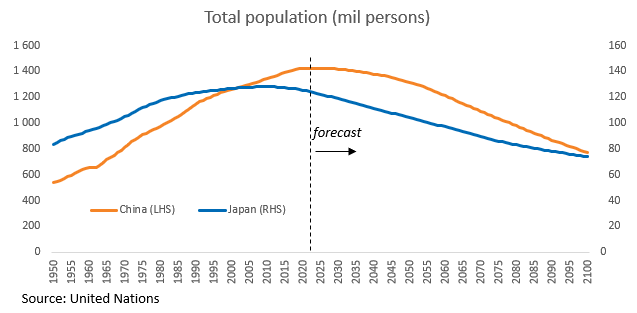
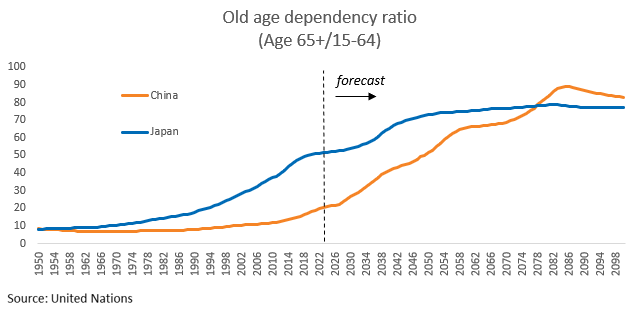
It would be an exaggeration to say that the light at the end of the tunnel for China’s Covid recovery is the oncoming train of a structural slowdown but…the point still stands. According to UN projections, this year will be the first since at least 1950 in which China’s population declines in absolute terms (other estimates suggest the decline may have started several years ago). Both in terms of the pace of the decline in the overall population, and the aging of the population structure, China is on a trajectory that follows the experience of Japan (see charts below). The difference is that China’s annual per capita income is only one-third of Japan’s, limiting the financial resources to cope with the burden of aging. China’s old age dependency ratio (the population age 65 and above/the population age 15-64) will double by 2040 and triple by 2055, straining the capacity of the fiscal and public health system.
Why point this out? While these trends will play out over the long term, they are already impacting policymaking, economic behavior, and expectations – investors ignore them at their own peril. The authorities’ concern about contingent liabilities from an under-funded pension and healthcare system is one factor behind their reticence to adopt a more robust fiscal policy. Slowing growth of the urban population is already limiting demand for new housing and increasing Beijing’s determination to limit further speculative excess in the sector. Consider the analysis of Ken Rogoff (Harvard) and Yuanchen Yang (IMF), who project that real demand for urban housing in China will decline by 3% per year from 2022 through 2035. (There are also positive investment themes that flow from demographic trends, including the development of a private pension market and demand for services such as elder care).
Concern that China’s growth model is running out of gas is animating policy debates within China and calls for stepped up structural reforms as Xi starts his third term in office. While I don’t think we should automatically assume that Xi will resist these reforms, there is as of yet no strong indication that he or the new leadership team will take up the toughest challenges, including more aggressive efforts to liberalize migrations (the hukou system) or scale back the size of the state sector.
Markets and domestic policy: Fewer near-term regulatory risks for private firms
Since the Party Congress, Beijing has taken steps to reassure the private sector, including an e-commerce sector still reeling from a series of rectification campaigns that began in late 2020 with the surprise suspension of Ant Group’s IPO shortly after Jack Ma criticized financial regulators. Regulatory fervor towards China’s platform companies in fact had already cooled over the course of 2022, but the latest signals – while still qualified – are stronger and include:
- A CEWC statement that stressed equal treatment and protection of property rights for private firms, pledged to support the platform companies in “playing a leading role in development,” and avoided mention of anti-trust initiatives or language on avoiding the “disorderly expansion of capital.”
- Approval of a capital-raising plan for Ant’s consumer finance unit, which doesn’t necessarily signal a resumed IPO but brings the company further out of the regulatory doghouse. Of course, the second part of this news was the announcement this week that Jack Ma will cede control of Ant, meaning the company’s rehabilitation comes with major conditions.
- Steps by the central bank to boost access to financing for private property developers, who have been largely shut out of capital markets while state developers (with their implicit government guarantees) have been more insulated.
There are a few factors behind what we expect to be a somewhat more constructive approach to the private sector this year:
- Xi’s desire to boost broader private sector confidence, given their key role in growth, employment and innovation;
- The fact that Xi’s rectification campaigns had accomplished their main goal of warning the entrepreneurial class to toe the line on concerns ranging from regulatory arbitrage (fintech), anti-trust (platform companies), video game content (Tencent et al), consumer and employee rights (platform companies), and data security (Didi, among others);
- The arrival of a new leadership team around Xi, including incoming premier Li Qiang. Li, who spent his career in provinces with a robust private and foreign investment, including Zhejiang (home to Alibaba/Ant), has already effectively taken up the post and will draw on this background in his new role;
What does this attitude mean in practical terms? From the markets standpoint, it reduces the risk this year of sweeping new regulatory campaigns that hit private firms and investors. This comes on top of the recent audit agreement that for now removes the risk of delisting Chinese ADRs from US exchanges (see our coverage here). While Chinese tech ADRs have already rallied in recent weeks, there is likely additional upside in 2023 as foreign investors become more comfortable with the end of zero-Covid and the regulatory environment.
Here come the caveats:
- Platform companies and other consumer-focused tech firms will still exist in a new normal of tighter regulation. As with all of Xi’s campaigns, signs that firms are failing to adhere to the new red lines will be met with a new series of crackdowns.
- Firms will need to adjust business models to the new normal. The platform giants are being forced to divest some of their holdings amid tougher anti-trust rules. Margins may also compress due to explicit or implicit political pressure to boost investment in priority fields such as semiconductors and to lower executive pay and increase corporate philanthropy if “common prosperity” makes a strong comeback.
- Over time, new regulatory priorities will come to the fore, so it will be important to watch rhetoric from Xi and other Party leaders as to their rising concerns.
- While Beijing is downplaying previous language on regulating capital (including a pledge to establish a “stoplight” system showing where capital is encouraged/tolerated/prohibited), Xi Jinping will continue to view capital in highly instrumental terms — that is to say, capital is important but exists mainly to serve national development goals or at least not contradict them. The government will continue to try to steer capital markets towards “hard tech” projects such as advanced manufacturing, semiconductors and biotech. Investors in those areas face trade-offs that come with Beijing’s political support, including grappling with the distortions that come from too much private and state money chasing high-tech aspirations, and the potential impact of US tech controls. And as recent crackdowns on state-owned semiconductor companies show, China’s regulators will look to weed out firms that they see as benefiting from policy support but failing to deliver in terms of real innovation.
Geopolitics: Lower temperature, but the US-China rivalry is still on simmer
A number of signals suggest that Xi intends to lower the temperature of China’s foreign policy this year, focusing on re-engaging with key counterparts after three years of relative diplomatic isolation, and promoting external stability amid a weak domestic economy and the continued risks stemming from the Russia-Ukraine crisis.
Recent steps include:
- A constructive meeting with President Biden in November, with Secretary of State Blinken to travel to China this quarter for follow-on discussions;
- Hosting Australian foreign minister Penny Wong and signaling a potential thaw in trade measures (particularly the ban on imports of Australian coal) meant to punish Canberra for criticizing China and siding too closely with the US;
- A relatively conciliatory message to Taiwan in Xi’s New Year’s address on Chinese television
- Personnel moves. New foreign minister Qin Gang, who had served as China’s ambassador in Washington, does not steer foreign policy (which is set by higher up officials in the Party) but will be relatively pragmatic in style. It was also interesting this week to see that foreign ministry spokesperson, Zhao Lijian, the most notorious of China’s “wolf warriors,” received a nominal promotion to a post that dramatically lowers his profile.
These moves provide a sense of Xi’s current priorities but do not suggest a fundamental shift in policies. China’s foreign policy will still be characterized by an unyielding stance on what Beijing considers to be core interests and issues of sovereignty, and multi-pronged efforts to expand China’s influence around the world and in the global system.
US-China: The key themes from last month’s update on the US-China relationship, written with 22V’s head of Washington Policy Research Kim Wallace, still stand. Biden and Xi will look to follow up on their G-20 meeting and establish a “floor” for the relationship that prevents a crisis (such as Taiwan) and allows for a modicum of cooperation on shared issues such as climate. The fact that Xi will visit the US in November, when the US hosts the APEC Leaders summit, also provides a mechanism and some impetus for the two sides to keep relations from going off the rails.
The problem is that the “ceiling” on the relationship – the ability to make progress on core issues – remains very low. This is due to the structural dynamics of great power competition, and to domestic politics in each country. In the US, being tough on China is perhaps the only area of bipartisan agreement. The Republican-led House, including a new Select Committee on China, will increase scrutiny of China policies and make it more difficult for the administration to calibrate the nuances on issues like export controls.
National security concerns in both countries will continue to stymie any reduction in economic tensions, including in these areas:
- Export controls. Expect further export controls on “foundational technologies” including semiconductors, AI, quantum and biotech. A key theme this year will be the tussle between Beijing and Washington to shape the extent to which third countries (such as South Korea and the Netherlands) comply with sweeping US export controls on semiconductor technology imposed in the fall. Beijing has few attractive policies to directly retaliate against US firms and will focus instead on development of domestic industry, where success has eluded Beijing despite years of effort and massive investment.
- Treatment of TikTok continues to be the center of debate between US agencies. But the clear national security concerns of the FBI and Justice Department, the revelations that parent company ByteDance used the TikTok app to determine the physical location of US journalists looking into the company, and the broader political heat on this issue all point to a likelihood that either Executive or Congressional pressure forces ByteDance to divest TikTok.
- Low likelihood of changes in US tariffs on China, though there continues to be some internal debate in the Biden administration on a strategy that would reduce tariffs on consumer items while increasing tariffs on products in areas benefiting from Chinese subsidies and industrial policies. Watch for Beijing to continue to press its advantage in economic diplomacy by negotiating trade and investment agreements with third countries, while the US looks to put meat on the Indo-Pacific Economic Framework but shows little appetite to move against a populist mood in Washington.
- The Biden administration will unveil a new mechanism to scrutinize US outbound investment in China in critical technologies and supply chains. This will likely take a relatively light touch at first, focusing on corporate investment and supply chain moves rather than portfolio flows, though venture capital into Chinese tech firms will likely be impacted.
The biggest flashpoint in the relationship will remain Taiwan. The Biden administration, Beijing and Tsai Ing-wen’s administration in Tapei all appear keen to lower the temperature this year. However, politics will complicate this, particularly in the run-up to presidential elections in Taiwan (Jan. 2024) and the onset of the US presidential campaign:
- New House Speaker Kevin McCarthy pledged last year to visit Taiwan, following the recent precedent of Nancy Pelosi. Biden is quite unlikely to try to shut down the visit, and Beijing will need to respond at least as aggressively as it did to the Pelosi visit.
- Beijing took some comfort from the fact that Taiwan’s more mainland-friendly party, the KMT, performed extremely well against the ruling DPP party in local elections in November. Those elections had little to do with policy towards China, but Beijing is eager to see a viable political counterpart in Taiwan. Presidential elections in January 2024 are an important risk event. The DPP’s most likely candidate to replace Tsai, who will step down, is Vice President William Lai (Lai Ching-te), who has been notably outspoken in the past on Taiwan’s independence. Should Lai look like a front-runner, it will increase the risk that Beijing engages in saber-rattling before or after the election. The risks also depend on how Lai modulates his language on this issue.
- As the US presidential campaign for 2024 heats up, Republican candidates are likely to try to outdo themselves in conveying support for Taiwan. This will compound concerns in China that the US may fundamentally revise its One China policy.
We continue to think that the risks of military conflict over Taiwan are very low for the next several years. But there is a significantly higher risk of a foreign policy crisis that stops short of a full conflict, and to some extent the overall US-China relationship will remain hostage to the Taiwan issue.
North Korea will also be a thorn in the US-China relationship, as Washington and Beijing disagree on how to address Kim Jong-un’s spate of missile launches and the potential that he conducts another nuclear test this year (which would be the first since 2017).
On the Russia-Ukraine conflict, Beijing will maintain its awkward balance of maintaining diplomatic support and trade with Putin’s regime while avoiding US/EU redlines on breaching sanctions and export controls. Xi will encourage Putin to de-escalate but is unlikely to spearhead talks or exert hard pressure on him.
Xi is likely to exert considerable effort this year in repairing China-EU ties – damaged by China’s stance on Russia – and prevent a deepening of further transatlantic cooperation on China. This stance is likely to benefit European firms’ ability to secure key approvals in China, though debate in Europe is picking up, particularly in Germany, on the economic and geopolitical risks of further deepening a reliance on China. Beijing is also benefiting from a US-own goal from displeasure in Europe (and Japan and South Korea) over the Biden’s administration’s localization requirements for EVs and clean tech industries in the Inflation Reduction Act.
Xi will also continue to focus on strengthening relationships with countries outside the G7, including Brazil (where Lula will be much friendlier to China than Bolsonaro was), Turkey, and the Gulf States. On the latter point, China and Saudi announcements last year of efforts to expand yuan-denominated oil trade is diplomatically symbolic but is no threat to dollar dominance.
Near-term calendar watchpoints:
- The Lunar New Year Holiday (starts Jan. 22) and its aftermath will be important to monitor in terms of the progress of Covid outbreaks as well as signs that consumption is rebounding.
- The National People’s Congress (early/mid March) will be especially important this year, not only in terms of policy announcements (such as GDP and fiscal deficit targets) but also the appointment of a slew of government personnel moves that complete the current leadership transition – from the specific portfolios of vice premiers to the appointments of the central bank governor, minister of finance, and lead banking regulator.
With thanks to Houze Song for his contributions to the analysis.

