
SUMMARY
- Xi Jinping stacked China’s highest political body with loyalists and appointed his ally Li Qiang as the next premier, an outcome that was 22V’s downside scenario for the leadership transition
- Xi’s power play is negative for markets and China’s long-term trajectory because it removes officials with the inclination and ability to moderate his policies and agitate for needed reforms
- There is an increased risk that Xi’s economic security agenda will trump economic pragmatism, as well as dangers of greater policy volatility and a lack of communication
- US officials will view the lineup as further indication that Xi won’t bend on key policies and could become more assertive
- The 20th Party Congress also brings the retirement of a generation of reform-minded economic and financial officials (vice premier Liu He, banking regulator Guo Shuqing, and central bank governor Yi Gang); a key question is whether their replacements will have the political support to continue technocratic policies
- The dramatic removal of former general secretary Hu Jintao from the Congress remains a mystery but is unlikely to have any serious implications for political stability
- With the 20th Party Congress now over, attention will shift back to China’s near-term growth outlook, zero-Covid, pressures on the currency, and US-China tensions
Xi chooses political loyalty over pragmatism
On Sunday, the Chinese Communist Party (CCP) revealed a new leadership team completely dominated by Xi Jinping. As Xi starts his third five-year term, he and his close allies hold every spot in the seven-member Politburo Standing Committee (PBSC), with one of his proteges, current Shanghai Party Secretary Li Qiang, taking the key role of premier. While Xi was already fully in control of China’s political system, China has not seen this degree of concentration of power – with non-loyalists completely absent from the top leadership – since the Mao period of the 1970s.
This was precisely the set of outcomes that our preview of the Congress (link here) identified as a downside scenario for markets and the economy. While it does not change the fundamental direction of China’s policies – a course that Xi has already set – this new leadership lineup increases the risk that Xi’s political objectives will swamp economic pragmatism. Political loyalists are less likely to question his decisions or try to moderate the impact on the economy.
It could be worse: Xi’s speech at the Congress last weekend did not break new ground or announce a shift towards more radical policies (link to our summary here). But Xi’s existing policy agenda and governance style already puts China on a risky trajectory, with an uneven commitment to reforms, assertive foreign policy that worsens geopolitical tensions, and volatile top-down policymaking that tends to elevate political priorities over economic considerations (as with zero-Covid).
This is a particular concern because Beijing’s margin for error is shrinking. China faces mounting structural constraints to growth (debt, demographics, stalled productivity growth), high tensions with the US and its allies, and weak business and household confidence amid two years of zero-Covid. Pragmatism and nimble policymaking are more important than ever if China is to avoid a stagnation scenario or geopolitical crisis.
What were the key developments?
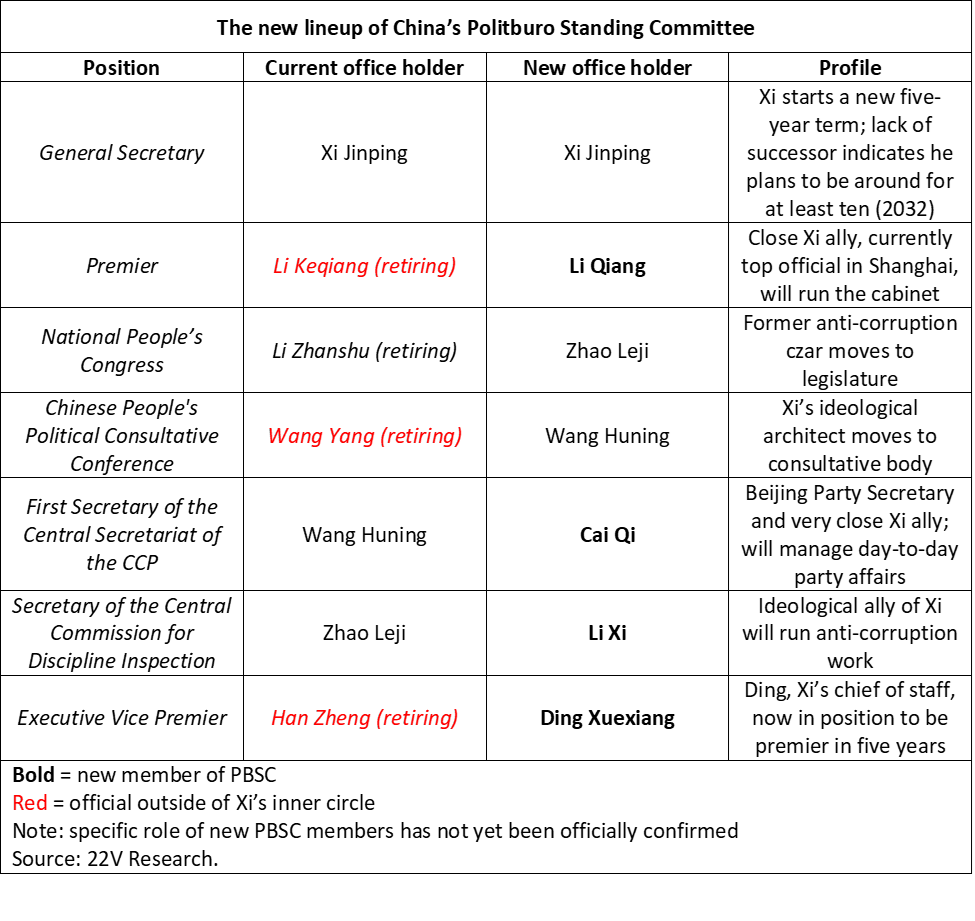
- Xi stacked the Politburo Standing Committee (PBSC). To cement his control, Xi pushed two officials who are outside of his circle – premier Li Keqiang and former vice premier Wang Yang – into retiring from the PBSC before the customary age of 68. Wang Yang had been among leading contenders to replace Li as premier. With the retirement of two other members of the PBSC, Xi had four spots to fill and installed firm loyalists (see table below). This brings the number of non-loyalists on the PBSC to zero, from 3 currently. Xi did not appoint an obvious successor, and at this point the strong assumption should be that he plans to serve at least another ten years as China’s leader.
- Xi chose Li Qiang as Premier. The traditional qualification for premier is experience at the local level and serving as a vice premier in the cabinet. There were two candidates with this background: Wang Yang (who was our upside scenario), and Hu Chunhua (our neutral scenario). Xi chose neither and instead tapped Li Qiang, who lacks leadership experience in the central government; this was our downside scenario. While Xi has reduced the power of the premier role under Li Keqiang, it remains a key position with responsibility for day-to-day management of the economy and administration. The dangers are that Li Qiang’s political allegiance to Xi means he will not question policies that could have a disruptive impact on the economy, while his lack of state council experience increases the risks of policies that are fumbled in implementation. Li does have experience running localities with thriving economies and private sectors – Zhejiang, Jiangsu and Shanghai – and among his flagship initiatives in Shanghai were luring Elon Musk to build Tesla’s largest factory and launching the Shanghai STAR Board to provide funding for innovative companies. We will need to fully render verdict when we see Li in action starting in March.
- Retirement of core financial team. Less dramatic but still important is the coming retirement of a generation of reform-minded financial and economic officials. Vice premier Liu He (Xi’s key economic advisor), banking regulator Guo Shuqing, and central bank governor Yi Gang all were dropped from the central committee and are thus likely to retire in March, in keeping with their retirement age. The biggest hole to fill is Liu He, who has pushed for action on financial stability concerns, led economic engagement with the US, and provided political support for the financial regulators serving under him; he will likely be replaced by the less dynamic He Lifeng, head of the state planning agency (NDRC). Banking regulator Guo Shuqing, the most respected official in China’s financial system, seems likely to be replaced by current securities regulator Yi Huiman, who is qualified but less likely to push for aggressive reforms. Finally, Yi Gang seems likely to be replaced by Yin Yong, a highly qualified PBOC veteran currently serving as vice mayor of Beijing. We will have to see how the financial team evolves, but the main question is whether they will have enough political support to maintain technocratic policies, particularly given Liu He’s retirement.
Direct implications for markets and the economy:
As noted, the overall takeaway from this lineup is that there are fewer pragmatic voices in the leadership with the inclination and ability to try to balance Xi’s policies and moderate the economic impact.
There are several specific risks that arise from this dynamic:
- Fewer checks on Xi’s economic security agenda, which could increase risks of accelerated decoupling and lower long-term growth. Xi’s emphasis on economic security is an overarching theme, a broad agenda that includes greater self-reliance in critical technologies, resilient supply chains with control over key inputs (including natural resources), and great attention to food and energy security. To be sure, in his Congress speech Xi emphasized that economic growth remains one of his top priorities. But this is not really the key question, which instead is whether Xi is implementing the reforms necessary to maintain high rates of growth, particularly by boosting productivity. Unfortunately, an economic security agenda – while it has a geopolitical logic – is frequently at odds with an agenda aimed at increasing efficiency and productivity. It entails a strong role for state-owned enterprises and a heavy hand for the party-state in steering resources and capital to priority sectors, which are the sources of the key distortions in the economy. Without a careful balance, economic security risks sapping long-term growth and contributing to decoupling pressures. The return of Common Prosperity could be another area in which it is important to carefully balance political objectives (a more fair distribution of wealth) with pragmatism.
- Increased policy volatility. As Xi has consolidated power, his tenure has seen a repeated pattern of policy overshooting leading to increased economic volatility. This occurs when Xi outlines a broad directive, which the bureaucracy, acting under intense political pressure, implements inflexibly. Examples including financial de-risking, environmental controls, the tech regulatory crackdown and zero-Covid. Even when the objectives are sound this campaign-style pattern of policy is disruptive to markets and the economy at a time when long-term confidence is weak.
- Lack of communication. The impact of volatile policies is made worse by the lack of communication from the leadership and growing opacity of economic information and reporting (China’s delayed 3Q GDP data just being the latest example). One question for this new leadership is the degree to which senior economic officials will have both the inclination and the credibility to communicate to markets and the business community during periods of economic stress. This role has been filled by Li Keqiang and especially vice premier Liu He, both of whom are retiring. New premier Li Qiang could step up to this role, but the general pattern of policymaking moving to an ever-tighter circle around Xi points to increased opacity. The risk is that rocky developments in China, such as debt events or geopolitical tensions, spark uncertainty that leads to risk aversion domestically and in global markets. China’s 2015 exchange rate reform, which unnecessarily rocked global markets and cost China $1 trillion in reserves to stabilize the currency, was the first major preview of these dynamics.
Geopolitical and foreign policy implications:
Xi’s leadership lineup is on balance a negative for the US-China relationship. US officials will perceive the absence of prominent reformers in the leadership as a further sign that China will not budge on key policies, reducing the prospect of meaningful negotiations on industrial policies, tech or trade. They will worry about what this all means for geopolitical risks, with Xi seeming to harden China’s political system for storms ahead, and his allies less likely to counter risky moves such as on Taiwan (which we, to be clear, think are generally overstated). At a person-to-person level, the new leadership team lacks economic officials who have a strong rapport with US counterparts, especially with the retirement of vice premier Liu He.
On the broader foreign policy agenda, foreign minister Wang Yi appears set to move up to the senior Party role overseeing foreign policy (replacing retiring Yang Jiechi), which implies assertive “wolf warrior” diplomacy is here to stay. One positive is that Qin Gang, China’s ambassador to the US, received an unusual promotion to the central committee and may be tapped to become foreign minister; Qin is a more pragmatic/moderate voice and his promotion could point to Xi wanting to stabilize relations with the US and key allies, though the underlying structural dynamics of the US-China rivalry and domestics politics in Washington and Beijing will make this very challenging.
The caveats
Xi’s consolidation of power and ambitious agenda has sweeping implications, but it is also important to briefly note what is not likely to be in store:
- Autarky: Xi is out to build a more resilient economy and boost China’s self-reliance. This does not mean that he aims to reduce China’s role in the global economy, though this may (in some sectors) be the result. Xi continues to see a strong strategic and economic imperative for China to maintain a key role in global supply chains and continue to attract high-quality foreign direct investment. The formal environment for US firms and other multinationals operating in China will likely be stable, though political and geopolitical factors (from data controls to fears over Taiwan to sensitive political topics) will remain key concerns for foreign firms.
- War over Taiwan: Beijing’s language on Taiwan is strident and it remains the most serious flashpoint in the US-China relationship. But there are no indications that China is contemplating an invasion of Taiwan over the next several years.
What’s up with the Hu Jintao episode?
The strangest moment of the Congress came on Saturday, when former general secretary Hu Jintao – Xi’s immediate predecessor – seemed to be forcibly removed from his seat next to Xi and escorted out of the room. It remains unclear whether Hu was sick/disoriented, purged for potentially opposing Xi’s changes to the central committee, or whether this was another kind of power play by Xi. At this point we are suspending judgment as our most other China watchers, who have been giving this footage Zapruder-like levels of scrutiny. At the very least, the mystery does seem emblematic of the deepening uncertainties in this new era of Xi’s complete dominance.
What is coming next?
This new leadership team does not take up its official government posts until the annual National People’s Congress in March, so the immediate impact for policy is limited. Domestic and international focus will now shift to other watchpoints for China’s outlook, of which there are many:
- The delayed GDP release and broader questions about near-term growth. We continue to see few reasons to expect major positive catalysts (see our 4Q policy outlook here).
- Signaling over zero-Covid. Xi took a victory lap for China’s Covid performance at the Congress with no signals of a change. It will be important to monitor shifts in messaging but we continue to emphasize that China is not close to ready to begin its pivot. Beware of potential head-fakes.
- Pressure on the RMB exchange rate. The authorities have been stepping in during the Congress to prevent further RMB depreciation. It will be interesting to see what happens when they step out. We expect that PBOC will allow further depreciation against the dollar but try to carefully manage the pace and to discourage one-way bets of further weakness.
- US-China tensions and export controls. Beijing has yet to forcefully respond to sweeping US controls on advanced semiconductor technology. This is partly due to the sensitivity of the Congress, but we also expect Beijing to wait for an understanding of the full scope of the measures before calibrating its response. If the US measures do not have a highly disruptive impact on current activity, such as hurting production of mature semiconductors or causing the failure of prominent Chinese firms, we expect Beijing to be fairly disciplined in retaliating and not weaponize Chinese supply chains such as rare earths. We will also be watching for whether Xi meets with President Biden at the G-20 in mid-November; we expect a meeting to happen as both leaders seek to maintain their personal channel and avoid crisis.

