SUMMARY
- The Party Congress (starts October 16) is key for understanding China’s outlook, from Xi Jinping’s economic priorities to US-China decoupling risks to the quality of his supporting cast
- Xi will not begin a pivot on zero-Covid and is unlikely to send other strong pro-growth signals for the short term; the disinflationary impulse from China is set to continue amid weak demand
- China faces mounting structural constraints to growth and rising geopolitical risks; signs that Xi is continuing to emphasize political goals over pragmatism will mean greater danger of a stagnation scenario in coming years
- Xi is likely to emphasize economic security as an overarching theme, implying all-out efforts to reduce reliance on the US in critical areas of technology, continued preference for “deep tech” firms over consumer e-commerce platforms, and more active state intervention in key commodities
- Xi will increase his dominance of China’s top leadership but the key question is how he prioritizes competence vs. political loyalty; the selection of Wang Yang as premier would be a positive sign and suggest Xi feels greater urgency to revive private sector confidence
- Xi is very unlikely to take a new title of “chairman,” but even less dramatic elevation of his role would further erode willingness to criticize his decisions and increase risks of errant policies
The Party Congress, which runs 16-23 October, is the key event in China’s five-year political cycle but challenging for investors to parse. The signals on policy issues are high-level and couched in the boilerplate of China’s politics. The significance of changes in leadership are often ambiguous, particularly in an era where Xi Jinping is already dominant.
Still, this event is critical for understanding China’s outlook, from growth and key reforms to geopolitical tensions and risks around technology decoupling. In this preview report we aim to demystify the Congress and outline the key watchpoints for markets. 22V will provide ongoing coverage of the Congress, including a webinar on 18 October at 10:30am EST that discusses takeaways from Xi’s report to the Congress and from China’s Q3 GDP release (please register here).
The Basics:
Here are the key events of the Congress in chronological order:
- 16 October: Xi will deliver his report to the Congress, a mega speech that outlines his policy agenda for the next five years, spanning politics, economics, social policy and foreign policy.
- 22 October: the Congress will technically conclude by electing a new central committee (205 members) of the Chinese Communist Party (CCP). It will also approve changes to the CCP’s constitution, which is all about ideology but can still provide important signals.
- 23 October: the new central committee will convene to appoint the Party’s senior leadership. Xi will start an unprecedented third term as general secretary of the central committee, having pushed through a removal of term limits in 2018. The key points of suspense are the degree of turnover and nature of the changes to his supporting cast on the 25-member Politburo and its 7-member Politburo Standing Committee (PBSC).
The leadership transition will not fully conclude until the March 2023 National People’s Congress (NPC). While the Party Congress appoints senior Party positions – the most important in China’s system – government positions for this political cycle will only be announced around the annual NPC in March. There are two implications:
- Until the transition is fully complete, China is unlikely to implement bold or complex changes in policy, including a pivot from zero-Covid.
- We won’t have a full picture of the quality of Xi’s economic team for several more months. Notably, this NPC could see a generational change among key financial officials, as vice premier Liu He, PBOC governor Yi Gang, and banking regulator Guo Shuqing – a high caliber team that has worked together for years – are each likely (but not guaranteed) to retire. The Party Congress will provide partial clues as to their fate and potential successors, as financial officials who are appointed to the central committee this month will likely stay on for senior government positions in March.
The Stakes:
The Congress is unlikely to bring radical changes to Chinese politics. Xi has been in power for ten years and made his priorities clear: securing the Party’s grip on China’s political system and society; overseeing China’s “national rejuvenation” as a great power; shaping the global system to accommodate China’s rise and its security; and shifting China’s economy from an emphasis on rapid growth to quality growth.
But the Congress will reveal the evolving balance between Xi’s political objectives and his pragmatism. On the policy side, how is Xi calibrating between his mantra of economic security and the need for key reforms? Nationalism vs. reducing tensions with the West? Steering capital to favored sectors vs. reviving foreign and domestic investor confidence? On the governance side, is he prioritizing political loyalty over competence in selecting his leadership team, increasing the risk of policy errors?
With China’s current growth model running into major structural constraints (demographics, debt, stalling productivity), and US-China tensions at the highest level since the 1970s, the degree of pragmatism will dictate whether and when China can eventually rebound from its anemic growth this year or is headed for longer-term malaise and sustained economic and geopolitical risks, with broader implications for global growth and key industries. A hard landing for China remains unlikely but the risks of medium-term stagnation (growth mired below 4%) are significant and rising.
Xi’s Gotta Have It: The Congress Report
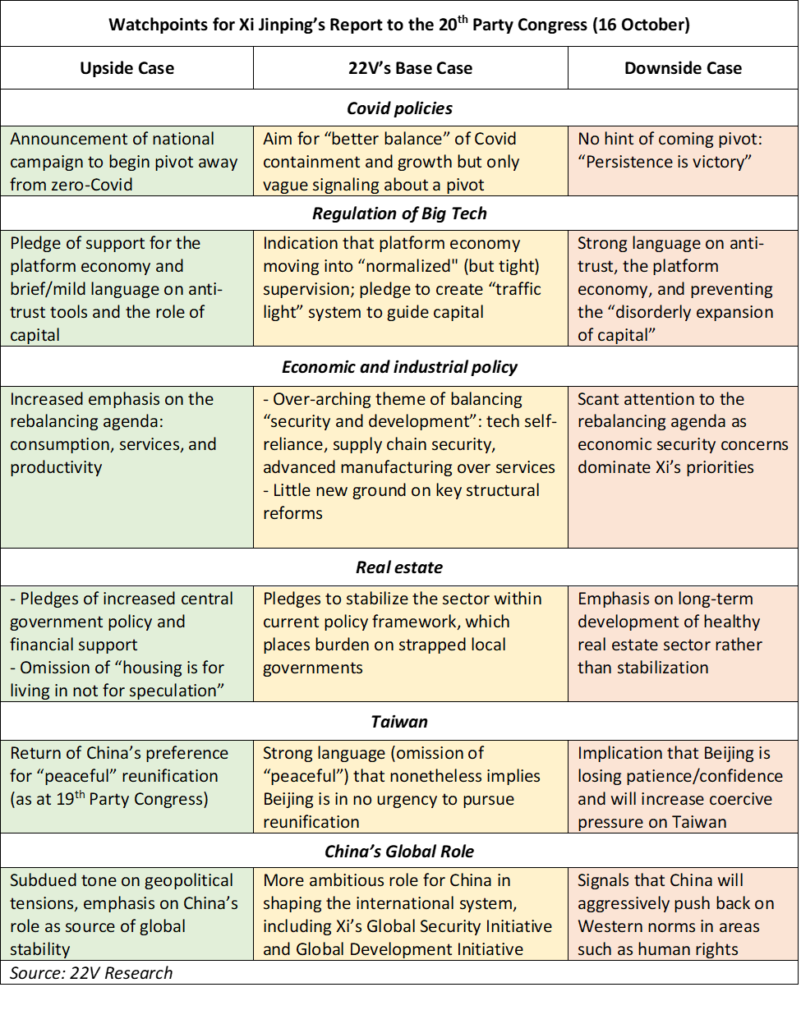
Xi’s report to the 2017 Congress lasted 2.5 hours and ran 65 pages (good news: we at 22V will be listening/reading so that you don’t have to). There will be watchpoints for both the short-term and especially the long-term, also summarized in the table further below.
The report is unlikely to send strong pro-growth signals for the short-term, particularly on Covid, or reverse the disinflationary impulse coming from China:
- We warned in our report last week on China’s Q4 policy outlook that anyone expecting a quick pivot away from zero-Covid at the Congress is very likely to be disappointed. To drive this point home, the official People’s Daily has published three high-profile editorials this week pushing back on hopes of a shift, emphasizing that zero-Covid “is sustainable and must be sustained.” Xi and the CCP face a difficult task in moving away from zero-Covid without triggering a surge in serious illness in deaths and the corresponding political and economic risks. The best outcome would be the announcement of national campaign to prepare for the pivot, including completing vaccinations (which lag in the elderly population), boosting hospital capacity and supplies of therapeutics, and communicating the shift to a nervous public. However, it is more likely that Xi stresses the success of zero-Covid and saves changes for later. We expect a pivot to begin only after the March 2023 NPC at earliest and proceed cautiously next year.
- We will also be watching Xi’s messaging on the property sector, though do not expect signs of scaled up support necessary to quickly revive real estate investment (such as major financial rescues for private developers). With exports also facing new headwinds, China’s growth outlook remains subdued for at least the next two quarters.
Longer-term themes will be especially important. Xi’s report at the 2017 Congress clearly signaled the two key shifts in China’s policy over the subsequent five years: (1) a more assertive foreign policy, which ushered in “wolf warrior diplomacy” and contributed to rising geopolitical tensions with the West; and (2) a shift in economic policy from high-speed growth to a focus on sustainability and the reduction of economic and financial risks. Both of themes will continue in Xi’s third term.
On the foreign policy side, Xi will outline further efforts to position China as a rule-maker (not rule-taker) in the international system through his new Global Security Initiative and Global Development Initiative. Both are mostly slogans for now, but the extent of Xi’s willingness to aggressively challenge the US for leadership – particularly on norms such as human rights – will exacerbate an intensifying rivalry. We will also be parsing language on Taiwan but do not expect signals that China is running out of “strategic patience” and inching towards forced reunification.
A likely overarching theme will be Xi’s focus on “economic security,” which is implicitly in tension with other reform goals. Since coming into office Xi has been obsessed with boosting China’s “national security,” a broad definition that increasingly focuses on economic security including technology, data, food, energy and key supply chains. In the last three years, rising US-China tensions, volatile commodity prices, and pandemic disruptions have all increased Xi’s concerns over China’s reliance on foreign inputs. This was a key theme in the 14th Five-Year Plan released in March 2021, and recent months have seen high-level messaging on the need to “balance development and security.” This impulse will ratchet up further with last week’s announcement of tightened US controls on advanced semiconductor technology, an inflection point that now has the US explicitly seeking to contain China’s technological advancement.
Xi is increasingly optimizing for a geopolitically resilient economy more than a high-growth economy. The features of the economic security agenda include:
- An all-out campaign to boost innovation and reduce technological reliance on the US, particularly in semiconductors, by channeling both government and capital markets funding
- Efforts to promote specialized private firms that are leaders in “deep tech” (semiconductors, clean tech, biotech, advanced manufacturing, quantum, software), while consumer-focused e-commerce platforms remain out of favor and under scrutiny
- A renewed priority on manufacturing and reduced emphasis on boosting the under-developed services sector (this is not good for China’s rebalancing)
- A larger and more active role for state commodity reserves to smooth out price and supply volatility
- Stepped up efforts to boost domestic production of several commodities (e.g., coal and iron ore) and create larger state-owned national champions to procure strategically important resources such as rare earths
How Xi sets the parameters of economic security will be key for specific sectors as well as China’s broader macro outlook. The priorities above entail a major role for state-owned enterprises and for the party-state to allocate capital and other resources, but it is increasingly urgent for China to boost efficiency and reduce such distortions to avoid a stagnation scenario. As we noted in our Q4 policy outlook, the US is also emphasizing “resilience” over economic efficiency. The relationship between the two largest economies in the world is increasingly dominated by dueling industrial policies and a security mentality.
Finally, we will be looking for signs that Xi might reinvigorate a lagging reform agenda but are keeping our expectations low. Stepped up policies to boost household consumption, badly depressed by Covid, are especially important given headwinds to exports and investment. Fiscal reform is also increasingly urgent given battered local government finances and rising debt risks for their local financing vehicles. Financial sector and capital markets reforms will proceed gradually, with financial stability (a “national security” issue for Xi) as the dominant concern.
Xi’s Peeps: Leadership changes
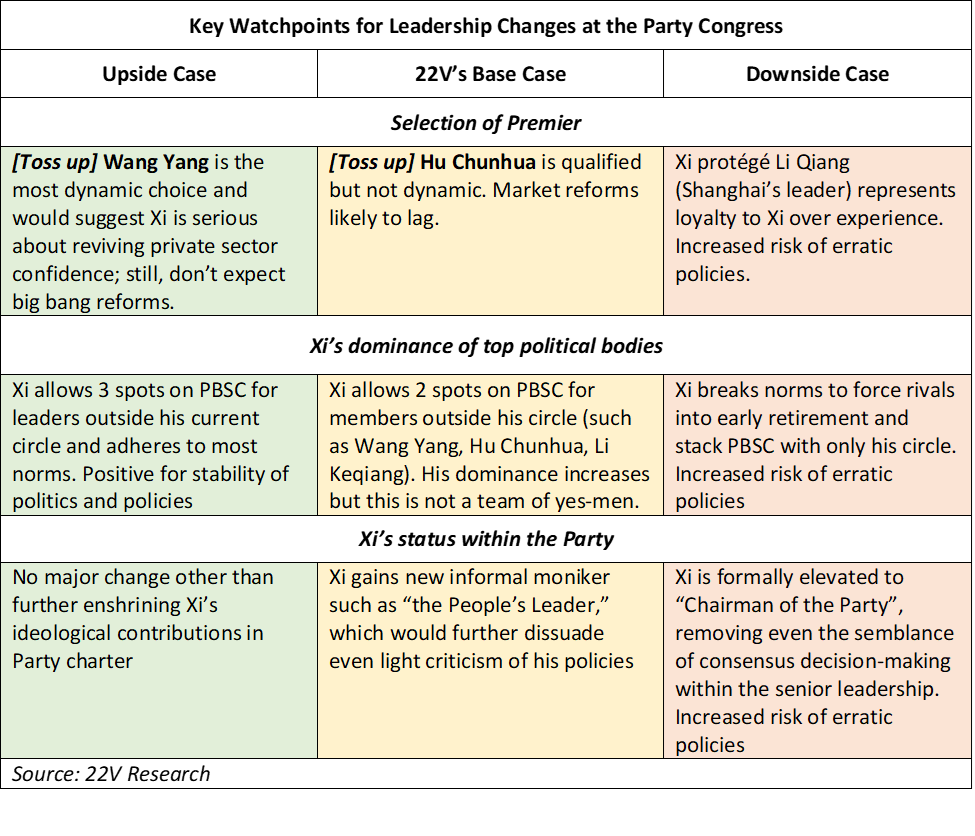
The high drama comes on 23 October, when the members of China’s new Politburo Standing Committee step out on stage and greet the world. Other than Xi, the rest of the lineup is educated guesswork. There are only loose norms that guide the selection of the PBSC – in particular, a soft rule since 2002 that bars the appointment of officials aged 68 and above – which Xi could decide to ignore and likely has the power to flout.
Xi and his allies account for 4 of 7 members of the PBSC and 15 of 25 members of the Politburo. Both proportions will increase at this Congress, and media narratives will focus obsessively on tallying these numbers to weigh his dominance. But the more important issue is the extent to which Xi prioritizes political loyalty two other qualities: professional competence and leaving voice for officials outside his inner circle.
These dynamics will play out in Xi’s choice of successor to the current premier, Li Keqiang. Nominally the lead official on day-to-day economic policy and the head of the State Council (cabinet), the premier role has been diminished, with Xi sidelining Li and shifting policymaking to Party bodies under Xi’s direct control. Still, it is the second-ranked role within the party and remains important for economic management.
We see a toss-up between the two main candidates:
- Vice Premier Hu Chunhua comes from the Communist Youth League (CYL) faction associated with former general secretary Hu Jintao (and Li Keqiang). He is experienced but even less dynamic than Li and would likely continue to play the role of a weak premier – and Xi’s scapegoat for an anemic economy. This is negative for ambitious reforms.
- The upside pick is Wang Yang, already a member of the PBSC with past experience as the vice premier in charge of trade issues and the US-China economic relationship (2013-2018). Also associated with the CYL (and not a Xi protégé), Wang is the most dynamic choice and a skilled politician. His appointment would suggest that Xi is prioritizing competence and the need to revive private sector confidence. But it is important to keep this in context: Xi will continue to dominate economic policymaking, so major U-turns are unlikely. (One reason Xi could appoint Wang is that his age means he would only serve for one term, giving Xi flexibility to appoint an ally in five years).
- Less likely than Hu or Wang is Li Qiang, a close Xi ally who is currently the leader (party secretary) of Shanghai. Li lacks the traditional qualification of having previously served in the cabinet as a vice premier. This is the downside pick, pointing to loyalty over experience, with an increased risk of poorly vetted policies and fumbled implementation.
Once the new PBSC and Politburo are announced we will render verdict on the overall lineup. All the same, it is important to be humble about predicting policy outcomes and power dynamics in China. A loyalist with Xi’s trust could potentially be more effective than an outsider whose views are discarded. What looks like weakness for Xi (fewer-than-expected allies in key spots) could also represent confidence and vice versa. Only time will tell.
Xi-Hulk: His Role within the Party
The final area to monitor at the Congress is potential changes in Xi’s stature within the Party. The most worrying development – and one that we think is quite unlikely – would be Xi reviving Mao’s role as “chairman” of the Party rather than general secretary of the central committee. This would be an institutional change that removes even the semblance of collective decision-making within the Politburo. It would increase the risk of erratic policies that come from Xi without vetting and are rigidly implemented by the rest of the system.
More likely are changes that are ideological in nature and come in amendments to the Party’s charter. One possibility is that Xi could receive a moniker such as “the People’s Leader,” a title that would harken back to the Mao era. While not a sea-change, such a power play would further raise the political risks for those in China even indirectly criticizing Xi’s policies. Again, the risk would be increased probability of erratic policies.
The upside scenario is one in which Xi gains further stature incrementally – e.g., further enshrinement of his ideological and historical contributions – but does not push through a step change in his role within China’s system.