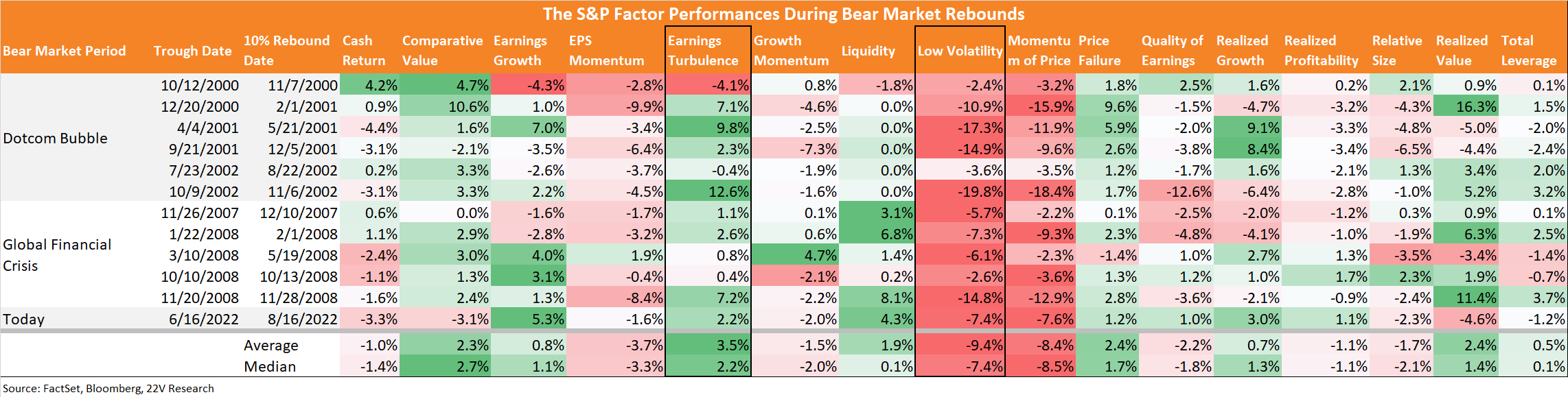
Last month, our Macro Regime Classification Model shifted to “Recession”, indicating that the broad market backdrop was more like previous periods of economic contraction than expansion (report HERE). following the release of more of August’s data, our model has shifted back to a “Transition” classification. There are two implications: 1) Regime classifications can be volatile when macro indicators are sitting near recession levels.; 2) Macro uncertainty remains high, but a recession can be avoided if inflation falls without financial conditions tightening much more.
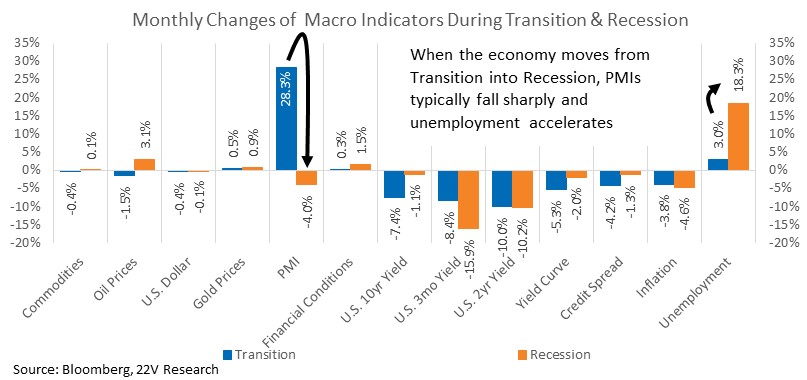
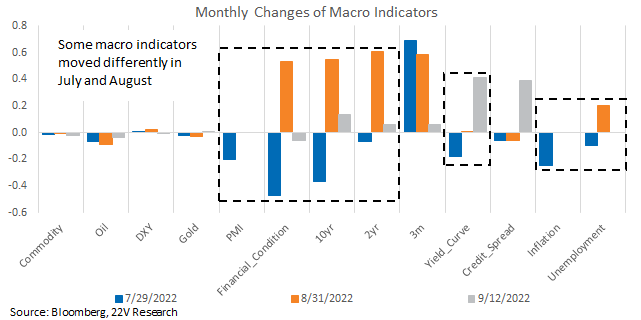
The readings that change most when the economy is falling into recession are 1) PMIs (they fall) and 2) Unemployment (it rises). From July to August, a number of secondary macro forces became less recessionary (U.S 10yr yield and 2yr yield rose, curves steepened) and the manufacturing PMI stabilized. Until there is a clear shift in PMIs and unemployment, recession risk and factor rotations will remain dependent on relatively volatile market indicators. Put simply, recession risk remains elevated and is likely to remain so for at least a few months.
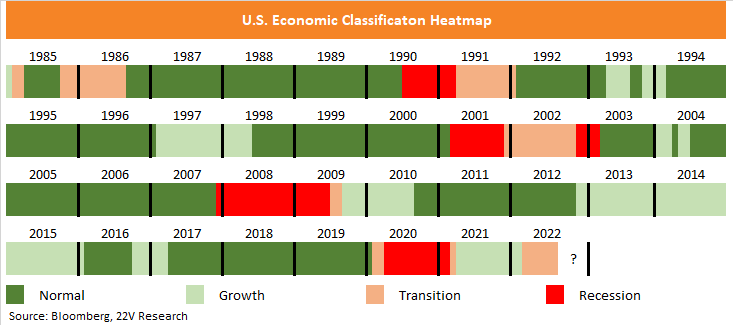
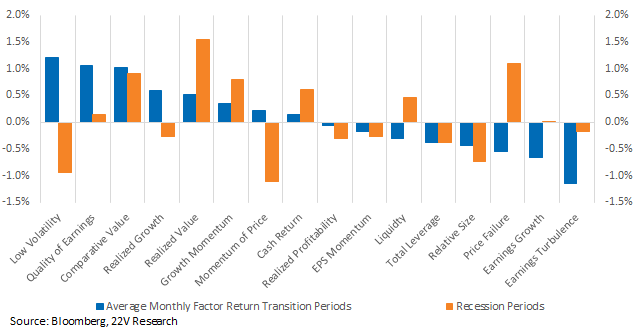
Monthly factor returns have mapped over to typical patterns seen during Transition and Recession periods. Low Volatility and Quality of Earnings were the leading factors on average for months classified as Transition, while Value factors and Price Failure outperformed during historical Recessions. Currently, the absolute reading of the PMI and inflation remains much higher than their historical averages, and unemployment is much lower. Higher than normal PMI and inflation together with a low unemployment rate implies further tightening will be needed to reduce inflation at the expense of growth and employment.
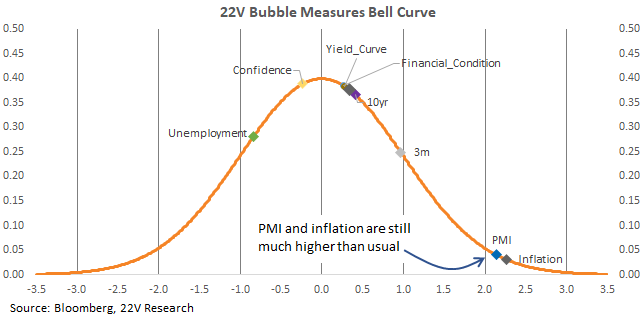
As we discussed in last Friday’s report (HERE) the bear market rally/failure paradigm remains a useful framework for thinking about factor rotations near-term. A continuation of the current risk-on rotation would favor Earnings Turbulence but the overall macro backdrop suggests those rallies will be short-lived. Longer-term, we continue to favor Quality (despite its recent struggles) names.
Recession Uncertainty Remains High: Last month, our Macro Regime Classification Model shifted to “Recession”, indicating that the broad market backdrop was more like previous periods of economic contraction than expansion (report HERE). We noted back then that our model shifting to recession does not mean an official contraction and following the release of more of August’s data, our model has shifted back to a “Transition” classification. There are two implications: 1) Regime classifications can be volatile, particularly when a number of macro indicators are sitting near recession levels.; 2) Macro uncertainty remains high but a recession can be avoided if inflation falls without financial conditions having to tighten much more.
Macro indicator changes during Transition and Recession periods are frequently similar. The readings than tend to change most when the economy is falling into recession are 1) PMIs (they fall) and 2) Unemployment (it rises). Other indicators like the Dollar, Gold, and 2yr yields have followed similar patterns during recessions and transitions. Those indicators are already near recessionary levels, so marginal changes in spreads, curves, the Dollar, etc. will shift our model closer or further from recession. A definitive shift is dependent on how leading indicators and unemployment readings unfold over the coming months.
Treasury yields and financial conditions changed more than other macro inputs in July and August. U.S 10yr yield and 2yr yield rose 54 bps and 61 bps respectively over the past month after posting declines in July. The yield curve steepened in August after moving flattening in July. GS financial conditions tightened sharply in August after easing in July. Manufacturing PMI stabilized after two months of consecutive declines and the Services PMI was better than expected last week, suggesting growth is slowing but at a modest pace.
Mapping the current readings for important macro indicator changes onto normal distributions, inflation and Manufacturing PMI readings are still much higher than usual. Unemployment is much lower than normal. Those readings argue against the economy being in a recession. They also suggest further financial condition tightening/rate hikes will be needed to bring down inflation, which increases the risk that unemployment will rise. Put simply, recession risk remains elevated and is likely to remain so for at least a few months.

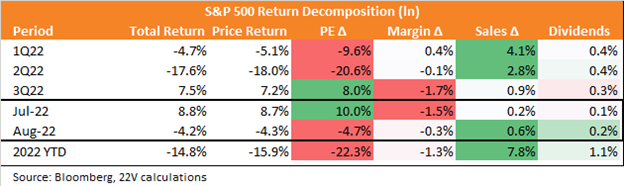
Macro volatility is having a larger than normal influence over index and factor volatility. S&P volatility explained by the first principal component is higher than normal, confirming the macro influence over equities. The risk-on rotation in July was driven largely by PE expansion while margins have become a drag on returns. Tightening of financial conditions and rising yields led to another risk-off rotation in August and PE declines offset firming top-line growth expectations.
Monthly factor returns mapped over to typical patterns seen during Transition and Recession periods as well. Low Volatility and Quality of Earnings were the leading factors on average for months classified as Transition, while Value factors and Price Failure outperformed during Recessions. Easing of financial conditions into Sept on improved growth readings and lower inflation expectations means more macro volatility should be expected. Factor returns are likely to remain a mix of historical Transition and Recession periods. Across both periods, Quality, Growth Momentum, and Realized Value tend to perform best.
Near-term, Low Volatility should perform well as long as recession risk remains elevated, but a recession remains uncertain. As we discussed in last Friday’s report (HERE) the bear market rally/failure paradigm remains a useful framework for thinking about factor rotations near-term. A continuation of the current risk-on rotation would favor Earnings Turbulence but the overall macro backdrop suggests those rallies will be short lived. Longer-term, we continue to favor Quality (despite its recent struggles) names.